
This week, TIME magazine released their list of the top 100 VC firms in the US.
The ranking was introduced by renowned VC researcher Ilya Strebulaev.
It’s safe to say that most readers scrolled straight past Strebulaev’s intro, down to the list without even stopping to see who wrote it. And they certainly didn’t click through to the page that explained how it was all calculated.
Cut to the reactions, where the list was met with confusion, frustration or laughter.


This is nothing unusual. In fact, it’s basically how every VC ranking is treated — because nobody reads the methodology.
If you don’t understand how firms are scored, the result will never make sense.

The Methodology
To summarise, half of the TIME scoring system explicitly rewards scale. Capital raised, fundraising momentum, dry powder, AUM, deal volume — 50% of the result.
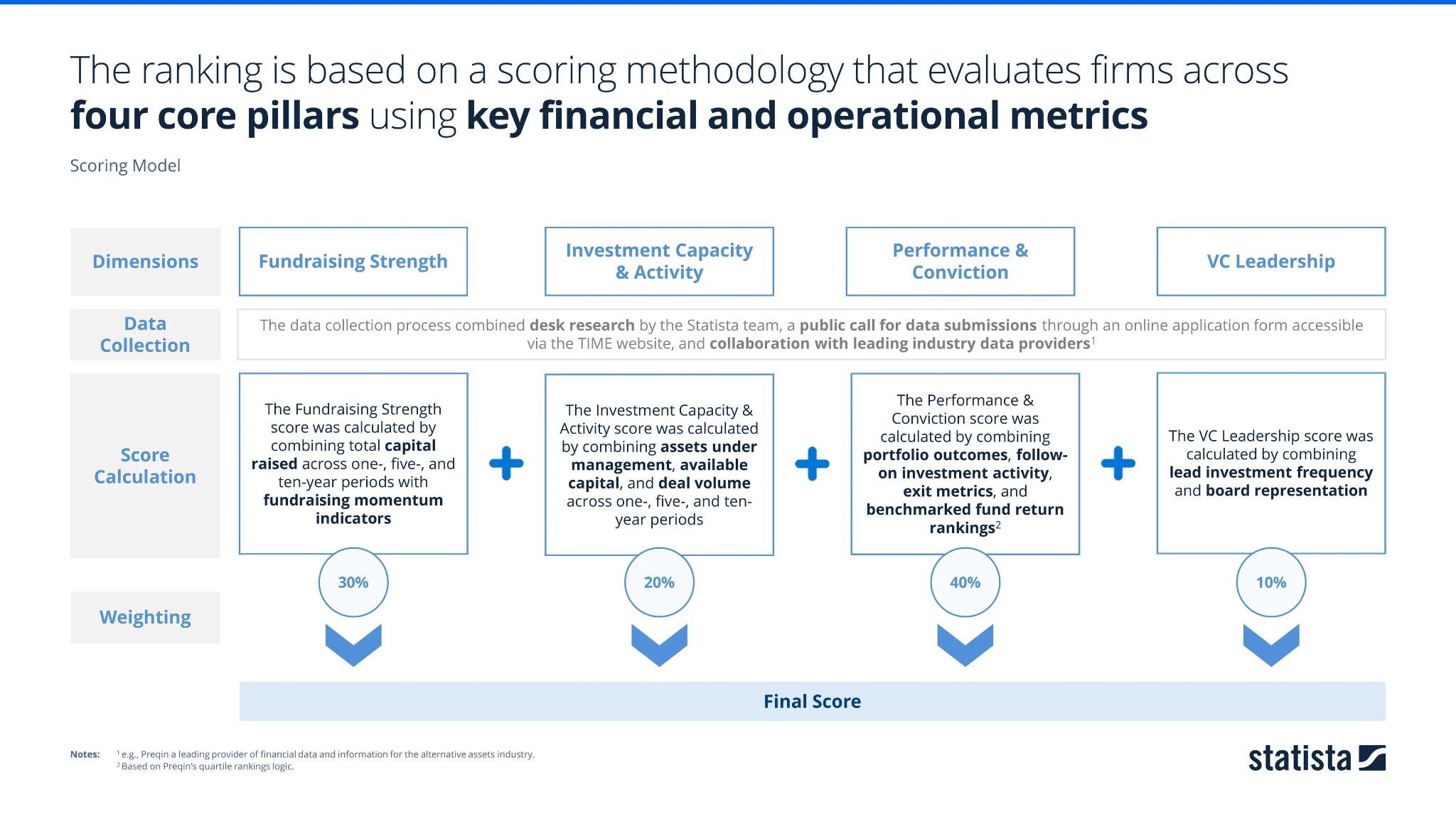
Of what is left, 40% is notionally performance, although it includes private valuations and follow-on capital rather than exits, which implicitly favours large firms who can continue stuffing their portfolio companies with cash.
The remaining 10% reflects VC leadership, reflecting how often they lead rounds or take board seats. Given that early investments often don’t involve leads or board seats, this nudges the scoring further towards firms with later-stage participation.
In fact, Strebulaev had specifically commented on this in the intro:
“Taken as a whole, the methodology rewards what can be observed from the outside. Capital raised, deals done, and marquee portfolio names are all visible; the money actually returned to limited partners, for the most part, is not. Firms that are big, busy, and prominent will therefore do well…”
As a result, the result was a top 5 dominated by all of the firms that the average person might expect — the biggest names in venture capital.
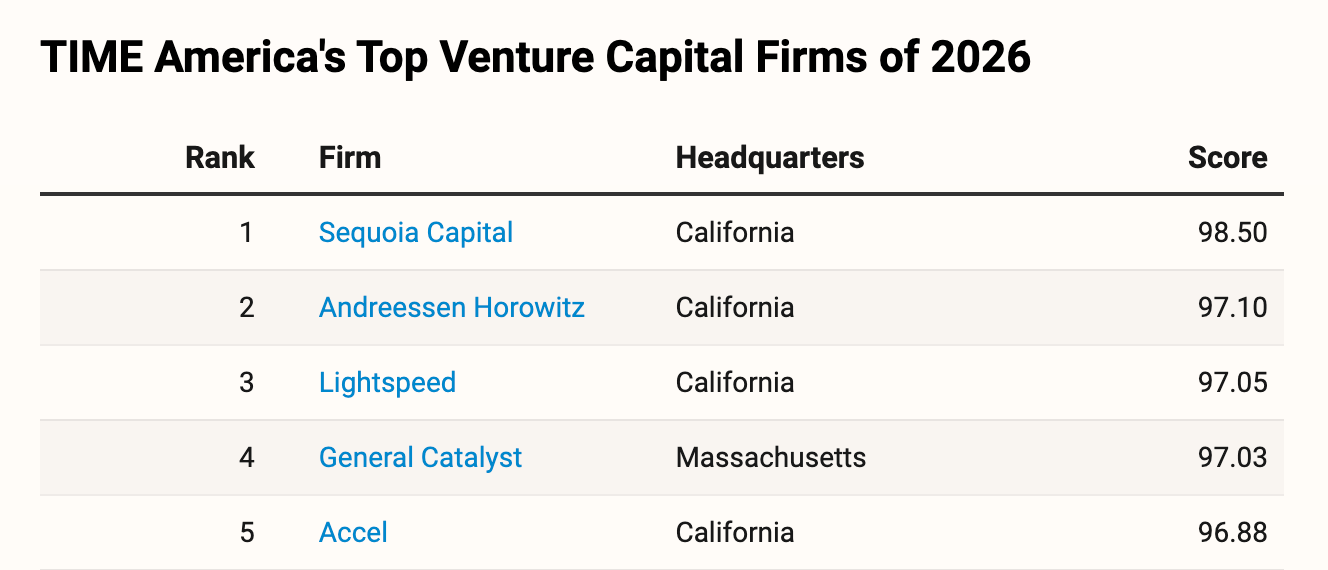
Beyond these “obvious” firms making an appearance, the remainder of the list raised many questions. Questions that could have been answered by understanding the various factors which were being scored.
For example, firms that deliver excellent DPI, from smaller funds, raised less often, who focus on Pre-Seed and Seed are fundamentally unlikely to feature regardless of their performance. Similarly, large firms that focus on highly selective, concentrated positions will suffer versus the “big and busy” multistage firms.
In summary, any ranking reflects the methodology on which it was designed, which in turn reflects the objectives of those who designed it. The critical question is whether they designed the methodology to produce an honest result, or a credible result, because the two aren’t always the same.
Confirmation Bias
“The human understanding when it has once adopted an opinion (either as being the received opinion or as being agreeable to itself) draws all things else to support and agree with it. And though there be a greater number and weight of instances to be found on the other side, yet these it either neglects and despises, or else by some distinction sets aside and rejects, in order that by this great and pernicious predetermination the authority of its former conclusions may remain inviolate.”
Francis Bacon, Novum Organum (1620)
The fundamental truth is that there’s no such thing as a list of the top 100 VC firms, because the data to create one isn’t available. Even where that information exists, publication is prohibited because the industry generally prefers opacity.
Instead, each new attempt to rank VC firms is some innovative form of statistical engineering. Bending public data about fundraises and investments into a pretzel to proxy success, tested for validity by whether the expected names appear at the top.
Essentially, the methodologies are designed to minimise surprise rather than to uncover unexpected truths. The more the output matches the priors of the industry, the more willingly it will be celebrated, and the less criticism the authors will face.
Ultimate Satisfaction
Another interesting example of this phenomenon is the TIME ranking of incubators and accelerators.
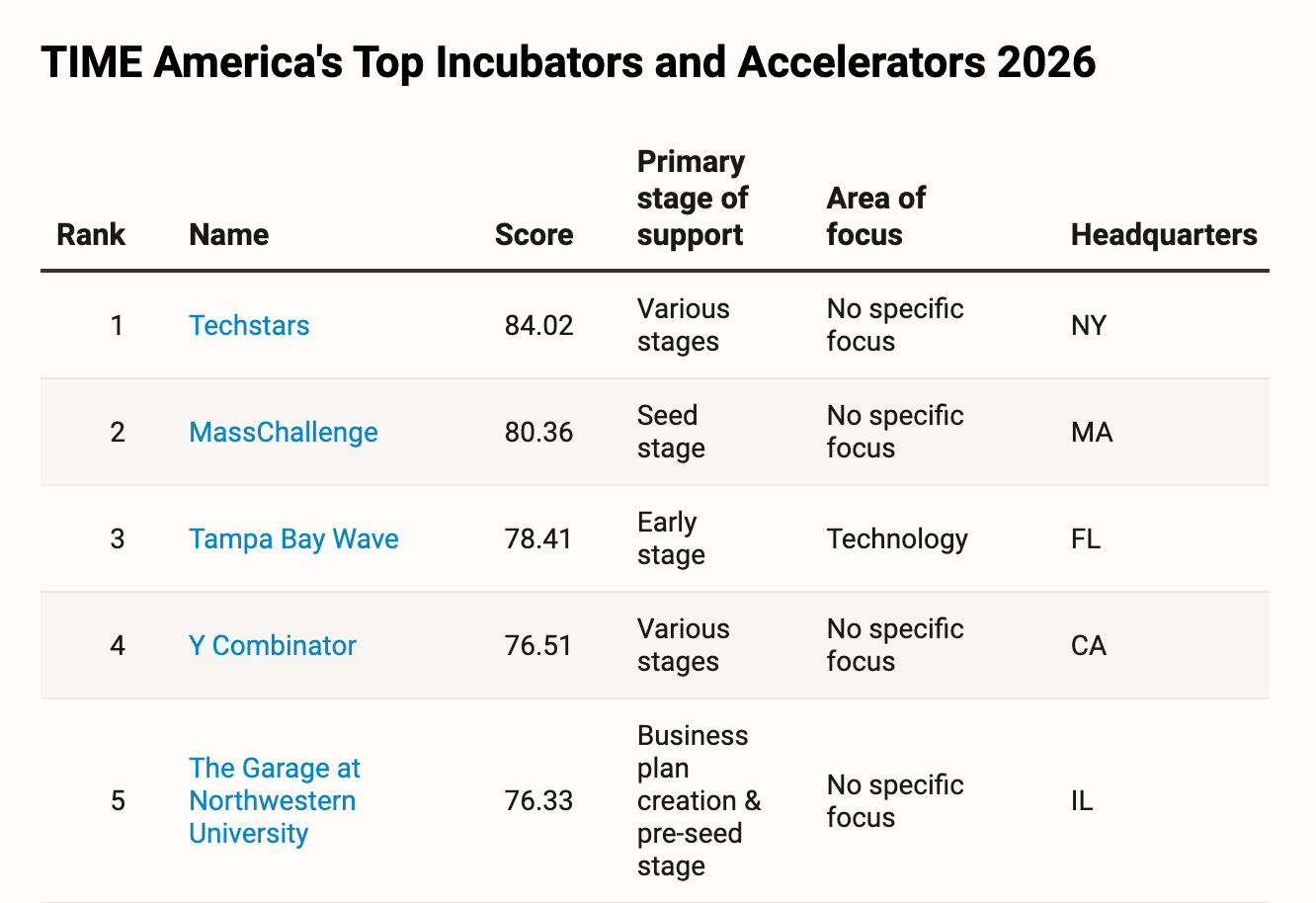
Accelerator performance is less opaque because data providers are happier to share performance metrics. We know, for example, that Y Combinator leads the pack by a significant margin on value creation over the decade from 2010 to 2020.

Which is not to say there aren’t other programs also doing incredibly well. Neo still mostly flies under the radar outside of tech insiders, although Ali Partovi is doing his best to change that with huge wins like Cursor
However, we can say with some confidence that a ranking that puts three other accelerators above Y Combinator is probably wrong. Or, more accurately, it’s showing something other than performance.
Again, this is something that readers would understand, if they read the methodology.
The TIME ranking relied on alumni satisfaction surveys, which is a fair approach if you want to find out whether or not people had a good time. It’s a second-rate approach to understanding the actual long-term success that a program produces.
“All eligible incubators and accelerators were asked to reach out to their alumni who had participated in programs between 2020 and 2025. More than 2,000 alumni responded and evaluated their experience. Each alumnus provided a general recommendation on a scale from 0 to 10 and rated six specific aspects on a scale from 1 to 5, with an additional ‘not relevant’ option.”
How TIME and Statista Determined America’s Best Incubators and Accelerators of 2026
So, shout-out to Tampa Bay Wave and The Garage at Northwestern for getting their moment in the spotlight, and for delivering a programme that founders must love.
However, if founder satisfaction is ultimately measured by the success of their company, it seems like there’s a clear leader to compete with.


Finding Efficiency
Returning to VC firm rankings, it’s worth looking at Strebulaev and Jackson’s approach, and the resulting list. Their work is unsurprisingly solid. Strebulaev has a history of publishing some of the most interesting research about venture capital.
However, Strebulaev and Jackson also designed a methodology which emphasises scale, by using a cumulative score of outcomes without balancing that against the capital deployed or the number of investments.
As a result, you got a list which is generally more robust than the TIME magazine ranking, but sharing a similar bias toward reflecting “impact” rather than quality, and therefore features many of the same names at the top.

Where the two differ, and where the academic rigor shines, is in Strebulaev and Jackson publishing a detailed methodology, with scoring, which allows for some interesting subsequent work.
You can, for example, use a weighted fund size parameter to adapt their scoring to reflect the efficiency of returns rather than just raw accumulation of outcomes. The resulting changes are a more intuitive match for the firms that are known to have a history of excellent DPI, rather than just the largest AUM.
Here, SV Angel, Ribbit, Benchmark and Kleiner Perkins join Sequoia in the top 5. Legendary firms like USV and First Round Capital leap up almost 40 places, while Andreessen Horowitz and NEA each drop 30 places. Impressively, Sequoia remains a top 5 firm by both approaches, which speaks to their persistent strength.
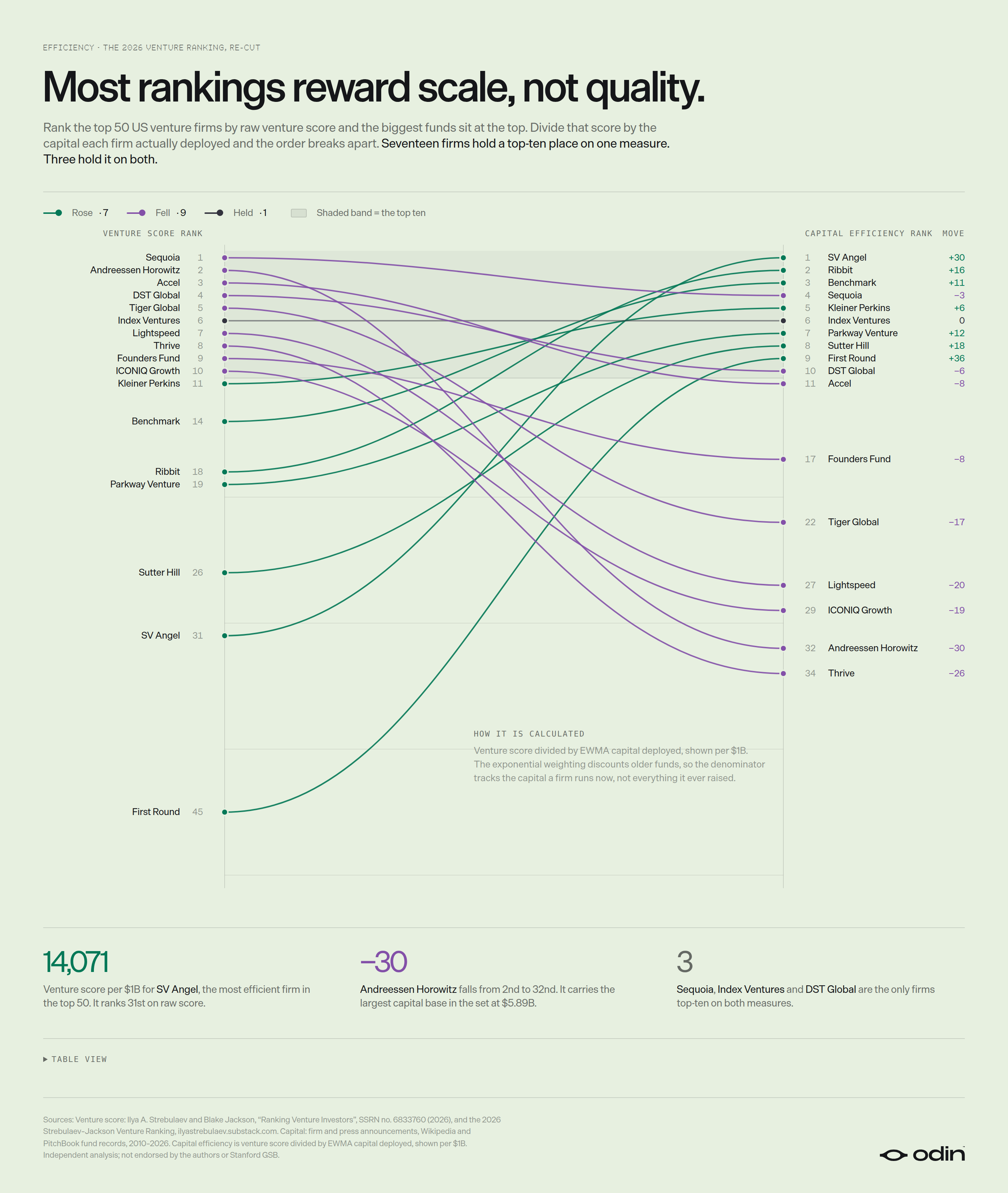
The resulting list is still bound by the initial selection by Strebulaev and Jackson, and so can’t account for those that might have scored much higher on an efficiency basis but weren’t in the initial set.
However, this is just methodology layered on methodology, and meaningless unless you understand the how and the why.
In truth, these rankings are all flawed. Either because they use weird proxy metrics rather than actual outcomes, or because they’re scoring decisions that were made a decade ago. It’s very hard to prove whether a firm has retained its edge.
Until the industry embraces greater transparency, none of this is really worth paying attention to. GPs should just focus on the work, ignore the noise, and hope that the smart LPs do the same.
What’s worth reflecting on is why these lists are absolute catnip for VCs in the first place. Why is an industry of bold contrarians so desperate for such superficial affirmation?
Run your investment firm from your phone, with Odin
The line about methodologies being "designed to minimise surprise rather than uncover unexpected truths" is such a sharp way to put it. It explains why every one of these lists ends up with the same five names near the top no matter who compiles it. Do you think a ranking like this could ever work without full LP-level transparency, or is that just structurally impossible given how much the industry likes its opacity?
The irony of venture capital is that an industry obsessed with "bold, non-conformist thinking" spends far more mental energy than it cares to admit obsessing over these "lists".
Thanks for including a link to Strebulaev-Jackson Venture Ranking article. I will read through that one next.