“Storytelling is literally fundamental to every business. There is not a business that exists that there isn’t storytelling at the foundation and the core of it. Whether it is the moment in time in which a founder has an idea and needs to explain that idea to other people, or they need to go raise capital, or they have a product and need to find their go-to-market. Storytelling is at the core of business building.”
In the spring of 2016, Diego Berdakin, the founder of CloudKitchens, sat down for a poker game with Jeffrey Katzenberg. The legendary Hollywood executive had just sold DreamWorks Animation to Comcast for $3.8 billion and was restless for a new venture. He wanted to start a holding company, inspired by what Barry Diller had done with IAC. Berdakin knew someone who had been thinking along similar lines; a former Dropbox executive named Sujay Jaswa, who had recently left the file-sharing company after helping scale it to a multi-billion-dollar enterprise.
“Diego calls me and says, listen, I just played poker with Jeffrey Katzenberg. He just sold DreamWorks to Comcast. He wants to start a holding company. And I did. I wanted to talk to Jeffrey Katzenberg”
He and Katzenberg had lunch the following Saturday. By August, they had agreed to build something together, although neither fully understood why it should work. As Jaswa put it: “I’m like a Silicon Valley software guy. You’re a Hollywood guy.”
Almost a decade later, WndrCo manages approximately $2.8 billion in assets and has backed 201 companies across three integrated strategies. It has produced at least eleven unicorns, a hit rate of 5.4% which places it in a similar performance category to Y Combinator.
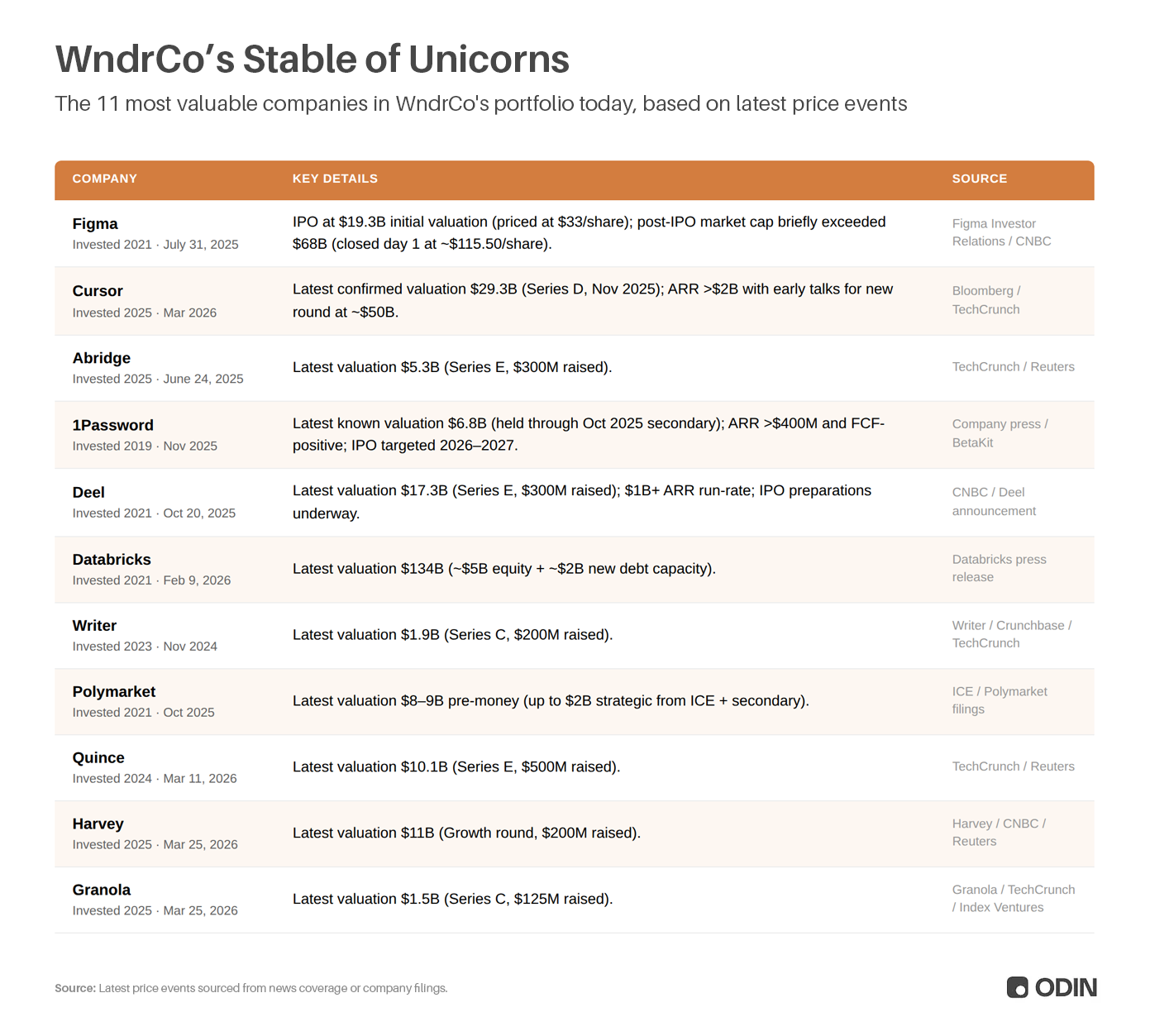
The WndrCo portfolio includes Cursor, the AI coding tool whose annual recurring revenue surpassed $2 billion in March 2026; Figma, which completed a blockbuster IPO in July 2025; Databricks, valued at $134 billion after a February 2026 raise; and Abridge, the medical AI company that doubled its valuation in four months.
Yet WndrCo remains, by its own partners’ admission, one of the best venture firms in the Valley that few people talk about.
Understanding why requires understanding how two people from entirely different worlds came to share a view of what makes companies succeed, and how that perspective has quietly produced extraordinary results during what might be the most consequential technology wave since the internet.
Quotes from Katzenberg, Jaswa and Wang are primarily sourced from excellent conversations they have recorded with esteemed technology yappers, Molly O’Shea and Logan Bartlett.
Narrative Devices
Katzenberg’s professional life has been defined by the pursuit of new technology for the purpose of telling better stories. At Paramount, working under Barry Diller, he rose to head of the studio by the age of thirty. At Disney, he saw a short film from a small company called Pixar, a piece called Luxo Jr. featuring an animated desk lamp, and became obsessed with what computer-generated imagery could do for animation. He tried to hire the film’s director, John Lasseter. When that failed, he tried to buy Pixar from Steve Jobs for $50 million. Jobs refused. Katzenberg settled for a three-picture deal. The first film was Toy Story.
“So there’s a connection here in this, through every chapter of my storytelling career, you can actually go and see that one of the foundational elements of certainly what I think was my success is how aggressive I was in finding state-of-the-art tech for my storytellers.
Wherever I was, whatever studio is at whatever era I was in, I always look to what are the best tools to be able to realize the most exciting and interesting stories. [...] So I was constantly having these pilgrimages to Northern California, to the tech world where I partnered with Hewlett Packard and Andy Grove and Intel and Steve Jobs on Pixar.”
When he sold DreamWorks at the age of sixty-five, Katzenberg found himself at a crossroads. He remembers asking himself what he would do if he were twenty-three again.
“I’d go to Silicon Valley. That’s where fortune and fame is today.”
But, unlike some of Silicon Valley’s most notorious figures, Katzenberg was keenly aware of the limits of his competence. “I know what I know,” he has said repeatedly. “I actually know what I don’t know.”
So, for the journey he was about to embark on, he’d have to find the right partner.
The Outsiders
Jaswa, meanwhile, was having his own crisis of ambition. After leaving Dropbox, where he had overseen the company’s growth from a cold start to $600 million in annual recurring revenue in roughly five years, he assumed he would return to venture capital. He had come to Dropbox from NEA, one of the oldest and most respected venture firms in the country. But something had changed. “I just realised my heart wasn’t into it,” he said. “I like the building.”
A friend introduced him to a book called The Outsiders, by William Thorndike, which profiled eight unconventional CEOs who dramatically outperformed their peers through shrewd capital allocation. Jaswa read about John Malone, about the long-term compounding strategies of patient holding companies, and saw a path that combined his love of building with the kind of durable value creation that pure venture capital sometimes struggled to deliver.
“The Outsiders, by William Thorndike, Jr., is an outstanding book about CEOs who excelled at capital allocation. It has an insightful chapter on our director, Tom Murphy, overall the best business manager I’ve ever met.”
“If you look at the history of tech, many of the great businesses didn’t start the way we all storytell them,” Jaswa observed. “IBM started as a private equity roll-up.”
When Jaswa and Katzenberg found each other through Berdakin’s introduction, they both saw an obviously complementary relationship. Katzenberg brought a lifetime of storytelling instinct, a network spanning Hollywood, Washington, and the Fortune 500, and a work ethic that borders on the superhuman (he sleeps five hours and fifteen minutes a night, a genetic trait he has had since adolescence). Jaswa brought deep product sensibility, operational experience at scale, and a first-principles approach to talent assessment inherited from his mentors at NEA, Dick Kramlich and Scott Sandell.
“Without Jeffrey, we’re just a bunch of people with reasonable resumes,” Jaswa told Logan Bartlett. “There’s like 500,000 people like us. There’s one person like him.”
Katzenberg was equally generous in his assessment of Jaswa. “If you take the ten ideas that have created all of the value of WndrCo in our nine years,” he said, gesturing toward his partner, “they’re all his.”
Are you an outsider looking to raise your own fund or SPV?
Deploy capital seamlessly with Odin
Humble Beginnings
WndrCo launched as a holding company, rather than a venture fund. The initial strategy was to acquire controlling stakes in underappreciated technology companies and operate them directly, applying the kind of hands-on product improvement and go-to-market refinement that both founders knew how to deliver.
Between 2016 and 2018, the firm incubated its first “Build” companies, rolling up sleeves on product roadmaps and operations in a manner more reminiscent of private equity than of Sand Hill Road.
The shift toward a venture capital operating model happened gradually. The firm’s first major outside investment was 1Password, the cybersecurity company, which WndrCo initially considered as a potential acquisition target before deciding to invest instead. That experience opened a door. The partners realised that many of the skills they used on the Build side, the product intuition, the storytelling coaching, the willingness to make hundreds of sales calls alongside founders, were equally valuable when deployed as support for independent companies they backed with minority stakes.
In 2024, WndrCo made it official, closing over $460 million across its first dedicated venture and seed funds. Today the firm operates across three distinct strategies.
The Build arm acquires and operates companies outright, with eight companies launched since 2018 that collectively generate substantial revenue and free cash flow, providing downside protection and dry powder for new investments.
The Venture arm leads or co-leads post-product-market-fit rounds, typically writing cheques in the range of $5 million to $15 million.
A $50 million Seed fund makes smaller, non-lead bets of around $500,000 each, placing roughly fifteen bets per year on the next generation of entrepreneurs.
The firm’s flagship Build company, Aura, a cybersecurity platform, is a good example of the model. Partnered with WndrCo since 2018, Aura announced in February 2026 that it would acquire Qoria, a youth online safety company, in a deal that would create a combined business valued at approximately $2.1 billion in pre-money equity, with combined annual recurring revenue exceeding $300 million. WndrCo remains Aura’s largest shareholder.
The holding company model gives WndrCo an unusual advantage in a world where most venture firms are dependent on management fees and carried interest. The cash generated by the Build portfolio offers the firm a degree of financial independence that most of its peers lack, and allows the partners to be patient with their venture investments in ways that the typical fund lifecycle does not permit.
“The holding company next year will probably be $400 million of free cash flow, extremely profitable and growing really, really nicely, which is kind of an amazing thing.”
Mastering the Story
What distinguishes WndrCo from other firms with operator backgrounds, and there are many, is the specificity of the value it offers founders. Every venture firm in Silicon Valley claims to be more than capital, but few can articulate exactly what that means.
Katzenberg’s contribution is perhaps the most unusual. He functions, in effect, as a storytelling consultant and an enterprise sales weapon for the companies he backs. He will sit down with a founder, go through their sales deck, and help them frame their narrative with the precision of someone who has spent forty-five years constructing stories for mass audiences.
Katzenberg will make a hundred sales calls alongside a founder if he believes in the product. He described himself, with evident relish, as having “a bottomless need to sell.” When WndrCo backed Harvey, the legal AI company now valued at approximately $11 billion, its founder Winston Weinberg told Katzenberg in their first meeting that he needed help with his storytelling. “I know my product crushes,” he said. “How do I get that out there into the world?” The same was true of Shiv Rao at Abridge, where the story needed to reach both the health systems buying the software and the doctors using it daily.
Katzenberg’s favourite maxim, borrowed from Walt Disney, is “My movies are only as good as their villains.” He can rattle off the list without pausing. “Ursula. Gaston. Scar. Farquaad. Tai Lung.” The lesson applies equally to business, where without a clearly articulated problem, without a compelling antagonist, the protagonist has nothing to overcome. It is a framework he applies rigorously to the way portfolio companies tell their stories to customers, investors, and recruits.
On the product side, the firm’s depth comes from ChenLi Wang, who has been with WndrCo since its inception and functions as something like a chief product officer across the portfolio. Wang, a Stanford computer science graduate who worked at Goldman Sachs, NEA, and Workday before joining Dropbox, where he ran the core product and engineering organisation, is described by Jaswa in terms that border on awe. When Wang applied for a job at Peter Thiel’s hedge fund Clarium Capital, Jaswa recounted, he scored the highest of anyone who had ever taken their aptitude test.
Together, this combination of storytelling and product craft gives WndrCo a distinctive pitch to founders. Their money, as Wang likes to say, is the same colour as everyone else’s. The question they try to answer is what else they can do.
“Listen, we all look for the cheat code. Our green is no different from anybody else’s. It’s not better, it’s not worse. It’s capital. But when you want to win deals, when you want to be with the best talent out there, they ask: what else can you do for me?
Fund Performance
The AI wave of 2025 and 2026 has been a vindication of WndrCo’s thesis, though the partners would be the first to caution against triumphalism.
“New technology just takes time to get moulded and shaped into products and into experiences that actually make an impact in people’s lives. This is really the year where we saw, oh yeah, this is different. AI is going to transform how we do business. And it’s not just people playing around with, hey, look how this is like a show-your-friend-over-their-shoulders type of moment.”
The numbers from WndrCo’s portfolio bear this out.
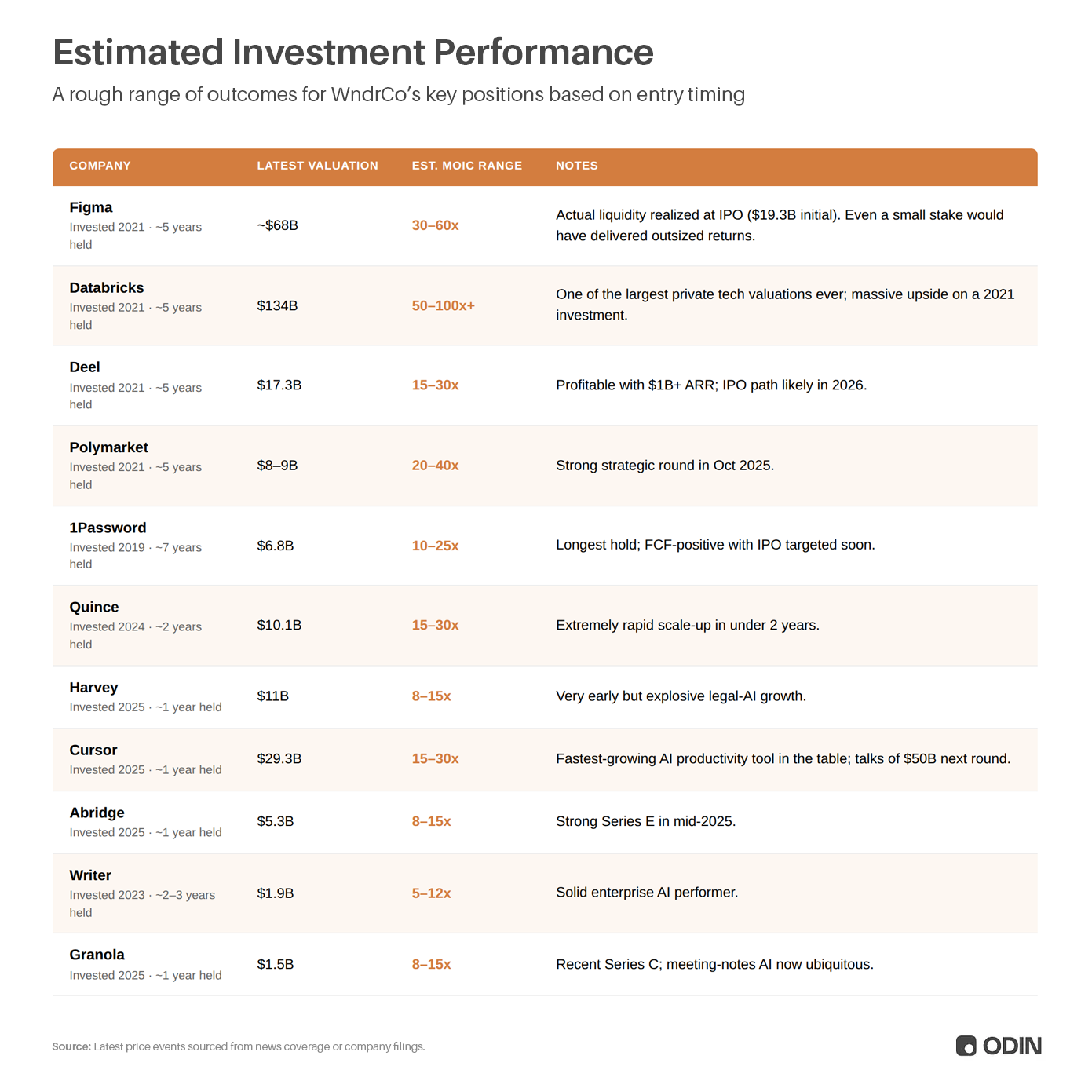
Cursor, the AI-powered coding tool, has been the firm’s most dramatic recent success. In November 2025, the company raised $2.3 billion at a $29.3 billion valuation. By March 2026, its annual recurring revenue had surpassed $2 billion, having doubled in three months, and the company was in early discussions for a new round at a reported $50 billion valuation. Wang described visiting startup offices and counting how many screens showed Cursor’s distinctive tab on the right side of the display. “In a year, if I just did a walk around in an office in twelve months, it just went from zero to 100 practically.”
Abridge, the medical documentation AI, has followed a similarly steep trajectory. After raising $250 million at a $2.75 billion valuation in February 2025, the company raised a further $300 million just four months later at $5.3 billion, led by Andreessen Horowitz and Khosla Ventures. The tool is now deployed in more than 150 health systems, transforming how physicians document patient interactions.
Figma’s IPO on 31 July 2025 was another landmark. The collaborative design platform raised $1.2 billion at $33 per share, giving it an initial valuation of approximately $19.3 billion. Shares surged more than 250% on their debut, briefly giving the company a market capitalisation exceeding $67 billion. Databricks, in which WndrCo invested in 2021, raised approximately $5 billion in equity plus $2 billion in debt in February 2026 at a $134 billion valuation, with a revenue run rate exceeding $5.4 billion. Deel, the global HR and payroll platform, reached a $1 billion-plus revenue run rate and is preparing for an IPO as early as 2026.
Yet Katzenberg is measured about what lies ahead. Asked whether the AI bubble will burst in 2026, he chose his words carefully.
“I don’t know whether it’s AI. Rather than look at it from the extreme notion of what it means for a bubble to burst, I think there’ll be a reckoning in which those that actually are producing real results and are being deployed in really effective and efficient ways, where you can actually see an outcome quickly and it’s real, will win. Not everybody is going to win at this.”
He pointed to the staggering sums being invested by the hyperscalers: $700 billion in capital investment over twenty-four months, by his estimate. “On the other side of that, it needs to produce a result,” he said. “It needs an ROI.”
Wang’s view is more positive, but complementary. He believes that even if model development were to stop at current levels, there would remain years of work to be done in productising AI for delightful user experiences.
“Even if you just froze model development at this moment in time, there’s still so much more that we need to figure out and do and productise to actually make delightful products and experiences for consumers, for businesses.”
This conviction that the application layer matters as much as or more than the model layer has guided WndrCo’s investment decisions, steering it toward companies like Granola (the AI note-taking tool that recently raised $125 million at a $1.5 billion valuation) and away from infrastructure bets that depend on winner-take-all outcomes at the foundation model level.
The Last Mile
There is an interesting tension in how WndrCo evaluates companies, one that speaks to a broader debate in the AI industry about what constitutes real quality.
Wang tells a story about Granola that reveals something about his sensibility. He was using the product in a meeting where a founder was rattling off the names of competitors in an esoteric domain. Later, when he reviewed the AI-generated notes, every company name had been spelled correctly, even the obscure ones. The product had clearly gone and performed web searches to verify the spellings, polishing the notes with a level of care that most competing products missed.
“Years ago, I read that Steve Jobs obsessed about the back of the circuit boards that went into the computers. He wanted them to look pretty, even though nobody really opens the computers to look at that. And that was sort of his craft and dedication and almost a message he sent to the team.”
That attention to craft, the thing that is almost impossible to measure but instantly recognisable when you encounter it, is central to how WndrCo thinks about what makes a great product. Wang has an explicit scepticism of benchmarks as the primary way to evaluate AI companies, a position that places him somewhat at odds with the dominant discourse in the industry.
“The irony is, as many people now talk about AI replacing humans, we have never assessed our best humans based on benchmarks. How many years have parents complained about standardised testing dumbing down their kids? And yet we’re going down the same route with AI. People do very well in benchmarks and they fail in the real world.”
His alternative framework centres on what he calls “the last mile”: the ingenuity, context, and workflow design required to turn a capable model into a product that transforms how a specific category of worker does their job. He believes that perhaps 60 to 70% of AI use cases do not actually require frontier models at all, and that the real competitive advantage lies in product craft, not raw model capability.
Katzenberg is emphatic that partners should try the product themselves before taking a meeting. “The first thing you should be doing is just try the product,” he said, with evident exasperation at the number of investors who do not. “And by the way, I can tell you when you’ve actually tried the product.”
Choosing Good Partners
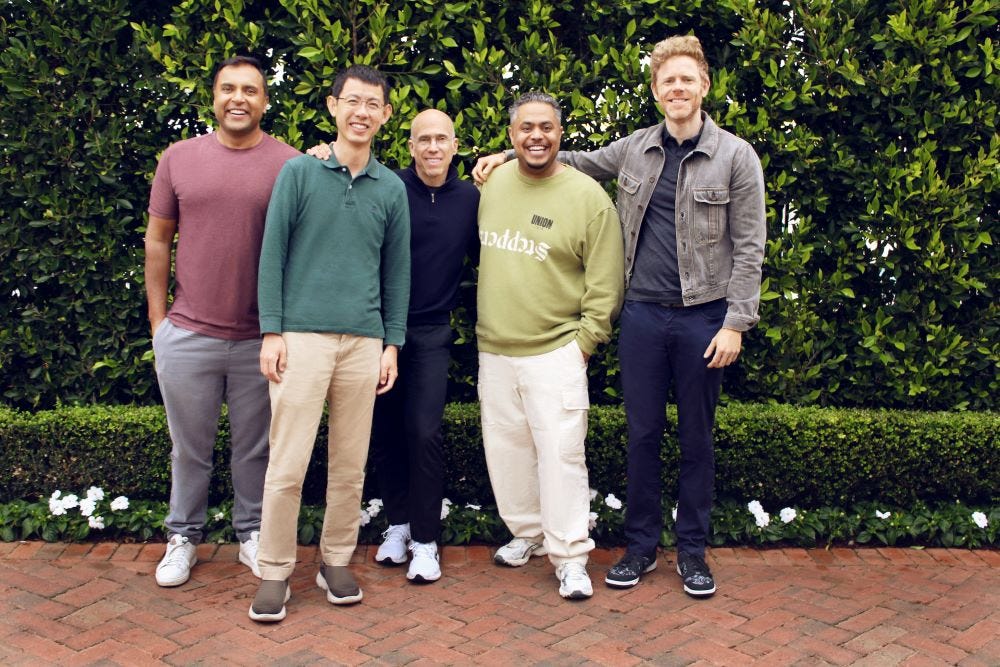
“Partnership to me is honestly, I look at it foundationally as maybe the single most important thing I’ve had in every chapter of my career,” Katzenberg said, listing the mentors who shaped him: Barry Diller, Michael Eisner, David Geffen, Steven Spielberg. When asked which had the greatest impact, he was unequivocal: “Barry Diller. He just invested in me and in my career. I think he believed and saw things in me I didn’t actually see in myself yet.”
WndrCo’s partnership itself, now a decade old, shows no signs of entropy. “It’s more fun than ever,” the partners have said, and the evidence suggests this is not mere performance. They recruited a team of partners whose complementary skills, ChenLi Wang on product, Anthony Saleh on seed-stage pattern recognition, Jeffrey Nykun on analytical rigour, Justin Wexler on enterprise AI deployment, form something closer to a company management team than a typical venture partnership.
“The common thread across everything is that we’re really looking for founders that we think have a chance of cracking an important problem,” Jaswa told TechCrunch when the firm’s venture funds were announced.
In a world awash with capital and increasingly sophisticated AI tools, WndrCo’s bet is that the scarcest resources remain human. The founder with genuine craft, the investor willing to make a hundred sales calls, or the partner who notices when an AI product spells an obscure company name correctly. It reflects their conviction in taste, in partnership, in the belief that storytelling and product obsession are the hardest skills of all.
And their track record indicates that’s leading them to look in all the right places.
Are you an outsider looking to raise your own fund? Deploy capital seamlessly with Odin.