
“Silicon Valley is littered with the corpses of hundreds of promising companies that sold out to Google, Facebook, and the like, only to be quietly shut down a few years later... the result of the acquisition is to co-opt a potential disruptive competitor.”
The most potent form of innovation is creative destruction; the birth of new business models and technologies which fundamentally reshape markets and industries.
This type of innovation is traditionally challenging for incumbents, as they face the well-known innovator’s dilemma; discouraged from investing in advances that might cannibalise their existing business.
Creating novel solutions which aim to displace incumbents also carries significant risk, which is why it has historically fallen to venture capitalists to fund the development of these ideas from the garage all the way to exit.
What happens when incumbents dominate the tech ecosystem, becoming the primary customer and path to exit? This has been the story of most of the 21st Century so far, and it has shaped how venture capital operates for the worse.

Consider venture capital via the analogy of a rally event, something like a cross between Cannonball Run and Wacky Races.
Thousands of teams participate each year, selling their combination of driving skill and engineering brilliance to an audience of sponsors.
The sponsors’ agents pick the teams they want to back, and if that team places in the top 5% it is deemed a good return on the investment.
The only catch is that the race spans continents and takes more than a decade. It might be as much as eight years until the leaders emerge. This makes for a uniquely uncomfortable combination of high stakes, deep uncertainty, and a long wait.
Unfortunately, the agents are lazy and it’s not their money. Rather than hang around to watch the race play out, they want evidence to make a defensible choice, book the sponsorship, and move on. Given the lack of real data to consider, with few experienced teams, they converge on ranking by top speed and acceleration.
Neither of these factors has any real relationship with success, but they are simple and credible. Easy to digest. Nobody will be judged harshly for picking the fastest car in a race, even if it doesn’t place well.
So, from that point on, potential is measured in a quarter mile. Engineers and drivers begin to optimise solely for speed in a straight line, ditching everything that might slow them down.
In the years following, more teams end up blowing up or tapping out, and sponsors begin to lose money in aggregate. But the handful who make it to the finish line are marginally faster, and it’s the winners that consume all of the attention.
Burning Jet Fuel
A theme of hot markets, where investors and startups are awash with capital, is the expectation that startups scale ARR at increasingly impressive speeds. Not long ago, $100M was the target for any company looking for a good exit — today many investors behave as if that should be the target for year one.
The implication is that startups must quickly find their fit with the market and begin the cycle of raising vast amounts of capital to fund exponential growth, ruling out any opportunity that requires thoughtful periods of experimentation and development.
There is little patience for founders to spend time figuring things out.

This attitude dramatically narrows the field of venture capital to ideas that are clearly “legible to capital”, where the path to revenue is immediate and growth is predictable. More often than not, the target startups service larger tech companies, and their goal is to secure lucrative contracts by riding whatever trend Big Tech is excited about.
Essentially, capital abundance makes venture capitalists impatient about growth. They focus on the speed and acceleration of revenue, which inclines them to look for a fundamentally different kind of company. It also defies evidence that raising too much capital too quickly is a common cause of startup failure, and pivots actually have some relationship with success.
Similarly, LPs can get lost in the associated IRR growth and prioritise managers that promise access to these fast-growing opportunities.
This is what is referred to in literature as “cheap talk”, where the relationship between investor and investee becomes shallow and myopic. Investors want promises of explosive growth which investees are happy to provide in return for generous funding.
“We might assume that VCs make investment decisions based on comprehensive analyses and rational considerations, but in reality, they seem to rely more on heuristic-based decisions in hot markets and fear missing out on opportunities.”
Venture Capitalists’ Decision-Making in Hot and Cold Markets: The Effect of Signals and Cheap Talk (2024)
The result is a market run by questionable incremental metrics stacked on top of other questionable incremental metrics. From LPs, through GPs, down to founders, the incentives are warped to produce and fund short-term opportunism rather than durable, important companies.
This problem is rooted in the fact that founders are spending money (that isn’t theirs) deployed by venture capitalists (not theirs either) who got allocation from some institutional money manager (also not really theirs).
The principals are separated from the agents by an ocean of obfuscation, complicated by competing financial incentives and career concerns.
Agency Problems
“Choices based on ‘shallow but nice-sounding rationales’ may be seen as more justifiable than decisions based on more thorough, rational processes. Research has documented a number of these ‘reason-based choice effects’, and in many of them the desire for easy justification leads to violations of various basic principles of rational choice.”
Decision Justification Theory is the principle that people have a tendency to make decisions based on avoiding regret, particularly when they feel insecure about their own judgement. The canonical example is “buying IBM” based on the logic that everyone else uses IBM and therefore you won’t be judged for doing the same.
Venture capital is riddled with this problem.
Investors, both LPs and VCs, routinely anchor their decisions on features that limit regret: a certain previous employer, a particularly hot category, or metrics like ARR or TVPI. The decision-making process is designed to avoid being obviously wrong, rather than to maximise the chance of being correct.
This is a classic agency problem. The institutional LP allocator and the VC, like the sponsor agent in the original analogy, are managing other people’s money. The cost of being wrong is very low. However, the reputational cost of being obviously wrong remains high. So, they choose to manage their own career risk rather than properly managing financial risk for the principal.
The outcome is herd behaviour and an increasingly concentrated and risk-averse market. Investors converge on the same ideas, pushing up prices through competition with no relation to actual potential. Inevitably, returns fall and innovation stalls.
Critically, there’s relatively little appetite for the uncertainty of seeding novel ideas, which may not scale as quickly or have such initially obvious exit opportunities.

Creative Destruction
“Policies supporting Kirznerian entrepreneurship—e.g., increased business formation rates—may promote the creation of low value-adding businesses which is not associated with higher TFP rates. Policy interventions targeting Schumpeterian entrepreneurship objectives—e.g., innovative entrepreneurship and the development of new technologies—are conducive to technical change by promoting upward shifts in the countries’ production function and, consequently, productivity growth.”
The claim that venture capital produces less innovation in the current era is hard to quantify. If innovation is measured by the amount of capital allocated to innovative companies, or the market price of those companies, the opposite would appear to be true. Venture capital is bigger and louder than ever, as are venture-backed companies.
The more accurate claim is that venture capital is now engaged in a different kind of innovation. Kirznerian innovation, rather than Schumpeterian. In a basic sense, this is the “faster horses” paradigm of more incremental advances, versus the creative destruction of wiping out the previous order with automobiles.
This is concerning, because iterative innovation is more easily handled within industries, by incumbents who are grappling with competitive pressure. Creative destruction, which is the catalyst for real progress, requires an outsider. If there is less competitive pressure from outsiders, there’s less motivation for innovation of any kind.
“In the long run, the ultimate source of productivity growth is Schumpeterian entrepreneurship which, for example, can be fueled by knowledge generation processes.”
There are two closely related expressions of this shift, seen in the changing profile of exits and the negative attitude toward antitrust.
Exits
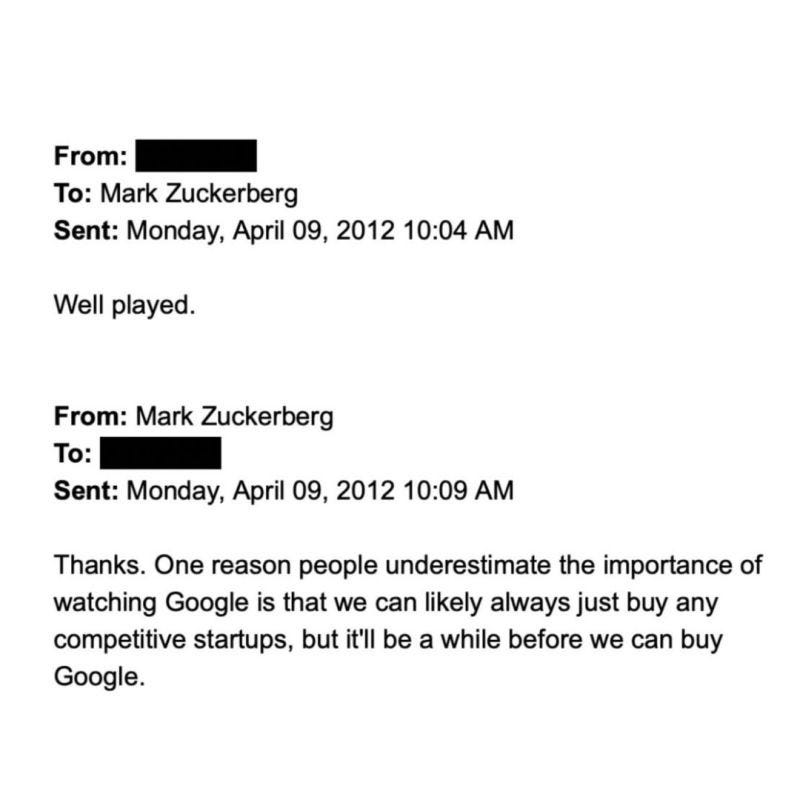
Over the last 25 years, venture-backed companies have increasingly generated returns through sale to incumbents, rather than exit by IPO and continued independence. This has reduced competitive pressure on Big Tech, entrenching their market position, leading to slower innovation and less consumer-friendly attitudes.
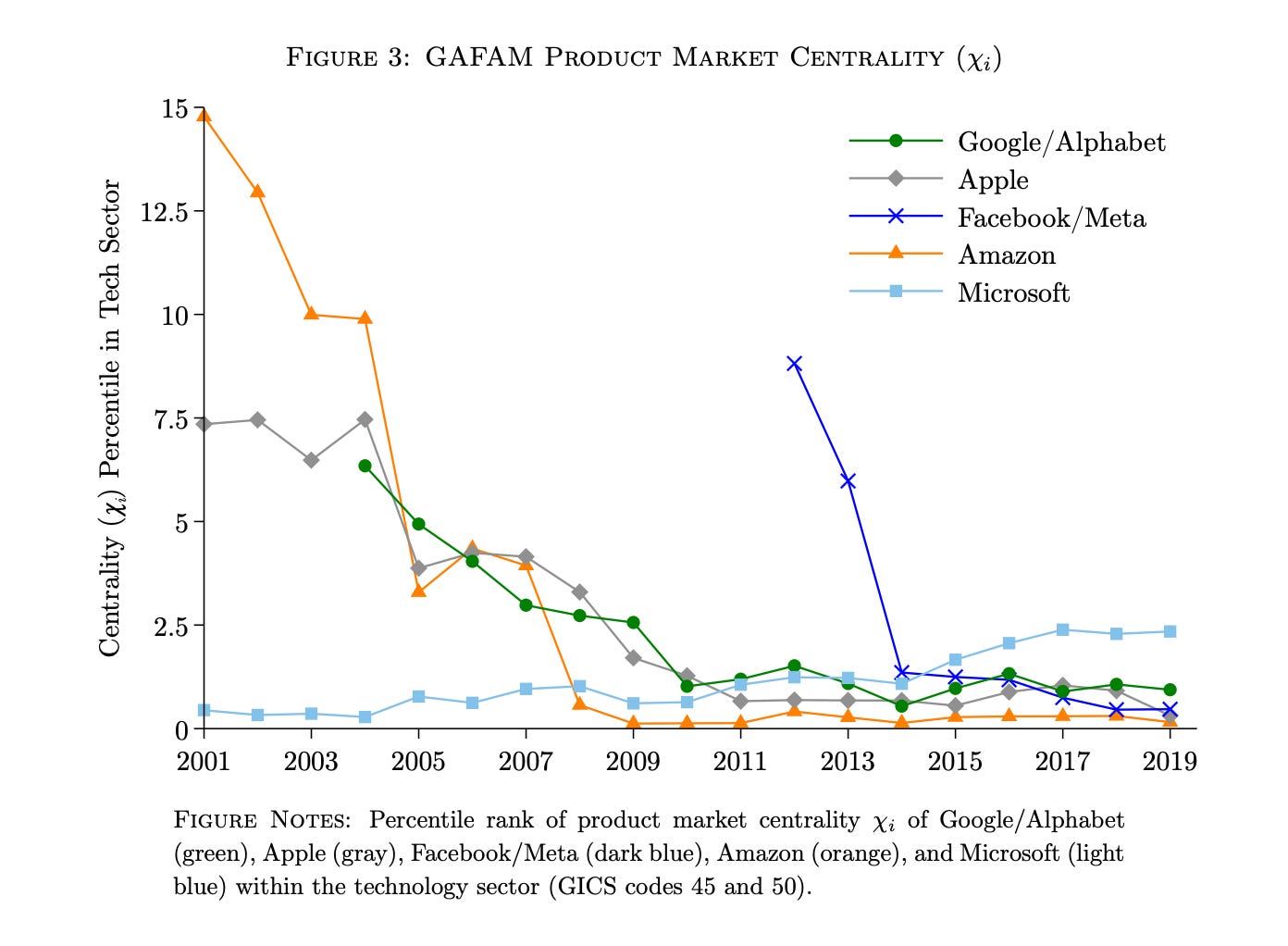
This partially explains the growing perception of oligopoly, with concerns among the public that tech is no longer a force for good.
“Dominant companies that are disproportionately active in the corporate control market for start-ups have become more insulated from the pressures of product market competition over the same period. These facts are consistent with the hypothesis that start-up acquisitions have contributed to rising oligopoly power.”
This is emphasised by research looking at the perceived threat to incumbents when private competitors go public, which is reflected by a fall in their stock price.
“Following a successful IPO in their industry, they show significant deterioration in their operating performance. These results are consistent with the existence of IPO-related competitive advantages through the loosening of financial constraints, financial intermediary certification, and the presence of knowledge capital.”
In summary, the venture capital industry has grown alongside today’s tech incumbents, and to some extent those interests have naturally aligned along the way.
“Disruptive technologies offer innovation that brings competition. And competition in turn brings disruptive innovation — a virtuous cycle that gives us the best of both worlds. The tech giants have increasingly found ways to coopt that disruption — sometimes squelching innovation altogether, and at best using it to protect monopolies rather than destroy them. If we are to restore competition to the tech industry, and so preserve innovation, we need to find ways to ensure that disruptive technologies do what they are supposed to do—disrupt.”
Coopting Disruption (2024)
Antitrust
This brings us to the second development, venture capital’s growing hostility toward antitrust enforcement.
In the aftermath of the ZIRP implosion, where market prices and valuations diverged radically (predictably killing M&A), many firms attempted to blame the weak liquidity environment on Lina Khan’s FTC. This ignores the fact that antitrust enforcement has historically been beneficial to “little tech” and venture capital returns.
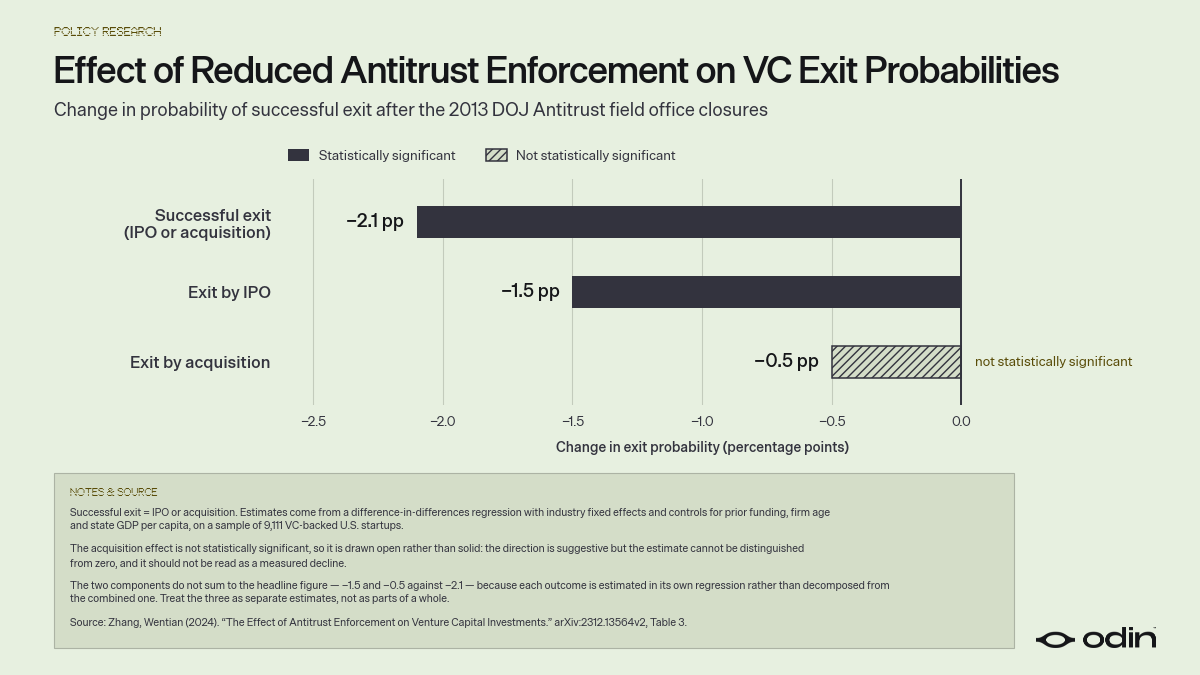
“The results show that VCs significantly reduce investments in startups located in areas less protected by the antitrust division. [...] Additional tests show that the lowered antitrust enforcement subsequently leads to a lower likelihood of successful exits and worse innovation outcomes for startups in the affected areas. [...] Overall, these results suggest that VCs avoid investing in startups located in areas less protected by the antitrust division, hindering the long-term development of startups in affected areas.”
The Effect of Antitrust Enforcement on Venture Capital Investments (2024)
Essentially, private market deregulation produced larger venture capital funds, which are structurally more risk-averse and consensus-driven. As a result, the venture market pivoted from funding creative destruction toward funding incremental innovation that was beneficial to a set of increasingly dominant incumbents.
This explains the otherwise puzzling alignment of large venture capital firms with Big Tech interests, rather than insurgent startups.
Iterative Decline
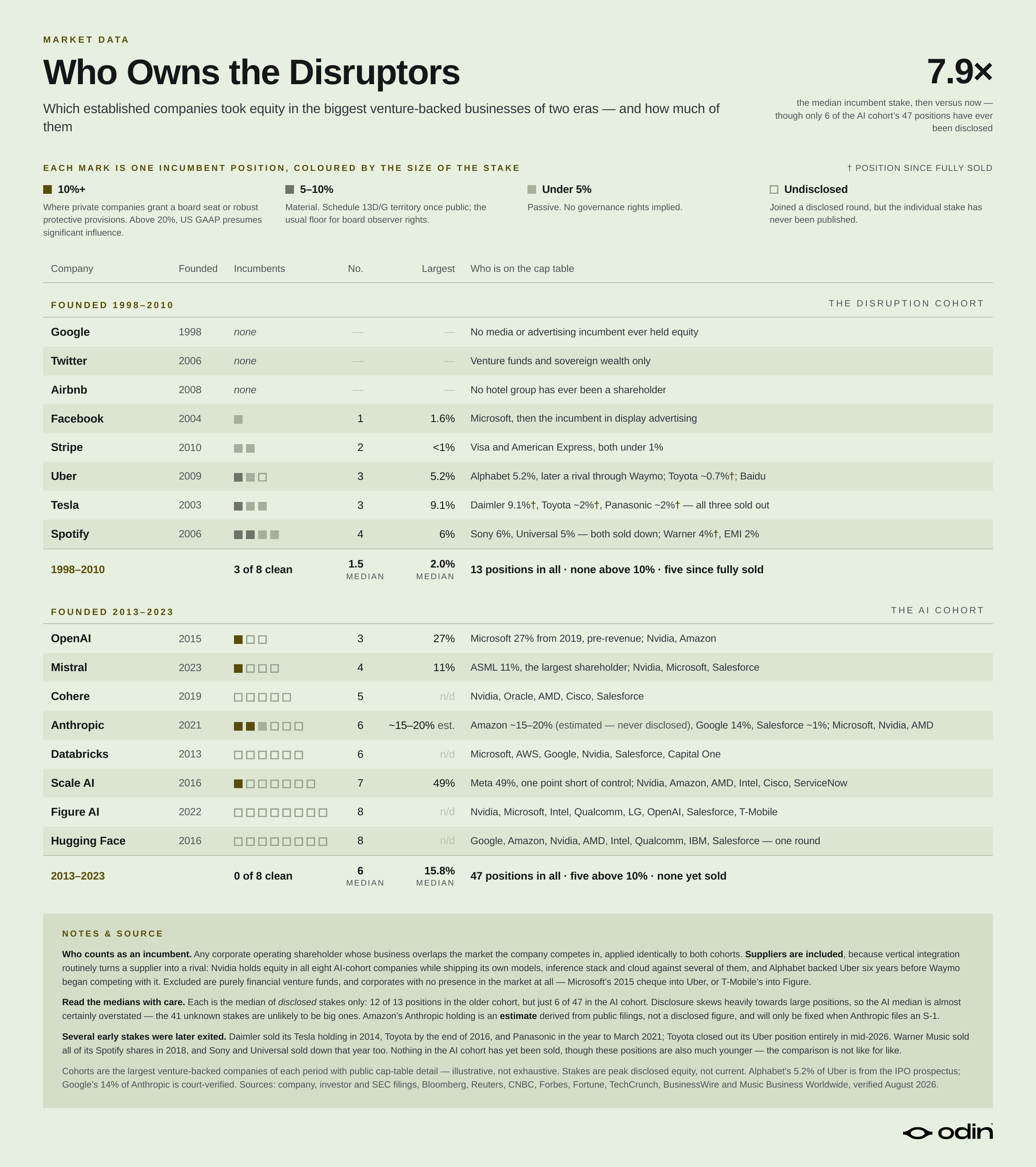
The dangerous appeal of working with incumbents, rather than looking to displace them, is the road to ruin for venture capital. It’s largely why the 2010 to 2022 period was marked by so much deployment producing so little ultimate value. This, in turn, is connected to the subsequent lack of liquidity recycled back into the ecosystem.
While there are exceptions to this, and some firms that are keen to embrace propositions of creative destruction, they are the minority. The largest pools of capital have been formed around interests that are aligned with incumbents, and rely on those incumbents for stability and security.
Indeed, the big venture capital firms might talk about antitrust as if they are defending the founder, but it’s telling how far their interest extends. They have no history of discussing cases where incumbents have engaged in practices that were intentionally harmful to startups. They have no record of celebrating steps taken by antitrust authorities which are beneficial to innovation. They specifically only talk about antitrust in the context of letting incumbents buy startups.
What is venture capital for, if it is not for pushing back against natural monopolies produced by network effects and economies of scale? It should be a tool that weaponises innovation against stagnation, rather than building an elaborate fee machine alongside the dominance of incumbents.
Innovation Theatre
You can take the original analogy to an extreme, to see where this might head.
As the amount of capital flowing into the race from sponsorship increases, the event slowly becomes more and more about the sponsorships and less about the race itself. More attention falls on the perceived appeal, and less onto the actual winners.
In its terminal state, it’s a glorified motor show. Sponsors look for the most expensive-looking car, with the largest engine and most charismatic driver. It’s all about the spectacle, and their payoff comes from status-by-association — winning access to the most desirable teams. Nobody cares about the race anymore.
Gradually, smaller teams fall away as the appetite for outside bets evaporates. Sponsors concentrate on the remaining few, which become increasingly competitive. The price of sponsorship inflates, which is recycled into an increasingly lavish treatment of the sponsorship process.
This is the part the agents enjoy: golf trips with the top teams, Taylor Swift performances for their kids, and the increasingly lavish annual meetings where they are repeatedly told how smart and important they all are.
Unfortunately, the cars are now just too valuable to really go for glory in the race, and they can’t really be tuned to go any faster. So they do a cursory lap around a track, and that’s all that is required.
Technical progress, and any real competition, effectively stops.
Run your investment firm from your phone, with Odin

The quarter-mile analogy holds up scarily well all the way to the "cursory lap around a track" ending. What's less clear to me is whether LPs actually have a way out of this, since even the ones who want patient capital still get judged against funds that chased the ARR sprint and won on paper. Has anyone actually tried an incentive structure that breaks the cycle, or is it just a handful of firms opting out and eating the career risk?
in its terminal state, it's a glorified motor show, nobody cares about the race anymore' is such a brutal ending line, and Decision Justification Theory is the sharpest concept in here, so much of what looks like analysis is really just picking the choice that's hardest to be blamed for later