
Once upon a time, a group of eight researchers from Shockley Semiconductor walked into the offices of a young San Francisco banker named Arthur Rock. The “traitorous eight” had a proposition; they wanted to start a rival firm. Rock saw something in them, perhaps the particular fury of the brilliant and underused, and set about helping them secure financing for what would become Fairchild Semiconductor, the company generally credited with seeding Silicon Valley. This is the story of how Rock, the group’s first believer, became the first modern venture capitalist.
Rock’s conviction, which he repeated for decades, was that backing people was the core of venture capital. A great management team, he liked to say, can find a good opportunity even if they have to jump from the market they currently occupy.
His contemporaries saw things differently. Tom Perkins at Kleiner Perkins trained his eye on technology, asking whether it was proprietary and meaningfully better than alternatives. Don Valentine, who had run marketing at Fairchild before founding Sequoia, became obsessed with the market. When Sequoia considered an early investment in Cisco in the mid-1980s, most of his peers passed; the founding team was considered weak. Valentine invested anyway, reasoning that the networking market was so large that even a mediocre team would sell a great deal of equipment.
The three men gave rise to three distinct philosophies of American venture capital; but Rock’s has won the cultural war. Not only does “venture capital is a people business” make an excellent slogan, it also puts the founder at the center of the story. And if you’re in the business of selling capital to founders, that’s exactly what they want to hear.
But is it really that simple? And what does a “people business” actually look like?
Normative Conformity
Today, virtually every venture capital firm presents itself as founder-first.
In 2016, four economists (Paul Gompers, William Gornall, Steven Kaplan, and Ilya Strebulaev) surveyed 885 venture capitalists at 681 firms to understand how they made decisions. Their study is the most thorough analysis of the industry’s decision-making, and appears to close the book on the Perkins and Valentine philosophies.
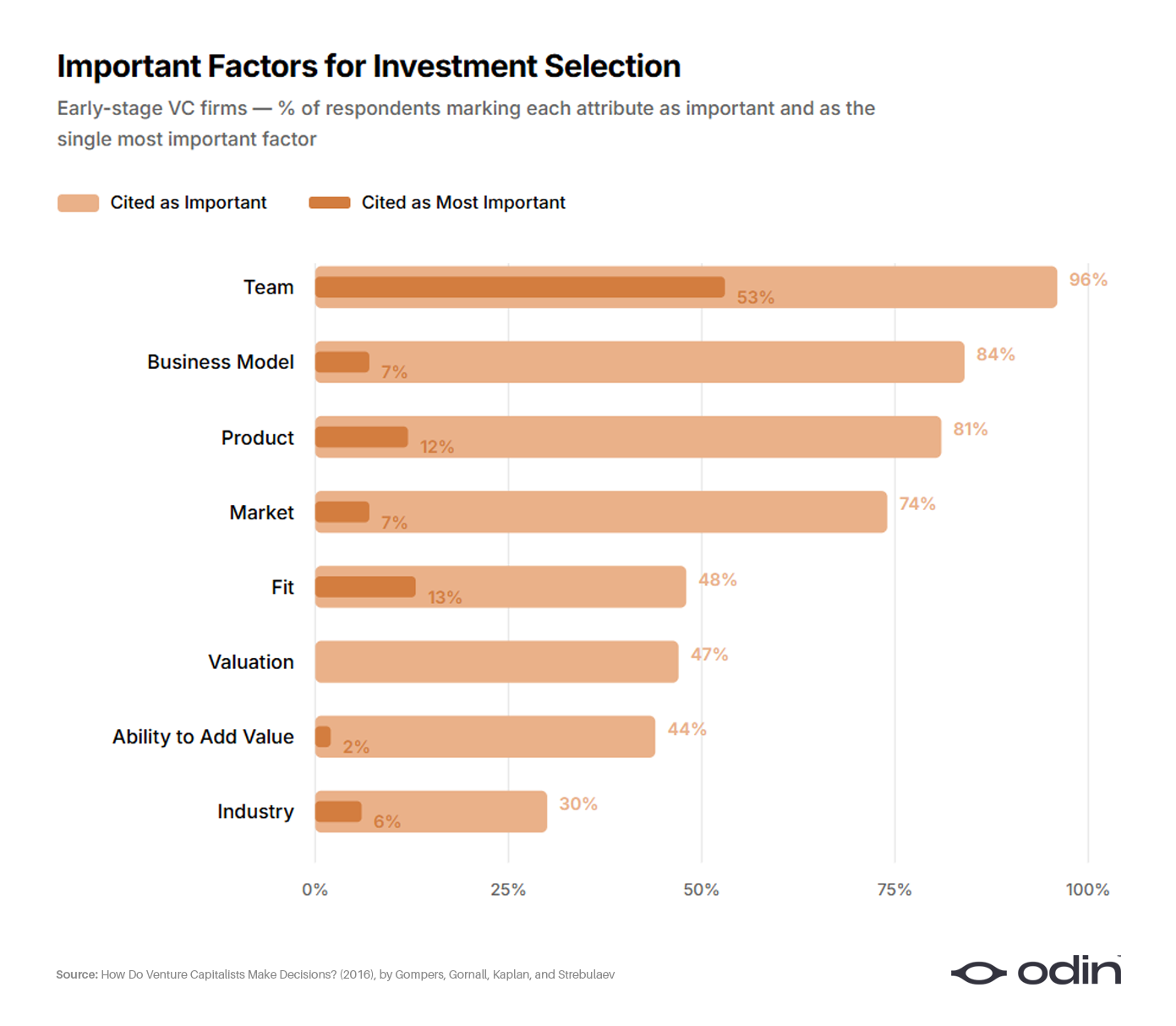
Around 53% of early-stage respondents ranked founders as the single most important factor in deal selection. Business model and product, Perkins’s traditional territory, were selected by roughly 10%. Market and industry, Valentine’s preoccupation, were selected by about 6%. The remainder scattered across valuation, fit with the fund, and the investors’ own ability to add value.
“96% (92%) of VC firms identified team as an important factor and 56% (55%) identified team as the most important factor for success (failure). Team was the most important for all subsamples, but particularly important for early-stage and IT VCs.”
How Do Venture Capitalists Make Decisions?, by Gompers, Gornall, Kaplan, and Strebulaev
Looking at other responses from the survey, 9% of investors admitted to using no financial metrics, which rose to 17% among early-stage investors. An industry so reliant on qualitative judgement might be expected to have thought about the judgement criteria and how the outcomes may be tracked.
Unfortunately, that answer remains a vague promise of investing in “the best founders” without the ability to articulate what that means, or why.
“The findings suggest that VCs are not good at introspecting about their own decision process. Even within the confines of a controlled experiment, which greatly reduces the amount of information considered, VCs lacked a strong understanding of how they made decisions.”
A Lack of Insight: Do Venture Capitalists Really Understand Their Own Decision Process?, by Andrew Zacharakis and G. Dale Meyer
As a result, the founder-first approach to venture capital has produced an epidemic of lazy thinking, infiltrated by biases and credentialism. This, in turn, is reflected in slipping performance and frequent horror stories of fraud and negligence.
A Billion-Dollar Blind Spot
In 2022, a Chicago Booth economist named Diag Davenport put a dollar figure on what this overly simplistic attitude has cost the industry.
Davenport built a machine-learning model on a dataset of more than 16,000 startups, representing over $9 billion of committed capital. He trained the model only on information that had been available to investors at the time of the decision, and asked how many of the investments that venture capitalists actually made could have been identified, ex ante, as worse than putting the same money into a standard public-market alternative? The answer was approximately half.
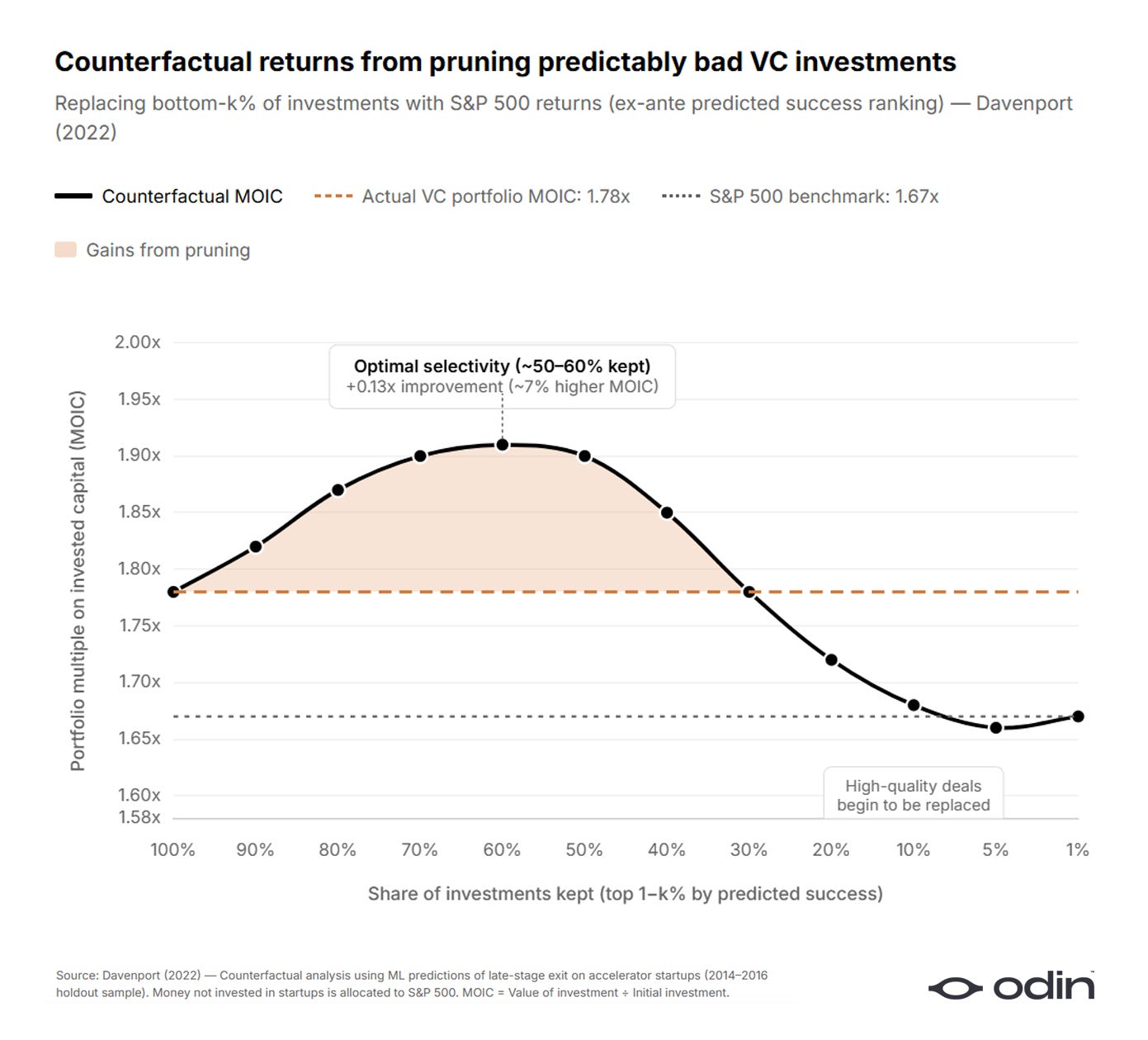
By dropping the bottom half of investments and redirecting the capital into a public-market option, Davenport found that venture returns would have been between 7 and 41 percentage points higher across the sample. In the data he worked with, that amounted to over $900 million of avoidable loss. The cost of the poor investments, expressed as a spread over the outside option, was around 1,000 basis points.
Davenport trained two parallel algorithms, one predicting which startups would become the best investments and another predicting which would become the worst. When he compared the signals that each model relied on, there was a curious pattern. The algorithm built on good outcomes leaned on product characteristics, while the algorithm built on bad outcomes leaned heavily on the founder ‘s background. When investors were making good decisions, they were looking more carefully at the idea. When they were making bad decisions, they appeared to be looking more carefully at the team.
To test the overweighting, Davenport built a separate model that used nothing but founder-education data, and he asked whether two companies that looked equally promising under the full model received different investment outcomes depending on how they looked under the education-only model. The model indicated that investors systematically overweighted education, and they did so most heavily for the startups that would go on to perform the worst.
“Investors seem convinced that the founder-first model of the world is the correct one. This likely facilitates investors neglecting to notice features that are predictive and a feedback loop of never noticing or learning persists, consistent with the model and evidence presented in Hanna et al. (2014).”
Predictably Bad Investments: Evidence from Venture Capitalists, by Diag Davenport
Davenport’s paper is part of a growing body of research that has reached similar conclusions, indicating that investors overweight shallow founder attributes in ways that produce predictably bad investments (errors of comission) and predictably good missed opportunities (errors of omission).
There’s a structural explanation for this; “success” in venture capital is more easily measured by incremental fundraising than by distant exits, and funding friction falls if investment decisions become a simple box-checking exercise.
Somewhere along the way the industry convinced itself that the ability to raise capital was itself a desirable founder trait and this logic became recursive. Investors began pattern-matching on the founder archetype most likely to raise the next round, making that archetype easier to fund, reinforcing the pattern. As a result, the quality of returns has largely declined while capital velocity (and fee income) has accelerated.
This loop is explained by the economist Daniel Kahneman, who describes how even sophisticated professionals can be seduced by simple, coherent ideas if they are aligned with the right incentives. Even when they produce obviously bad results.
“The statistical evidence of our failure should have shaken our confidence in our judgments of particular candidates, but it did not. It should also have caused us to moderate our predictions, but it did not. We knew as a general fact that our predictions were little better than random guesses, but we continued to feel and act as if each particular prediction was valid.”
Make it easy to back people building great ideas in great markets - run your venture firm from your phone with Odin.
The Paradox of the Good Investor
This creates an interesting puzzle. The data shows that overweighting founder attributes leads to worse investment decisions, particularly among the worst-performing deals. Yet some of the most successful firms in the industry are also the most aggressively founder-first.
Founders Fund has spent two decades backing unusual people before anyone else would. Peter Thiel also created the Thiel Fellowship, for young entrepreneurs who didn’t have a college degree, which has produced incredible success stories.
Y Combinator has run for twenty years on the premise of identifying great founders. In fact, the programme has been shown to reduce credentialism in venture capital by providing an alternative source of signal for investors.
If founder-first thinking were simply a systematic pathology, the firms most committed to it should be among the worst performers. Instead, they are among the best.
The answer is actually fairly straightforward. When great investors say “founders first,” they mean something significantly more sophisticated than the skin-deep interpretation of the industry at-large.
The Great Man Fallacy
The desire to reduce founder success to a checklist of predictable attributes is a modern manifestation of the Great Man Theory; the belief that history is shaped by exceptional individuals with innate greatness, ignoring how success itself forges those qualities.
“A successful company with a strong record of performance? The leader appears to be visionary, charismatic, with strong communication skills. A company that has suffered a downturn? The same leader appears to be hesitant, misguided, or even arrogant.”
For example, industrialists like Elon Musk have shaped investor expectations about hard tech founders, through the many stories about his multi-domain hyperfluency, discipline and assuredness. So, this is what they look for in first-time founders, not realising that Musk developed these attributes over time and they are denying others the opportunity to do the same.
Consider also Thiel’s investment in Mark Zuckerberg, a Harvard dropout. Today, it’s often cited as an example of Thiel’s ability to identify great founders early. Yet contemporary accounts reveal that Thiel was taken with Facebook itself, the early traction, and the specific way that Zuckerberg had chosen to frame the problem of online identity.
Would Thiel have recognised anything in Zuckerberg had he been building a flower-delivery startup? It is hard to imagine. The idea about how a university’s social network ought to function, and the particular form that Zuckerberg had already given it, was the magic that Thiel was looking for.
Indeed, at Andrew Ross Sorkin’s DealBook Conference, Peter Thiel was asked how he evaluated founders, and his answer matches the Facebook example.
“I don’t separate the ideas and the business strategy and the technology that much from the people. It’s all some sort of a complicated package deal.”
He cannot, he says, assess the quality of a founder without assessing the quality of the idea that the founder is working on. He cannot assess the idea without understanding the ways in which the founder has shaped it. The two are inseperable.
Problems Worth Solving
A complementary argument has been developed by academia. In a 2022 paper published in the Journal of Business Venturing Design, Mattia Bianchi and Roberto Verganti at the Stockholm School of Economics and the Politecnico di Milano argue that entrepreneurship has been systematically misunderstood as an exercise in problem solving, when in fact it is primarily an exercise in problem finding.
The founder’s most important creative act, in their framing, is the identification and framing of a problem worth solving. Everything else, the pitch deck, the go-to-market plan, the product road map, follows from the quality of that initial framing.
“Seeing problem finding as an act of design and not just discovery expands the potential impact of design practice from the creative generation of solutions to that of problems. Speculatively reframing problems is an additional lever for breakthrough innovation, since an unconventional problem formulation can open up unexpected solution paths.”
Entrepreneurs as Designers of Problems Worth Solving, by Bianchi and Verganti
If this framing is correct, the dichotomy at the heart of the jockey-versus-horse debate is false, and a founder should be assessed through the problem they have chosen to attack and the particular frame they have used to understand it. The idea cannot be assessed in isolation either, as it reflects the material expression of a founder’s beliefs about what the world will look like in ten years. Each illuminates the other, and any investor who claims to assess them separately is certainly doing neither well.
“By Their Fruits You Shall Know Them”
This combination approach is well framed by Nabeel Hyatt of Spark Capital. Asked how he distinguishes founders who are genuine operators from those who just check a lot of superficial boxes, his answer is surprisingly straightforward.
“The way we separate hucksters who do a good pitch from people who are real executors is to look at the thing that comes out of their hands. I’ve never evaluated a company by looking at the product or using the website and being like ‘this person should have a $15M check’. You look at the product, and you try to learn about the humans behind the product by evaluating the product.”
The product is the manifestation of the founder’s ambition, and a deep reflection of their judgement, their priorities, and of the problem they have chosen to solve.
An investor who says “I invest in people”, and has not looked carefully at the product, is either investing in shallow patterns or in charm and charisma. There are precisely the habits which reliably produce predictably bad investments.
Sam Altman, sharing his application-screening heuristics at a 2016 Khosla Ventures summit with Keith Rabois, put the same point in slightly different language:
“The hardest trait we’re looking for is determination. There are a few other topics in the middle we look at: Clarity of vision, communication skills, and the non-obvious brilliance of the idea we look at very hard. These are ones that you can’t always be right on, but you can usually get quite a lot of data, and unlike determination they’re not quite as difficult to figure out.”
He does not say the brilliance of the founder. He says the brilliance of the idea, qualified as “non-obvious”, which suggests the founder has picked a novel problem. And clarity of vision, which suggests looking at how they perceive and articulate that problem. And, of course, the determination they direct at that process.
He is talking, in Bianchi and Verganti’s language, about the founder as a designer of problems worth solving.
The Entire Ocean, In a Drop
There are two things an investor can mean when they say that they invest in people.
The first is the belief that attributes such as pedigree, biography, charisma, and past fundraising success carry more signal than what a founder has chosen to dedicate their time to. Essentially, that founders are a fungible commodity that can be stack-ranked. This is the version that Davenport’s data most directly contradicts.
The second, much rarer version is the belief that the subject being evaluated is a unique alchemical mix of people and ideas. It is the investor’s job to assemble a complete picture; the choice of problem, the form of the solution, and the character of the team. Only then, can they fully perceive the opportunity in front of them.
The two are easily confused because they use the same vocabulary. Both are expressed in the language of backing people and celebrating human potential. The first is lazy and well-rewarded by the norms of the industry. The second is hard, and often misunderstood, but it is clearly the path to better quality investments.
The argument is not that investors should abandon qualitative team analysis and return to Perkins and Valentine. The conclusion is simply that the team cannot be usefully assessed without the context of what they are working on, and the attempt to do so is where investors fall into problematic pattern matching.
This is why the atomic unit of entrepreneurship is not the founder nor the idea, but the unity of both. The venture capitalist must stand far enough back to see both at the same time, and to assess them as a single entity.
Rather than the tired question of jockey or horse, the investor’s job is to recognise the centaur.
N.B. A paper from 2009 offers empirical justification for focusing more on ideas when evaluating companies, by analysing how many had changed either leadership team or core product by the point of IPO. However, this covers a period when VCs regularly brought in new executives prior to listing, and no longer seems relevant.
Run your venture firm from your phone with Odin.
I read the same research papers earlier this year. Team, Market, and Fit (plus entry price), in my experience, matter most to early-stage VCs. Other parameters shift while these stay constant and shape long-term outcomes. Absolute success often turns into a unicorn or more. It comes down to betting on the team, backed by enough data to strengthen the thesis and our conviction.
The credentialism trap in VC has a hiring twin. The pattern I track in Indian GCC senior-IC hiring: resume screens reject roughly 30% of candidates who later score top quartile when peer-referred in, while close to 40% of resume-cleared candidates fail the first technical loop. Don Valentine's "great market, mediocre team" call survived because his audit trail was conviction, not pedigree. Modern hiring lost the same thing. The screener willing to be wrong on paper because the pattern was right in the conversation no longer exists. Audit-trail-defensibility now beats signal quality in both rooms.
Zia. AI career strategist for Indian professionals. itszia.ai