“We cofounded the Thiel Fellowship with Peter Thiel in 2010 with a few secrets in mind: young people should be taken seriously, outstanding founders are found without credentials and even in the oddest of places, and that the edges of technology and science can and often are advanced by those least likely to be recognized by sclerotic institutions.”
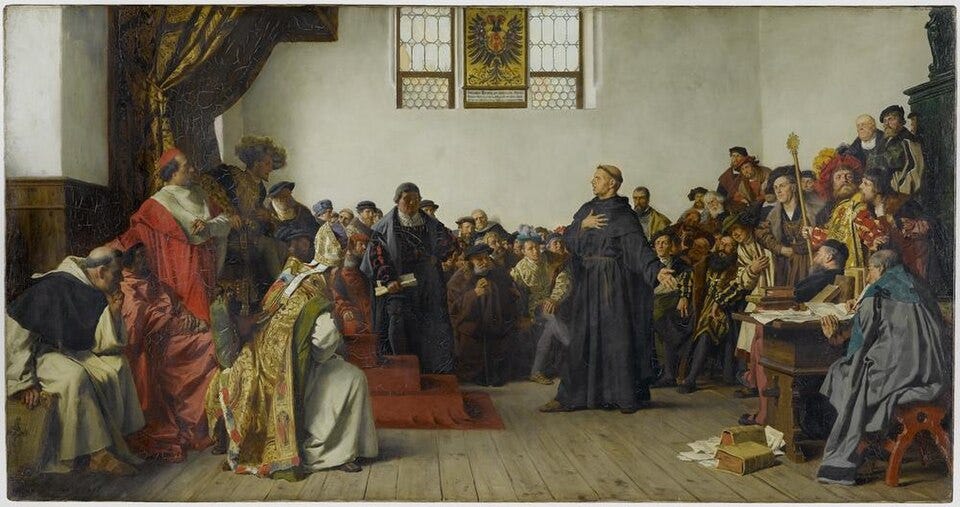
When Michael Gibson and Danielle Strachman launched their venture capital fund in the summer of 2015, they named it 1517: the year Martin Luther nailed his 95 Theses to a church door in Wittenberg, protesting the sale of indulgences, and sparking the Protestant reformation that, to a large extent, drove the cultural changes necessary for the development of the modern world.
Just as Luther believed that the medieval Catholic Church extracted wealth by selling pieces of paper that reserved your place in heaven, 1517 believed that the modern university extracts wealth by selling pieces of paper that promise to reserve your place in the workforce.
Gibson and Strachman wanted to finance the heretics, and they had earned the right to try.
For five years, the pair had run the Thiel Fellowship, Peter Thiel’s $100,000 grants to teenagers who dropped out of college to start companies. These supposed failures of the academic world would go on to build generational companies including Ethereum, Figma, and Anthropic.
1517’s debut fund, a modest $20 million vehicle, has (as of January 2026) already returned 4.41x its initial capital in cash to investors, after about a decade. The total value of all of their investments stands at 9.65x. By any measure, this puts 1517 among venture capital’s top-performers, providing clear evidence that they know how to find alpha.
This is the story of how they got started, and what their success reveals about the market’s blind spots.
The Anti-Rhodes Scholarship
“The Thiel Fellowship was a challenge to two big norms: that college was the only right path for young people and that making a real and recognized contribution was something you did once you did what everyone else told you to do: go to school, get a job, and get experience.”
The Thiel Fellowship was imagined on a cross-country flight. On September 28, 2010, the night before TechCrunch Disrupt in San Francisco, Peter Thiel was flying from New York with Jonathan Cain, Luke Nosek, and Jim O’Neill. The conversation drifted toward his signature obsession, technological stagnation, the thesis that genuine progress had flatlined since the 1970s in every domain except computing.
Someone floated the idea of an “anti-Rhodes Scholarship”. What if you paid brilliant young people not to attend college, but to skip it?
The next day, Thiel announced the “20 Under 20” program onstage. Michael Gibson, who had been hired the day before to help Thiel teach a Stanford Law School course, was urgently pulled in to flesh out the concept. One week later, Danielle Strachman was hired to help build and run it.
The fellowship operated through the Thiel Foundation: $100,000 over two years, no equity taken, no strings attached. The first cohort of 24 fellows (expanded from the planned 20) was announced on May 24, 2011, chosen from roughly 400 applicants.
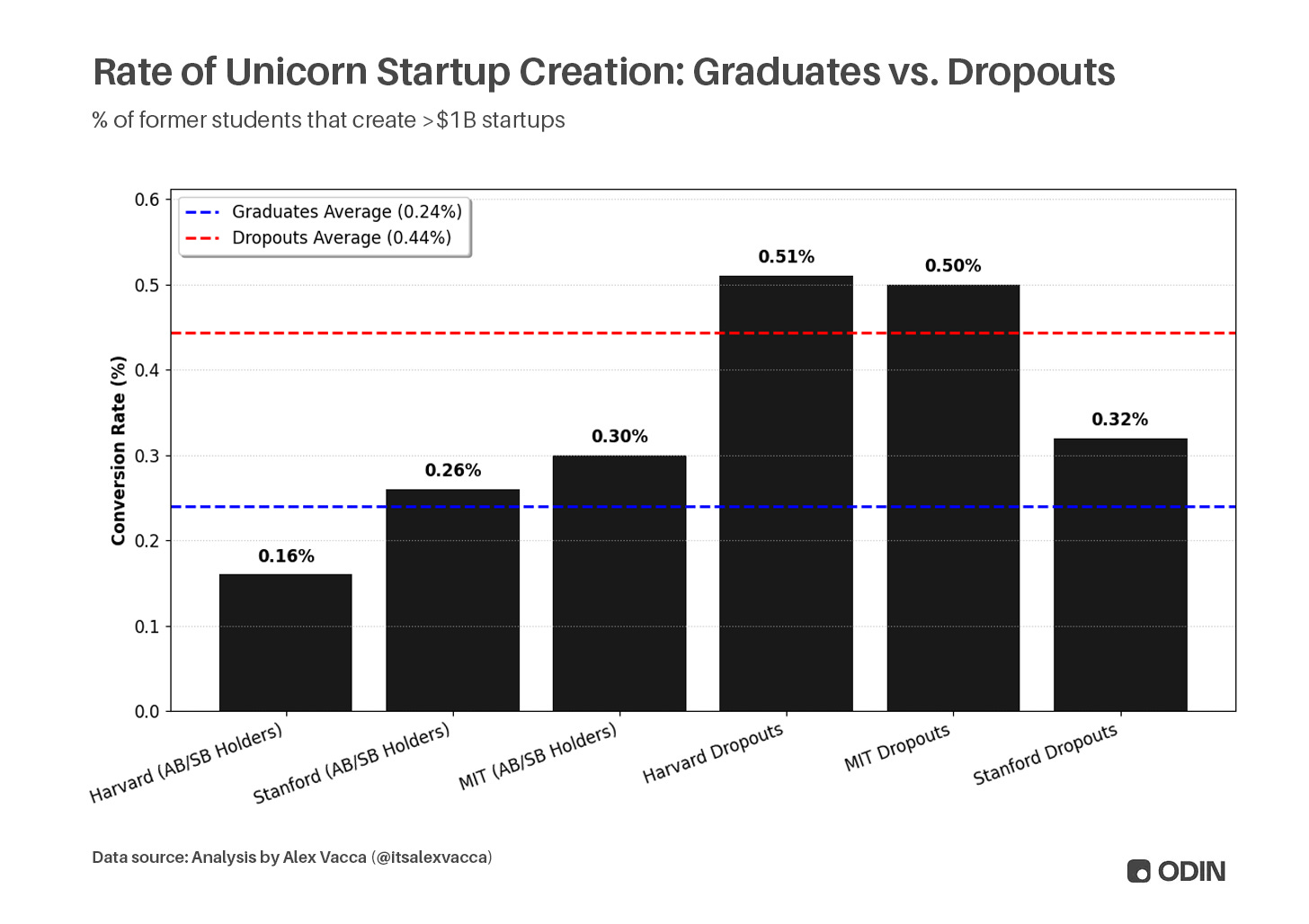
The establishment’s reaction was vicious. Larry Summers, the former Harvard president and Treasury secretary, called the fellowship “the single most misdirected bit of philanthropy in this decade”, a program to “bribe people to drop out of college.” Jacob Weisberg, editor of the Slate Group, dismissed it as “a white boy’s version of the NBA.” Vivek Wadhwa declared it had produced no notable successes. Critics pointed to survivorship bias, and to the irony that Thiel himself held two Stanford degrees.
Then the results started to come in.
Laura Deming, 17 years old when she left MIT in the first cohort, founded The Longevity Fund and is credited with making anti-aging research a legitimate investment category.
Paul Gu dropped out of Yale and co-founded Upstart, the AI lending platform that went public in 2020.
Dylan Field, who left Brown in 2012, co-founded Figma, the design tool Adobe tried to acquire for $20 billion before Field took it public himself. He is now worth an estimated $5 billion.
Chris Olah, also from the 2012 class, went on to co-found Anthropic, now valued at roughly $380 billion.
Austin Russell dropped out of Stanford at 17 and built Luminar Technologies into a LiDAR company that debuted on the public markets at $3.4 billion.
Ritesh Agarwal, the first Indian fellow, founded OYO Rooms, which grew to more than 330,000 rooms across 35 countries.
Vitalik Buterin, who left the University of Waterloo in 2014, used his fellowship to develop Ethereum which today has a “market cap” of $235B.
Bloomberg finance researchers Aaron Brown and Richard Dewey assessed the program in 2025, and concluded that every other elite scholarship program in the world, combined, could not match the output of Thiel fellows by age 35. The cumulative value created by fellows’ companies is estimated to exceed $750 billion, with about 40 unicorns from roughly 290 participants. The result is a unicorn rate of about 14%, which dwarfs the venture industry’s baseline by an order of magnitude.
The Philosopher and the Principal
Gibson and Strachman arrived at the fellowship from different directions, and their complementary instincts have come to define 1517’s character.
The Philosopher
“I have no business doing what I’m doing. I thought I was going to be a professor of philosophy. Through a series of unlikely events, I found myself interviewing for a job with Peter Thiel.”
Michael Gibson was born in 1977 and spent his twenties pursuing philosophy at NYU, the University of Chicago, and Oxford, where he enrolled in a doctoral program in ancient philosophy and moral theory. He never finished. He came to believe that academic life constrained the original thinking it claimed to cultivate, a conclusion he describes as his “academic apostasy.” After Oxford, he worked as an editorial assistant at MIT’s Technology Review, covering quantum computing and emerging technologies, and published essays in The Atlantic, National Review, Forbes, and City Journal. His blog posts caught Thiel’s attention.
Gibson’s book, Paper Belt on Fire, published in November 2022, lays out the intellectual architecture behind 1517. The thesis is that a corridor stretching from Washington to Boston, the “Paper Belt”, sustains itself by printing paper: money, laws, media, diplomas. Universities, he argues, are the most corrupt node in the system, operating a credentialing mechanism divorced from genuine talent. He cites research by Northwestern’s Benjamin Jones showing that the age of peak creativity is being pushed later because institutions take longer to bring minds to the frontier of knowledge. The book is also part memoir, woven through with his investigation into whether his father (who died under mysterious circumstances when Gibson was 16 months old) had CIA connections.
The publishing process added fuel to the fire. About a third of the roughly 20 publishers Gibson’s agent approached rejected the manuscript because, in their words, “Peter Thiel is evil”. Another third said some version of “I went to Yale. I love my English major”. The rest simply passed.
The Principal
“Danielle, the foundation has lost their minds. They’re running this new program, you have to get over here.”
Lindy Fishburne, Senior Vice President for Investments at the Thiel Foundation
Danielle Strachman came from the world of K-12 education. She had originally planned a career in neuropsychology before pivoting to teaching. Around 2000, she founded Heightened Learning, a private tutoring practice in San Diego organized around students’ interests and emotional needs. The work led her into homeschooling communities, where she began teaching creative writing in a cooperative run by Christine Kuglen. She was transformed by what she saw; the agency, the curiosity, the sheer aliveness of children who hadn’t been processed through conventional schooling.
Around 2007, Strachman and Kuglen co-founded Innovations Academy, a K-8 charter school in San Diego built on student-led, project-based learning and what was then a pioneering social-emotional curriculum. They wrote a 400-page charter petition and went through the Charter Launch accelerator. Strachman served as Director of Student Growth for the school’s first two years. (The school now serves roughly 400 to 450 students and continues to operate; she remains on its board.)
Lindy Fishburne at the Thiel Foundation, who knew of her charter school work, called with what might be the best recruiting pitch in Silicon Valley history: “The foundation has lost their minds. They’re running this new program, you have to get over here.” Strachman interviewed the following week, started the week after, and became Program Director within a month. As Founding Director of the Thiel Fellowship, she oversaw the first five cohorts, the classes that produced Buterin, Field, Russell, Deming, Gu, Agarwal, and Olah. She built the Thiel Summit community events, which drew roughly 2,000 young entrepreneurs, and created programming for applicants who weren’t selected.
Her business card at 1517 reads “professional fairy godmother”. Along with Gibson, she has developed a vocabulary for the intuitions that guide her judgment of young founders. There is “dog on a leash energy”, the quality of straining visibly against constraint. There is “hyperfluency”, the ability to geek out with experts in a domain and then turn around and explain it to a civilian. And there is what they call the “crazy, crazy awesome” spectrum, which is an admission that it takes years to know whether a founder is insane or brilliant, and the wisest thing an investor can do is stay in the room long enough to find out.
Starting your own renegade VC fund? You do the investing, let us do the admin
Three Hundred Emails
In June 2015, Gibson and Strachman left the Thiel Foundation and went to pitch Thiel over breakfast. The presentation was a single page, illustrating a hypothetical of what the fellowship’s $100,000 grants would have returned had they been investments. Thiel committed $4 million on the spot.
They wrote 300 emails to family offices and individual investors, and closed Fund I at $20 million with 30 limited partners in roughly eight months. The very first check 1517 ever wrote was a $1,000 micro-grant, sent to a teenager in a Boston cafe.
On October 31, 2017, the 500th anniversary of Luther’s theses, Gibson nailed a list of anti-education theses to the doors of university administration buildings. The fund published The New 95, declarations that included “Life in the U.S. begins with a 13-year mandatory minimum sentence: K-12” and “Higher education has become America’s national religion, complete with heaven and hell, salvation and damnation”.
The investment thesis was simple, they would back founders without undergraduate degrees at the earliest possible stage. First checks of $50,000 to $1 million into companies that had raised less than $1.5 million, targeting 7 to 10 percent ownership. Agnostic to sector (software, hardware, deep tech, biotech) but insistent on the founder profile. Starting around 2018, the firm expanded to include “renegade scientists” who had abandoned academia to focus on frontier technology like rockets, fusion, quantum computing.
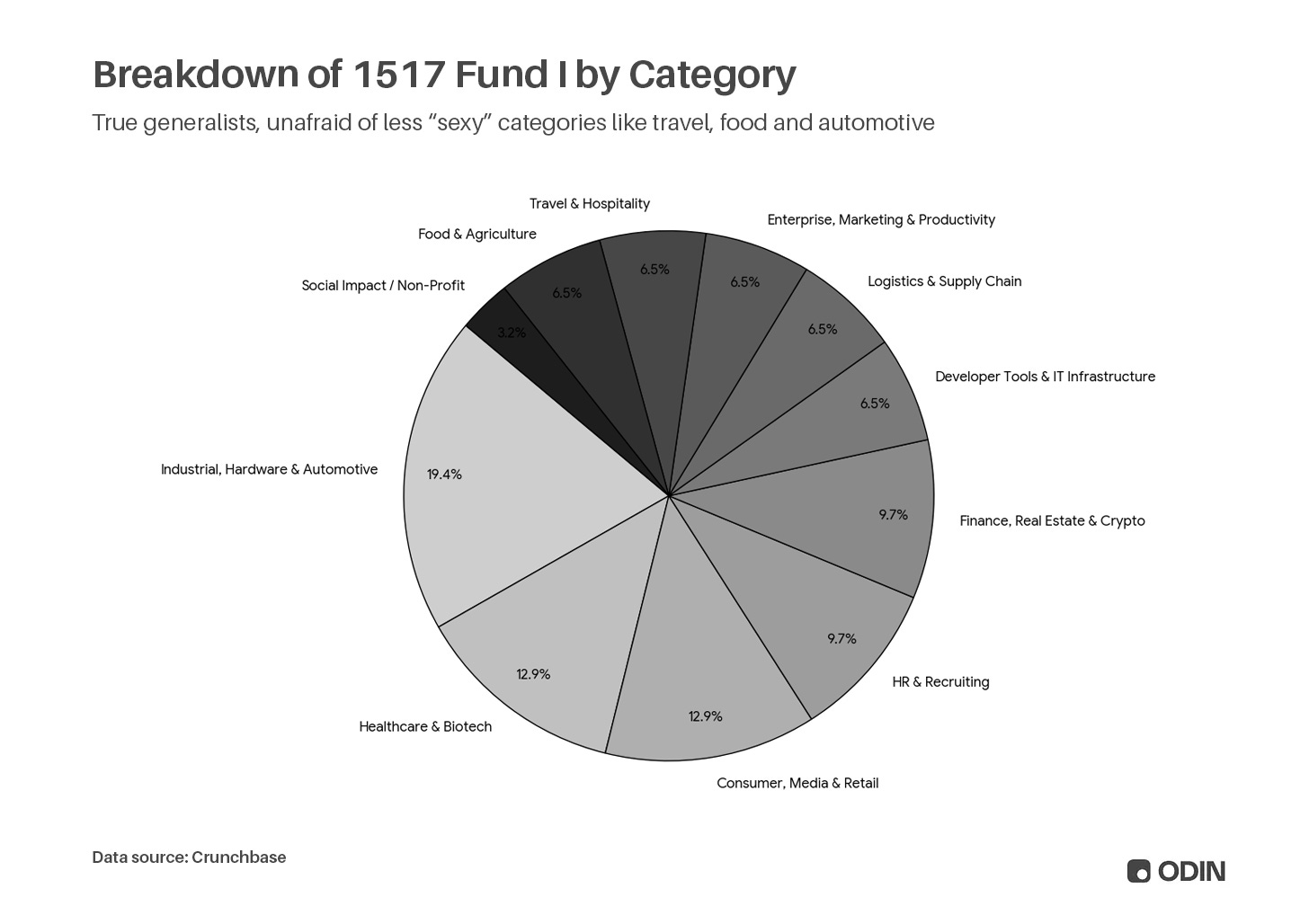
The firm has since grown through four vintages: Fund I at $20 million in 2015, Fund II at $24 million around 2020, Fund III at $80 million in early 2022, and a Fund IV currently in fundraising. The team has expanded to around 14 people, including partners Zak Slayback, who left the University of Pennsylvania in 2014, and Nick Arnett, who never attended university at all and founded a nonprofit at 18. The firm also deploys “operatives”, field agents embedded in cities like Los Angeles and Austin who find talent in communities of young makers before anyone else knows to look.
The Pillars of Fund I (So Far)
1517 Fund I holds 34 unique investments. Four of them have driven most of the returns so far, and each tells a different story about what it means to be the first believer.
Loom
“Danielle and Michael were our biggest early believers. They met with us weekly, gave us feedback, and wired us money before the deal docs were done as our pre-seed lead so that we wouldn’t run out of money 48hrs later. Can’t honestly say Loom would be a company if it hadn’t been for their belief.”
Co-founders Joe Thomas, Shahed Khan, and Vinay Hiremath started a usability testing tool called Opentest in 2015. After six months of failed launches and no traction, running on borrowed money and maxed-out credit cards, the three were nearly out of runway. In a last-ditch move in June 2016, they repurposed Opentest’s screen-recording feature into a standalone Chrome extension called Openvid and launched it on Product Hunt. Within 24 hours they had 3,000 signups, more than the previous six months combined. The product became Loom, an async video messaging tool that lets anyone record their screen and face, then share the result as a link. Hiremath, a college dropout from Illinois who had moved to Palo Alto to work as an engineer, was 1517’s kind of founder. The firm led the pre-seed round, becoming Loom’s earliest institutional backer.
The pandemic turned Loom from a useful tool into essential infrastructure for remote work. The user base exploded from 4 million to over 14 million in two years. Sequoia, Kleiner Perkins, Andreessen Horowitz, Coatue, and Slack all invested. A 2021 round valued the company at $1.53 billion. On October 12, 2023, Atlassian announced it would acquire Loom for approximately $975 million in nearly all cash, its largest acquisition ever, with 25 million users and 200,000 paying customers at the time of the deal.
Lambda
“1517 believed in me first.”
1517 was an early seed investor in Lambda, founded in 2012 by Stephen and Michael Balaban, participating when the company was valued at roughly $4 million. Lambda pivoted from deep learning workstations to become a leading GPU cloud and AI infrastructure provider, positioning itself as an Nvidia-aligned alternative to hyperscale cloud providers. By 2024, revenue had reached approximately $425 million with 70% year-over-year growth, serving 10,000+ customers including AI labs, Fortune 500 companies, and government agencies.
A $1.5 billion Series E in November 2025 valued Lambda at $5.9 billion, with Nvidia investing directly alongside TWG Global, ARK Invest, and G Squared. It is 1517’s largest outcome and is widely expected to IPO in 2026. For Fund I, an early seed check at a roughly $4 million valuation that grew to $5.9 billion represents a potential return exceeding 1000x.
Deepgram
“Voice is the dark matter of enterprise data. I have a PhD in particle physics and worked two miles underground architecting systems to detect dark matter with deep neural networks. And I left particle physics to tackle what feels like a bigger and more tangible problem.”
Scott Stephenson earned a PhD in particle physics from the University of Michigan, where his research involved building dark matter detectors two miles underground in China as part of the PandaX experiment. While working in the lab, he and his colleagues built a device to record audio around the clock as a log of their experiments, then realized the deep learning models they were using to analyze subatomic particle waveforms could be repurposed to analyze audio waveforms. When they looked for an API that could search through hundreds of hours of recordings, nothing adequate existed. Stephenson left his post-doctoral position in 2015 to found Deepgram, betting that end-to-end deep learning could outperform the legacy heuristic models Google and Amazon relied on for speech recognition.
1517 participated in a small 2017 round that placed Deepgram in Fund I’s portfolio, a tiny bet on a physicist building proprietary AI infrastructure for speech at a time when “voice AI” was not yet a recognized venture category. Nvidia and In-Q-Tel (the CIA’s venture arm) invested in the Series A. Tiger Global led the Series B. In the voice AI explosion of 2024 and 2025, enterprises rushed to deploy AI-powered voice agents, and much of the underlying technology ran on Deepgram APIs. In January 2026 the company raised $130 million at a $1.3 billion valuation, its second unicorn milestone for Fund I alongside Lambda. Stephenson was not a teenage dropout but a credentialed scientist who abandoned a prestigious academic career because he saw a problem the academy couldn’t solve at the speed the world needed.
Luminar Technologies
Austin Russell, a 2013 Thiel Fellow who dropped out of Stanford at 17, founded Luminar Technologies to build LiDAR sensors for autonomous vehicles. 1517 invested early. Luminar went public via SPAC in December 2020, opening at a market capitalization exceeding $7 billion and peaking at approximately $11 billion in early 2021. Russell briefly became one of the world’s youngest self-made billionaires at 25.
Unfortunately, this particular story does not have a happy ending. The stock lost over 99% of its value from its peak. Volvo terminated its supply agreement in November 2025, and Luminar filed Chapter 11 bankruptcy on December 15, 2025. MicroVision won the auction at just $33 million.
While 1517 Fund I is now 11 years old, it includes many success stories that are still in the process of playing out: Atom Computing in quantum computing; nTopology in advanced manufacturing design; FOSSA in open-source compliance; Xona Space Systems building a precision GPS alternative; CalWave Power Technologies in wave energy; and Kura, making AR glasses.
Across four funds, 1517 has made roughly 110 investments. More on those, later.
Beating the Benchmarks
The performance figures explain why 1517 has been able to raise progressively larger funds despite holding such a provocative thesis and avoiding the “obvious” deals.
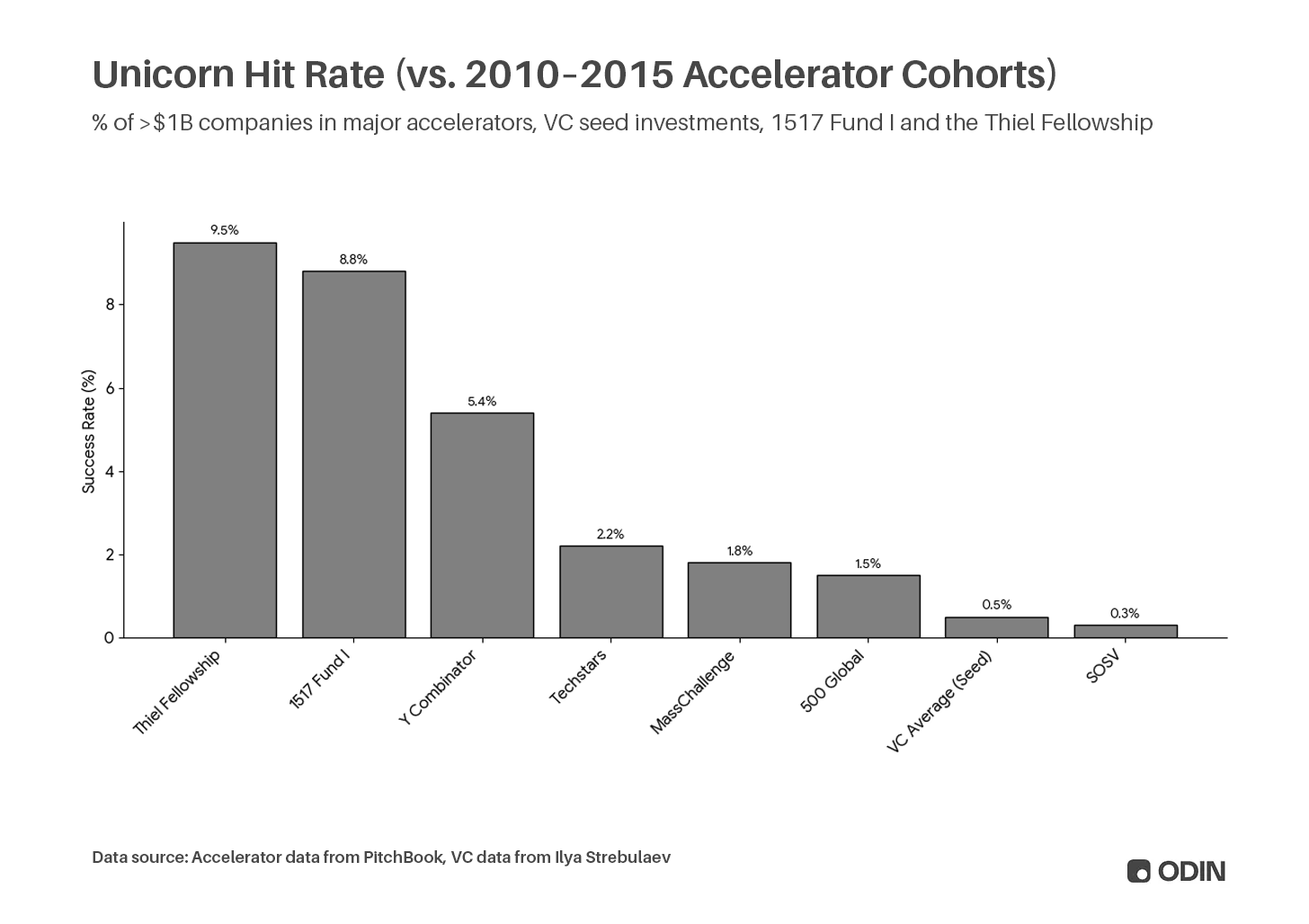
Fund I’s internal rate of return is 38.86%. The Cambridge Associates benchmark for the top 5% of 2015-vintage venture funds is 34.99% (as of 2025). The total value to paid-in (TVPI) multiple of 9.65 times is roughly three to four times higher than even 90th-percentile funds from comparable vintages.
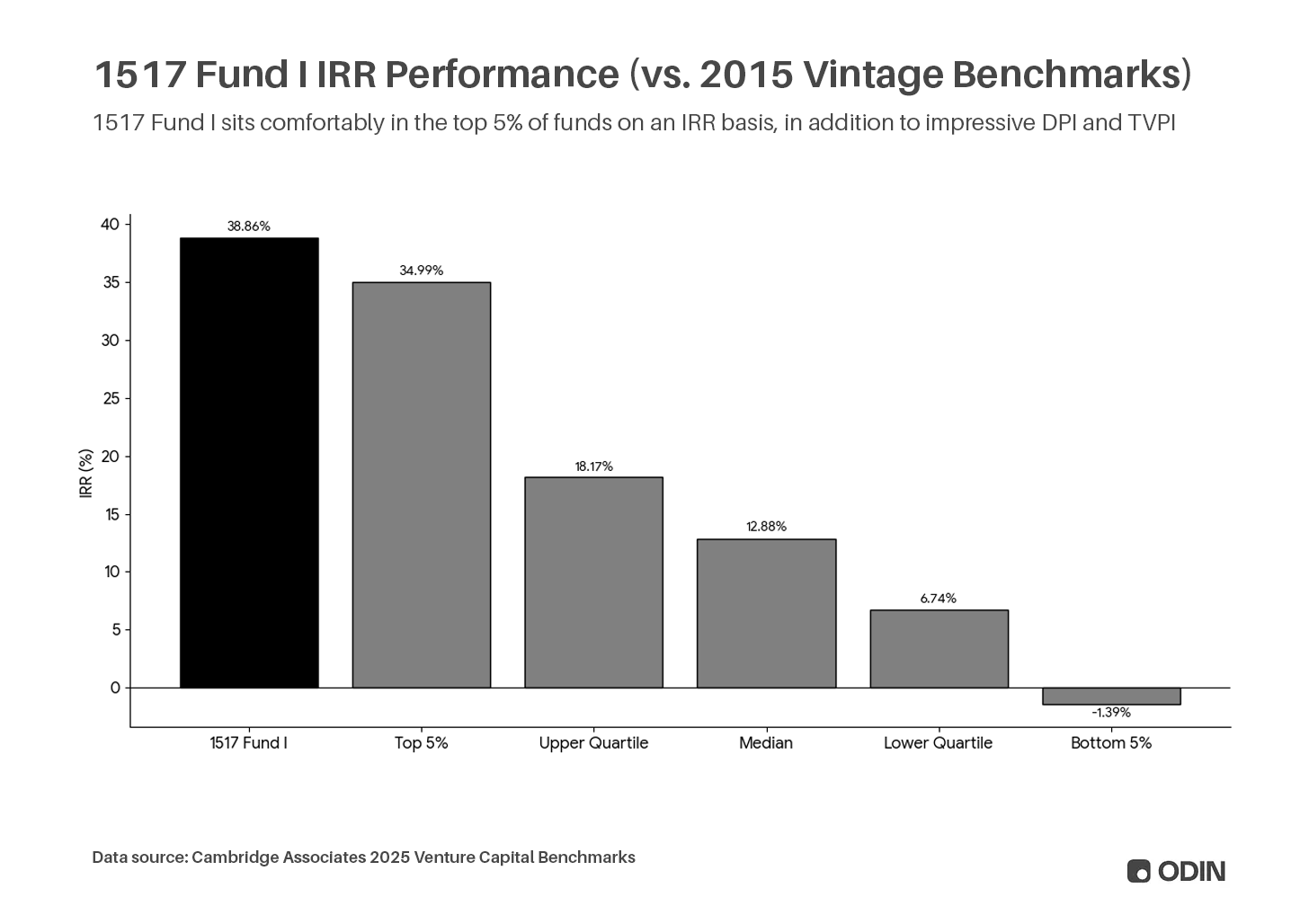
The most striking figure in today’s liquidity-starved environment is the distributed-to-paid-in (DPI) ratio of 4.41x. Their Limited partners have already received, in actual cash, more than four times the capital they committed, with substantial unrealized value remaining (roughly another 5.24x). Industry research consistently shows that even top-quartile venture funds often struggle to distribute 2x cash to their investors, while time to full liquidity is stretching from 16-20 years. These results, in roughly a decade, are excellent.
The secret to 1517’s success is that there were virtually no other institutional investors in the room. The so-called “tier-1” firms don’t send partners to coffee shops to talk to teenagers, as Gibson and Strachman have. As their portfolio companies have grown, those small initial checks produced have multiples that are very difficult for larger funds to achieve in more competitive deals for more “legible” investments.
And, more importantly, Gibson and Strachman gave these founders a chance when the industry as a whole would not. Without the early belief of true adventure capitalists, they may never have found their way to building a company, or they might have ended up pivoting to a worse version of their idea which could fundraise more easily.
Manifesting Science Fiction
“Younger and younger people are working on harder and harder problems and getting to the frontier of knowledge. The best is definitely yet to come.”
1517’s portfolio is growing with founders who combine the dropout audacity of the Thiel Fellowship with the frontier-science ambition of the renegade scientists.
In each of the examples below, 1517 invested in the founders ahead of anyone else, facilitating their path into programs like the Thiel Fellowship or their connection to later investors.
Positron AI
Thomas Sohmers, a 2013 Thiel Fellow, dropped out of high school at 17 to found chip startup REX Computing. He went on to serve as Principal Hardware Architect at Lambda (a 1517 portfolio company), then Director of Technology Strategy at Groq, before co-founding Positron AI in 2023 with Chief Scientist Edward Kmett. They recruited Lambda’s former COO Mitesh Agrawal as CEO. Their product, Atlas, is a U.S.-manufactured inference system delivering roughly 3x more tokens per watt than Nvidia GPUs.
1517 has participated in every round. In under two years Positron crossed a billion dollars in valuation, with strategic backing from the Qatar Investment Authority and Arm. Customers include Cloudflare, and the next-generation Titan system, built on Positron’s custom Asimov silicon and designed to run 16-trillion-parameter models, targets tape-out in late 2026.
Mach Industries
Ethan Thornton started building weapons prototypes in a high school workshop, dropped out of MIT at 19, became a Thiel Fellow on the recommendation of Strachman and GIbson, and founded Mach Industries in 2023 to build a vertically integrated industrial base for unmanned warfare. The product line includes Viper, a jet-powered VTOL strike aircraft reportedly 300x cheaper than traditional UAVs; Glide, a high-altitude precision glider; and Stratos, an extreme-altitude sensing satellite. Mach was selected by the Army Applications Laboratory to develop a vertical takeoff cruise missile, and has opened a 115,000-square-foot factory in Huntington Beach, the first node in a planned network of distributed manufacturing facilities.
1517 was the first money in, followed by Champion Hill Ventures. Sequoia then wrote its first-ever defense check into the seed round. Bedrock, Khosla Ventures, and Sequoia have since pushed total funding to roughly $185 million at a $470 million valuation.
Rainmaker
Augustus Doricko, a UC Berkeley physics dropout and 2024 Thiel Fellow (again on the recommendation of Gibson and Strachman, founded Rainmaker in 2023 to modernize cloud seeding, a technique invented in 1946 but historically imprecise and hard to verify. Rainmaker deploys autonomous drone fleets guided by numerical weather modeling and radar validation to seed specific clouds with measurable results. Now 25, Doricko leads 120 employees and holds contracts with the Utah Department of Natural Resources, Colorado, and Santa Barbara County. His biggest test is underway, generating snow over Utah’s Bear River Basin to help rescue the shrinking Great Salt Lake, which has lost over 800 square miles of surface area in four decades.
Following their initial check, 1517 invested in the seed round alongside Garry Tan and Balaji Srinivasan. Chris Sacca’s Lowercarbon Capital led the Series A, with Naval Ravikant also participating, bringing total funding to $31.3 million.
Trilobio
Roya Amini-Naieni led synthetic biology competition teams in high school, founded a biohacker space at Harvey Mudd College, and received a $100,000 grant from Alexis Ohanian’s 776 Foundation, all before co-founding Trilobio in 2021 with Maximilian Schommer. They developed modular robots called Trilobots paired with Trilobio OS, a no-code platform that lets scientists enter experimental protocols as naturally as writing a lab notebook, then walk away while the machines execute every step. An estimated 77% of biologists cannot reproduce their own or others’ research. Trilobots are designed so any protocol run on one system replicates exactly in any Trilobio-enabled lab worldwide.
Following 1517’s investment, Initialized Capital led the oversubscribed seed round in May 2025, with Argon Ventures and Lowercarbon Capital participating. The company is early-stage, but sits at the convergence of AI-driven drug discovery, the synthetic biology boom, and a growing recognition that lab infrastructure has not kept pace with computational tools.
There’s no venture industry trend to connect Positron, Mach, Rainmaker, and Trilobio. Instead, they all fit an enduring thesis on founder quality, proven across 15 years. Each was started by someone in their late teens or early twenties. Each founder chose to learn by taking action, rather than by seeking credentials. Each is working on problems that sound like science fiction (advanced silicon, autonomous weapons factories, drone-piloted rainfall, robotic biology labs) yet each has attracted serious institutional capital (Sequoia, Khosla, Lowercarbon, Initialized) within months of 1517’s early check.
1517’s strategy has remained consistent across the decade: arrive first, invest early, let the market catch up.
The Anti-Establishment Educational Institution
“At some point in the last fifty years, our culture flipped. Dedication to the truth became the counterculture. The establishment became denial. For us as a venture capital fund, the truth became profitable.”
The fund describes itself as “technically a venture capital fund, but we like to think of ourselves as an anti-establishment educational institution.” This is more than branding.
The Medici Grant program, named after the Renaissance family’s patronage of art and science, distributes $1,000 no-strings-attached grants to teenagers, college students, and dropouts working on passion projects. Applicants submit a five-minute Loom video. No equity is taken, no intellectual property claimed, no reporting required. More than 3,000 of these micro-grants have been issued. Phoebe Yao received one and went on to raise $4.5 million for her company Pareto.
The Invisible College program, named after the 1640s precursor to the Royal Society, provides $50,000 investments to independent young scientists and founders to run experiments that might become products. At least one founder must lack a college degree.
The community events trace back to the original Under 20 Summit that Strachman created at the Thiel Fellowship, the first of which was held at Mission High School in San Francisco on July 14, 2012, with more than 150 attendees. The Escape from Captivity summit in July 2022 marked the 10th anniversary. The firm runs teen founder coffee hours, city meetups, something called the Santarchy Ball, and a 1517 Flux Cohort launched in 2024.
All of this serves the central insight that Gibson and Strachman carried out of the Thiel Fellowship: traditional credentials (GPAs, test scores, Ivy League pedigrees) are poor predictors of entrepreneurial success. Character, obsessive curiosity, and what Strachman calls “dog on a leash energy” matter far more. The broken credentialing system misprices talent, and a mispriced market is exactly where a small, contrarian fund can generate alpha.
The Medici Family of Venture Capital
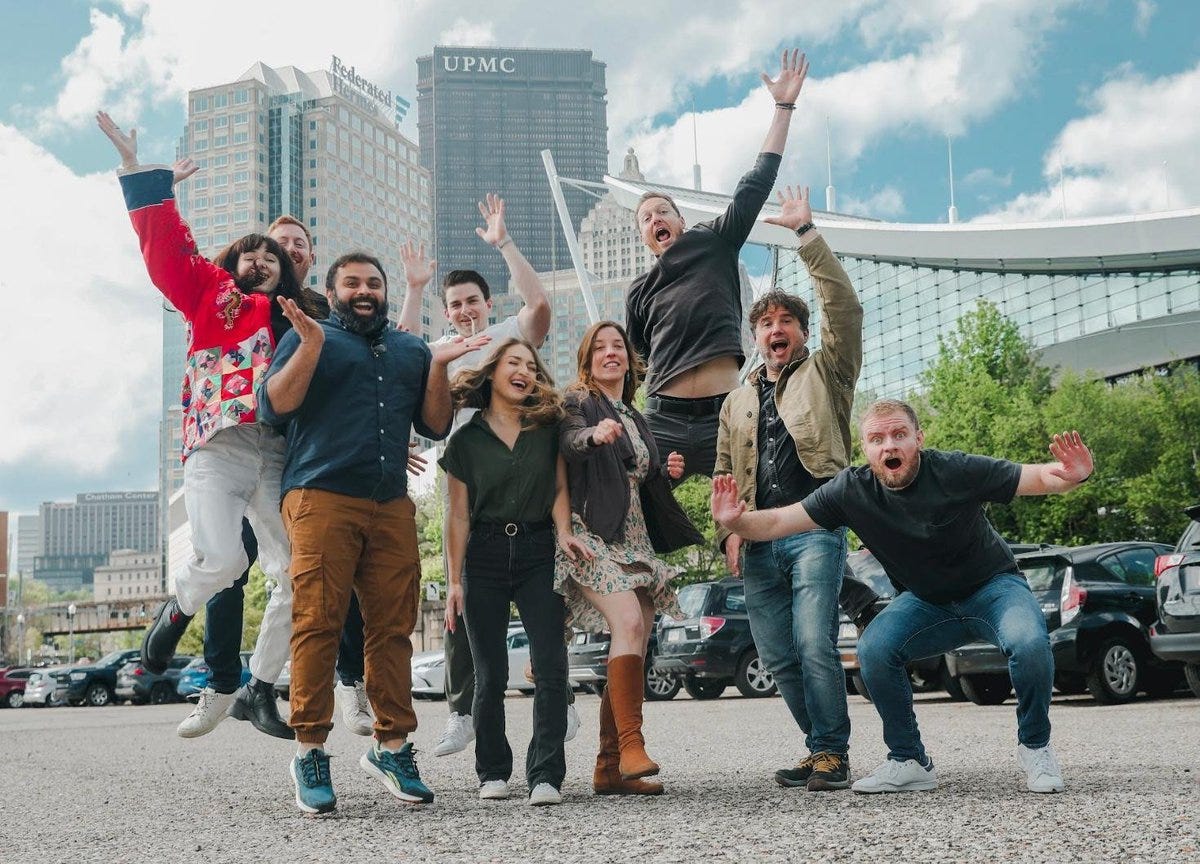
1517 is an unusual firm, built on an enduring philosophical conviction rather than a cyclical market thesis.
Gibson and Strachman spent five years inside the Thiel Fellowship watching young people without credentials build billion-dollar companies when the establishment insisted it couldn’t be done. They turned that observation into a fund, named it after history’s most famous challenge to institutional paper authority, and have proceeded to generate returns that place them among the top-performing firms of any vintage year.
Investing at the earliest possible stage in founders the rest of the industry routinely ignores (teenagers, dropouts, people without the credentials that signal “safe bet” to conventional VCs) 1517 accesses a talent pool with virtually no competition. Indeed, every investor who passes on a young dropout because they lack pedigree or experience is leaving money on the table.
1517’s performance suggests the pile of money left on that particular table was, and still is, very large.
As Strachman once put it, with the cheerful extremism of someone who has been vindicated by outperformance:
“In the future, I want to be funding 11-year-olds. The world won’t be ready, but I will be.”
Starting your own renegade VC fund? Deploy capital seamlessly with Odin