This week we shared our open letter addressing the consultation on fund regulation in the UK.
The cost of forming and operating a fund in the UK is far too high. Authorisation requirements under the Alternative Investment Fund Managers (AIFM) regime are effectively a prohibition on the micro funds that the startup economy relies on for discovery.
The US offers a simple solution with their Exempt Reporting Adviser (ERA) regime, removing the burden of authorisation and enabling smaller funds to flourish. By adopting a similar approach, the UK would develop a broader and stronger base for innovation.
If you would like to read the proposal and sign the letter, you can do so here:

In August, the UK government set out its goal of “growth in every postcode”, involving plans to back early-stage venture capital outside London.
While all support for emerging managers is welcome, simply committing more public capital does not reach the root of the problem; subsidised supply is not a sustainable solution for a lack of demand.
The deeper issue holding back the UK’s venture-funded technology ecosystem, particularly outside of London, is the high cost barrier for small funds.
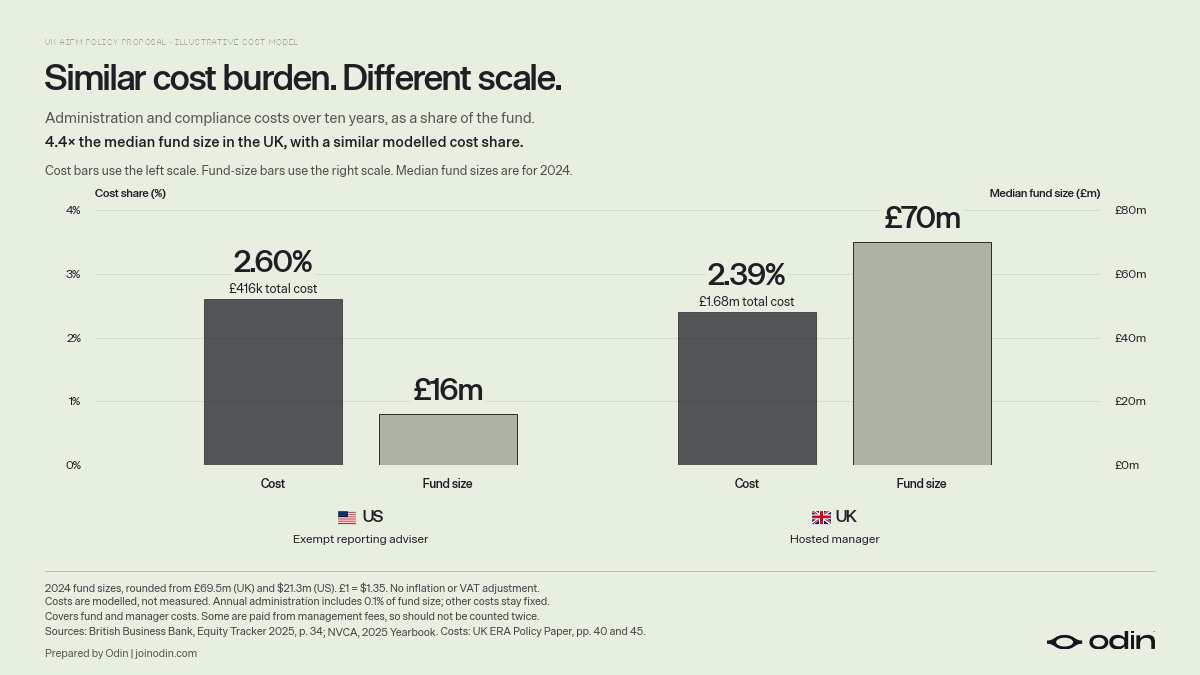
Consider that the median UK VC fund is £70M, versus just $21M (£16M) in the US.
Why does the world’s richest ecosystem have much smaller funds than its transatlantic cousin that operates at roughly a twentieth of the scale?
Surface Area
At its best, venture capital is a process of incremental allocation, allowing investors to test ideas with huge economic potential and an extreme risk of total failure. While the majority are destined to fail, the handful of successes more than make up for it.
Implicitly, this requires casting a wide net. Venture capital must be accessible anywhere, in any industry, to founders of any background, so the only remaining selection criteria is merit. Any constraint on access is a leakage of opportunity.
Indeed, the success of US venture capital has been built on the backs of thousands of small firms. This diffusive layer is the mechanism by which large pools of institutional capital can reach great founders, wherever they may be. It’s an exercise in expanding the intellectual bandwidth and risk appetite of investors to maximise discovery.
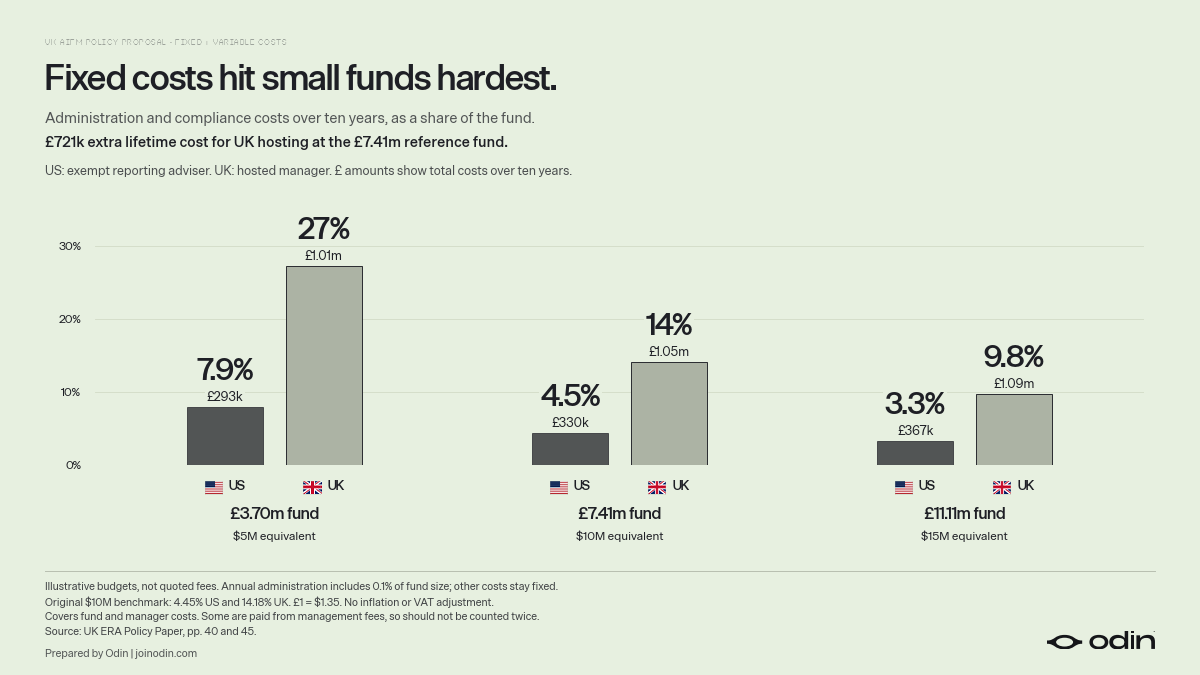
Unfortunately, fund managers in the UK face a hurdle of authorisation which consumes a huge percentage of their fund capacity. A $10M fund in the US loses about 4.5% to admin and compliance costs, versus up to 14% in the UK. The mostly fixed nature of these costs means it’s even more painful for smaller funds.
The Stakes
Today, Wayve is worth about £6.5 billion, Wise about £8.8 billion, and ElevenLabs about £8.3 billion. There’s also Revolut at £86 billion, and DeepMind that could be roughly estimated (now as a part of Google’s AI effort) as somewhere between £50 to £100 billion. These are the most significant success stories of UK tech today.
Collectively, these five companies are estimated to pay somewhere around £750 million to the state each year, in various forms of tax. They employ 30,000 of the brightest and most hardworking individuals as global beacons for talent.
Not only that, they have each distributed their success amongst employees. Generous equity compensation packages have rewarded long hours and hard problems with significant wealth, creating future generations of founders and potential investors.
They each have one other thing in common: they had to find early investors who believed in them before any bank was willing to underwrite their vision. Each raised their first institutional round in the £1-2M range, at valuations of £5-10M, and have collectively grown roughly 7000x in value in the years since.
These are success stories, but they should be viewed as the survivors of a dysfunctional system rather than evidence that all is well.
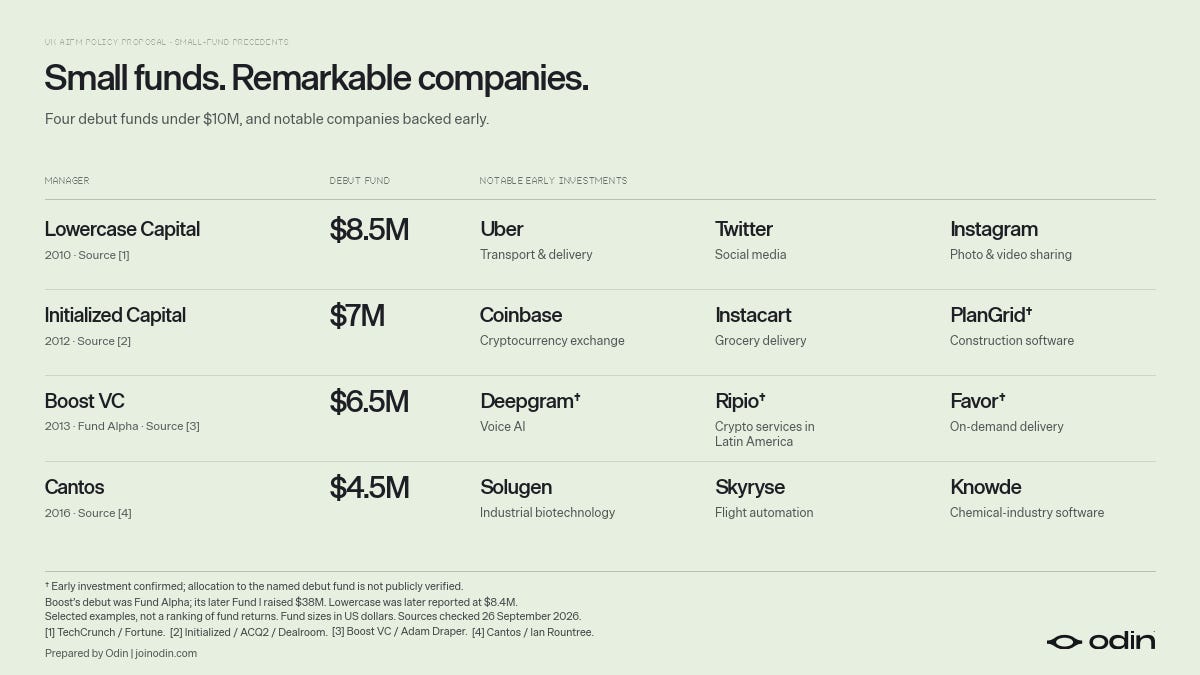
There is no easy way to quantify the cost of missed opportunity except by comparison to a more rational market order in the US. For example, the debut funds of legendary firms like Lowercase , Initialized, Boost VC and Cantos would have been remarkably difficult to raise in the UK.
The paradox here is that in the UK regulates with an intent to protect investors, and in doing so it makes failure more expensive and no less likely. First-time fund managers must put more money at risk in order to prove their ability, simultaneously making the market more risk averse, hurting returns.
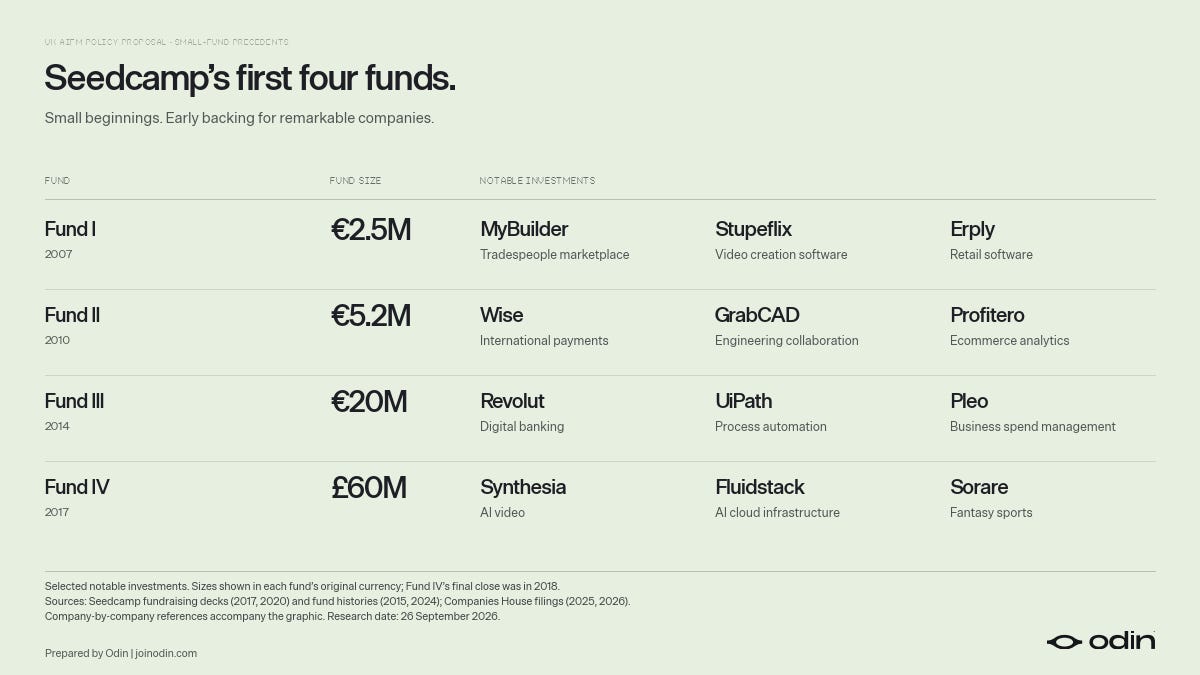
To use an exmaple that comes from closer to home, there is perhaps the most important early-stage firm in the UK: Seedcamp.
Across their first four funds, Seedcamp was an investor in some of Europe’s largest startup success stories, including Wise and Revolut. Had they gotten started in the years after AIFM came into force, their earlier funds of just €2.5M and €5.2M would have been far more difficult to justify relative to the costs involved.
Another perspective on this issue is to look at the broad outperformance of small and emerging managers. These firms have a number of structural advantages, being more agile than their larger peers and often closer to the metal of innovation. It is relatively easy, for example, for a US specialist in a field like robotics or biotech to raise a $3M fund to invest alongside their dayjob.
In the UK, this edge is sacrificed in the name of regulation, despite these firms targeting sophisticated investors who understand the risk and illiquidity of private markets.

Deregulating for Growth
The government can choose to keep pouring capital into markets that investors have deemed insufficiently appealing, or they can focus their time and legislative efforts on making those markets more appealing. The former solves a short-term optics problem with investment volume, while the latter supports meaningful growth.
Indeed, a large chunk of the capital that the government is currently devoting to emerging managers will end up being sacrificed to these unnecessary costs. This is essentially leakage out of the market; a structural cost to every firm that results in higher fees, reduced investment and weaker performance.
The argument for regulation is that it protects investors. Investors in venture capital funds must already be at least self-certified sophisticated (the same requirement for investing in equity crowdfunding). They’re investing in a vehicle which is likely to take more than a decade to return capital. This is not a seductive get-rich-quick proposition; average returns across venture should put off all but the most keen.
The problem with AIFM regulation as it stands today is that it is disproportionately punitive to the small firms which provide the critical interface between capital and talent. These firms are the surface area for opportunity, and without it the market will continue to concentrate around the “safest” investments.
The remedy of an ERA-style regime is straightforward, proven, and easily implemented if the relevant bodies are receptive to these arguments. It is a critical correction if the goal of growth in every postcode is to be tackled seriously.
So, we invite you to read the open letter, check out the details of the proposal, and — assuming you are supportive — add your signature to the list.
Thank you.

Run your investment firm from your phone, with Odin