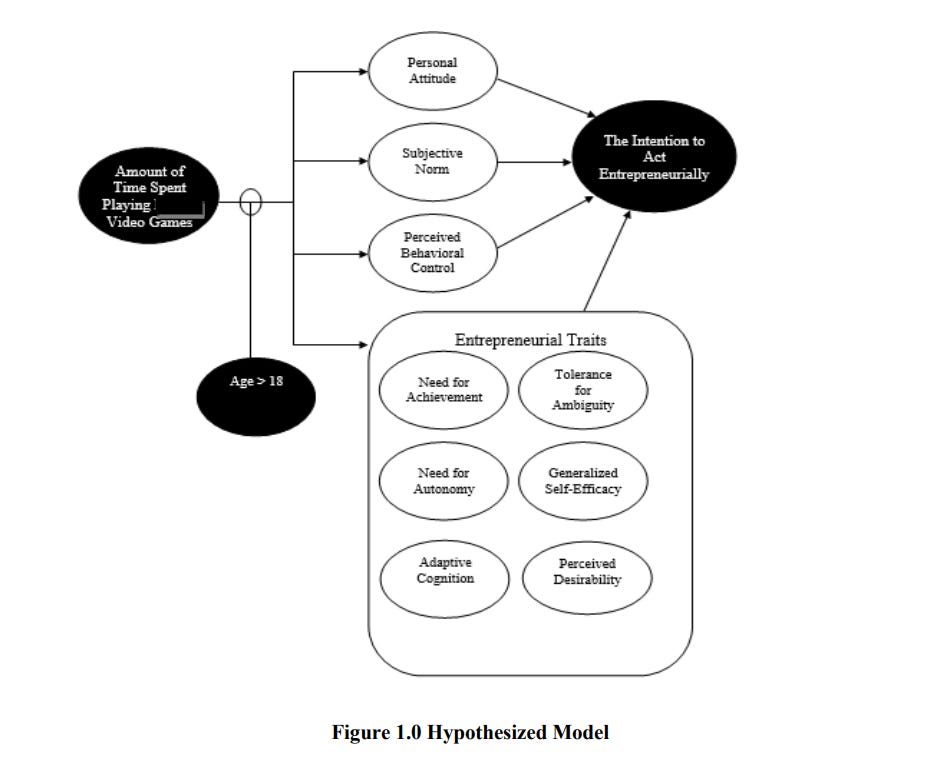
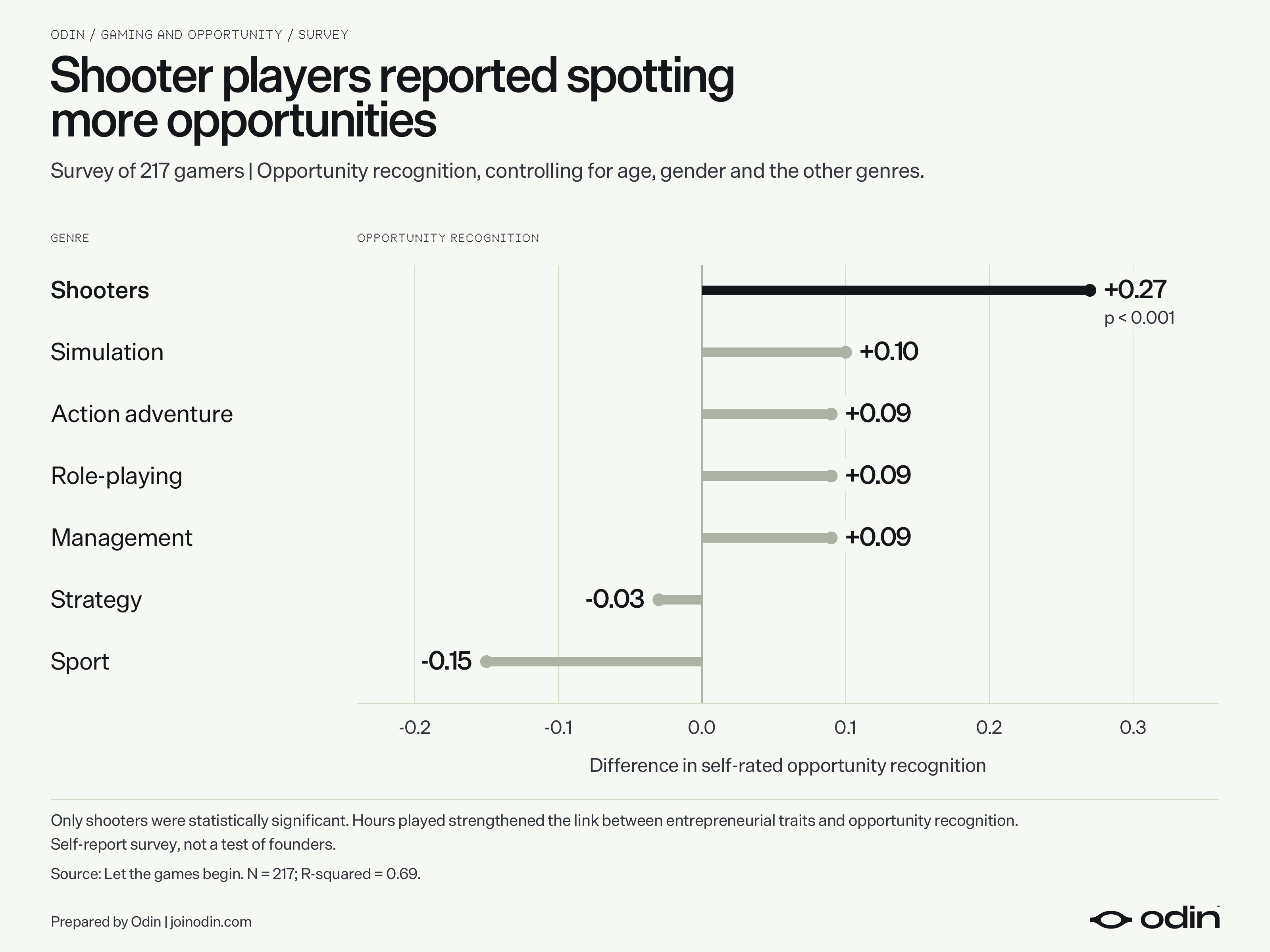
“The results of this study suggest that an individual who exhibits a high level of entrepreneurial orientation has an enhanced opportunity recognition capability when the intensity of playing video games is also high.”
Let the games begin: The relationship between video gaming and entrepreneurial mindsets (2021)
Fred Ehrsam. Max Junestrand. Tobias Lütke. Aidan Gomez. Dennis Fong. Elon Musk.
Six individuals with two common features: they are each highly successful founders with a history in competitive gaming.
It’s a trend that is likely to persist. From Musk’s Quake tournaments in the 90s to Junestrand’s more recent experience with Dota 2, eSports is ascendant — each year attracting a larger audience of talented young adults with something to prove.
However, it would be a mistake for venture capitalists to assume a simple connection between gaming and entrepreneurial success. The more useful exercise is to identify the underlying features which can be generalised to the evaluation process.

Mind Games
A surprising amount of academic attention has been paid to the transferrable skills of gaming and entrepreneurship, but the core of this relationship is a mindset often expressed as playing to win — a three-word philosophy which shapes the top-performing individuals and teams.
Playing to win is why a player turns up to practice on time, with a good attitude. It’s why they take ownership for mistakes, ensure feedback is constructive, and prioritise the team above personal glory. Importantly, it’s why they would prefer a loss against a competitive team, where the experience is valuable, over a less meaningful victory.
Essentially, it’s a mantra which permits infinitely deferred satisfaction, or tolerance of infinite failure, in the pursuit of a greater goal. It reflects the infinite game mentality of seeking improvement, versus the finite game mentality of merely chasing victories.
“In the context of serious games, good performance in a game should indicate that learning has occurred. We found that growth mindset players performed better than fixed mindset players, their mistakes did not affect their attention to the game, and they read more learning feedback than fixed mindset players. In addition, growth mindset players were more likely to actively seek difficult challenges, which is often essential to self-directed learning.”
Gaming Mindsets: Implicit Theories in Serious Game Learning (2012)
Much of this overlaps with competitive sports, generally, but three major differences explain why gaming is uniquely interesting as a field of study:
There are few barriers to entry. Beyond owning a capable PC and a decent internet connection, nothing prevents any individual from participating. Physical condition and equipment provide marginal gains, rather than being prerequisites.
Gaming is more transparent and meritocratic. If you are very good at something, that is inherently measurable and immediately legible through rankings and reward systems. It doesn’t matter where you are, or who you are.
Competitive teams are (initially) self-regulating and self-coaching. Typically, only teams who are already at an elite level will have a coach or a manager. On the way there, teams must learn to replicate the value of these functions internally.
Competitive games, particularly in team-based settings, provide an effective training ground for all of the skills required to build effective entrepreneurial organisations.
This can be divided into three basic categories:
Reactivity
Strategy
Social mechanics

Reactivity
“One of the world’s most popular first-person shooter games - Counter-Strike - could help to improve people’s cognitive abilities, according to research from the University of Sheffield. The study, by scientists in the University’s School of Psychology, has found that experienced, highly skilled players of the game – which was first released 25 years ago – are faster at decision-making and executing a response. These veterans of the game were also found to be faster at choosing the correct course of action.”
Counter-Strike players faster at decision-making, study shows (2025)
Learning to make high-stakes decisions under pressure is one of the most valuable lessons of competitive gaming. To succeed, players must get used to rapidly accumulating evidence, processing it quickly, and taking action — also known as probabilistic inference.
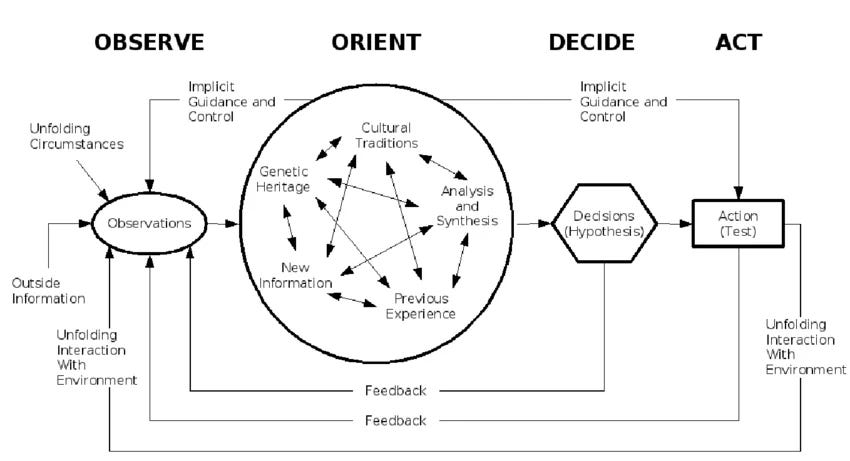
This is reminiscent of the OODA (observe, orient, decide, act) loop framework conceived by a US fighter pilot, John Boyd, which is often applied to business operations. The key insight is that action produces information, and so the ability to move quickly and decisively becomes a meaningful competitive edge.
Playing fast-paced competitive games trains the decision-making muscle, which includes evaluating risk and the cost implied by a choice not made. Delaying decisions which could have been made in the moment becomes an explicit choice of its own, often with worse consequences and a more significant cognitive burden.
Essentially, the upside here is to increase your rate of ‘good decisions per minute’, which fits an environment of rapid execution on a mostly pre-determined framework by removing unproductive hesitation. Of course, this is also likely to increase your marginal rate of bad decisions, which in some circumstances may not be desirable.
This appears to be a relatively easy skill to pick up. One study found that just 50 hours of playing competitive action games led to a measurable increase in the ability of participants to quickly arrive at correct answers.
However, while good choices can be decisive, they are downstream of strategy.

Strategy
“Under controlled laboratory conditions, we asked forty business students to play the Civilization game and to participate in a series of assessment exercises. We find that students who had high scores in the game had better skills related to problem-solving and organizing and planning than the students who had low scores.”
Good gamers, good managers? A proof‑of‑concept study with Sid Meier’s Civilization (2021)
Success or failure may be determined by a series of critical decisions, but the options available are shaped by earlier strategic choices. Strategy dictates the conditions on the field, by balancing forces like economy and aggression.
Similar to the studies on reactivity, the focus is turning information into better outcomes. However, strategy focuses on the macro picture of a continuously evolving decision tree, rather than the micro-management of decisions. This is the big picture, which can inform when a short-term sacrifice may be preferable, for example.
Studies using brain imaging, looking at how gaming stimulates neuroplasticity, found that strategy game players became more specialised in processing task-relevant information. Where conditions required put more focus on task switching and information management, it resulted in greater enhancement of high-level cognition.
“Regions that increased their connectivity strength in video game players are known to be involved in cognitive processes crucial for task performance such as attention, reasoning, and inference.”
In an entrepreneurial context, this has clear parallels to managing financial, technical and human capital, while processing market and customer information. This reflects a founder’s ability to monitor and effectively manage all of these fronts, particularly early in a company’s life or in times of extreme pressure.

Social Mechanics
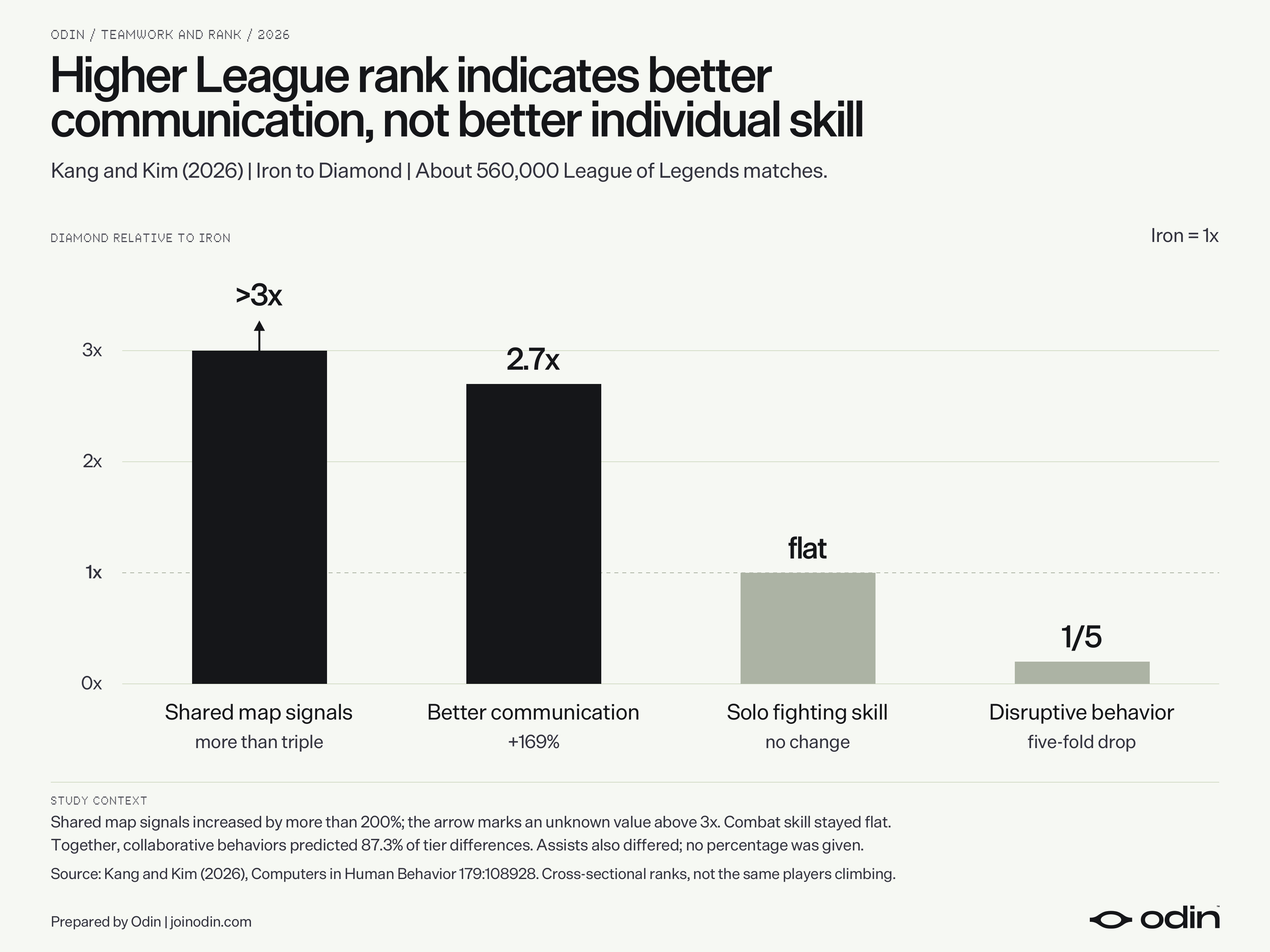
“Collaborative behaviors—vision control, strategic communication, and assists—differentiate tiers far more strongly than individual performance.”
While rectivity is downstream of strategy, strategy itself is downstream of the social mechanics of team games. The best individual skill, and the brightest strategic minds, will not save a team that cannot communicate effectively.
Here, again, gaming is an excellent training ground for this behavior.
Consider the reality of an up-and-coming team in a competitive setting. The path to championship level requires a tempering process of hot streaks followed by strings of difficult losses. It takes a particular mindset to get through that process, for a team to support each other without ego or insecurity, only binding closer together.
There are also similarities in the required leadership skills. Screening and recruiting, managing disagreements, handling scheduling, and knowing when to make a more dramatic change of direction — these areas of responsibility have clear parallels to life in a small entrepreneurial organisation.
Intense team environments also require that players convert individual skill and strategic thinking into precise communication, which itself is a layered skill of understanding signals and priorities.
Handling all of these challenges in a distributed environment, through gaming, is a bit like playing on hard mode. If you can master giving constructive criticism in a high-stakes environment over voice chat or in text, you’ll probably find it relatively easy in-person when you have the benefit of social cues.
“Collaboration among geographically distributed employees requires similar skills to communication among team members of MMORPGs since both forms of communication are: 1) mediated by computer-mediated communication (CMC) channels, and 2) limited in social cues, among other common traits. Due to the similarity of these skills, players may transfer leadership skills honed in MMORPGs to offline contexts as they become leaders in societies of tomorrow, heralding new forms of leadership nurtured in MMORPGs.”
Competition is for Winners
Finally, there’s real value in just understanding competitive spirit.
As venture capital has become more credentialist, both institutionally and through founder selection, it has implicitly become less competitive, and less meritocratic.
Consider a stereotypical journey in 2026:
A founder with a PhD in ML spins out of Meta with an AI inference startup, raising $150M from a megafund and TechCrunch headlines out of the gate. From there, they don’t really need to worry about capital or talent and there’s an entire platform team on standby to support them across core functions.
What competitive pressure does this company face? How long could they survive without even having a real product? What’s the upper limit on the amount of cash they can burn before turning a profit?
Compare this to a more rational market:
A founder tours around venture capital firms until they find a partner who shares their vision and can start to pull together the round. From there, pressure is on to hit milestones, generate traction, and derisk the business so downstream capital can be raised without excessive dilution or friction.
The second scenario sounds less pleasant, but it is necessary.
This is the darwinian selection process which has historically produced the power law of outcomes in venture capital. Most startups are destined to fail, you cannot identify which are the exceptions, and the worst thing you can do is to delay the process of finding out. The field must be narrowed to the most dedicated founders and best ideas.
Similarly, venture capitalists need to reflect on what competition looks like in their own industry. Historical practices like freezing out peers who enable new entrants is not the growth mindset of a winner; it is a reflection of institutional insecurity.
Similarly, the recent conversion of venture capital into a zero-sum game of “winning deals” is a low-ambition, low-agency strategy for losers. Find your own opportunities.
It’s not just founders that stand to benefit from playing to win.
Run your investment firm from your phone, with Odin