
Outperformance in venture capital is directly related to uncertainty; if you’re not taking any risk, you won’t be generating any alpha.
To some, this manifests as maximising risk to maximise returns, which justifies everything from overbidding to neglecting due diligence. This is where venture capital starts to resemble trading, or gambling, rather than investing.
The ability to produce strong, consistent returns is in learning how to properly manage risk.

Risk Management
Most conversations about diversification in venture capital focus on the mathematical distribution of outcomes. Larger portfolios make it more likely you will catch outliers, while smaller portfolios allow for greater concentration which amplifies returns.
This is usually framed as a question of talent versus ego, where investors must decide if they have the picking skill for a concentrated strategy or the humility to present a broader portfolio of investments.
This conflict is where venture capital diverges from other fund strategies.
For PE or public equities, managers will pitch an ambition that is basically in line with the historical top quartile performance. Reasonable targets which are achievable with good strategy and execution.
For venture capital, where the top quartile DPI is 1.5–2x, this just isn’t a compelling proposition for 10–15 years of illiquidity. So, managers make irrational promises of outperformance, which implicitly promote concentration rather than diversification with less extreme upside.
This attitude has undermined any proper examination of portfolio design and diversification in venture capital, and the topic remains poorly understood.
The Baseline
The root of this issue begins with the distribution of outcomes in venture capital.
On average, around 65% of investments are expected to lose money while around 0.5% will return 50x or more. There is no single authoritative tabulation of venture investment returns, but the graph below provides a reasonable illustration:
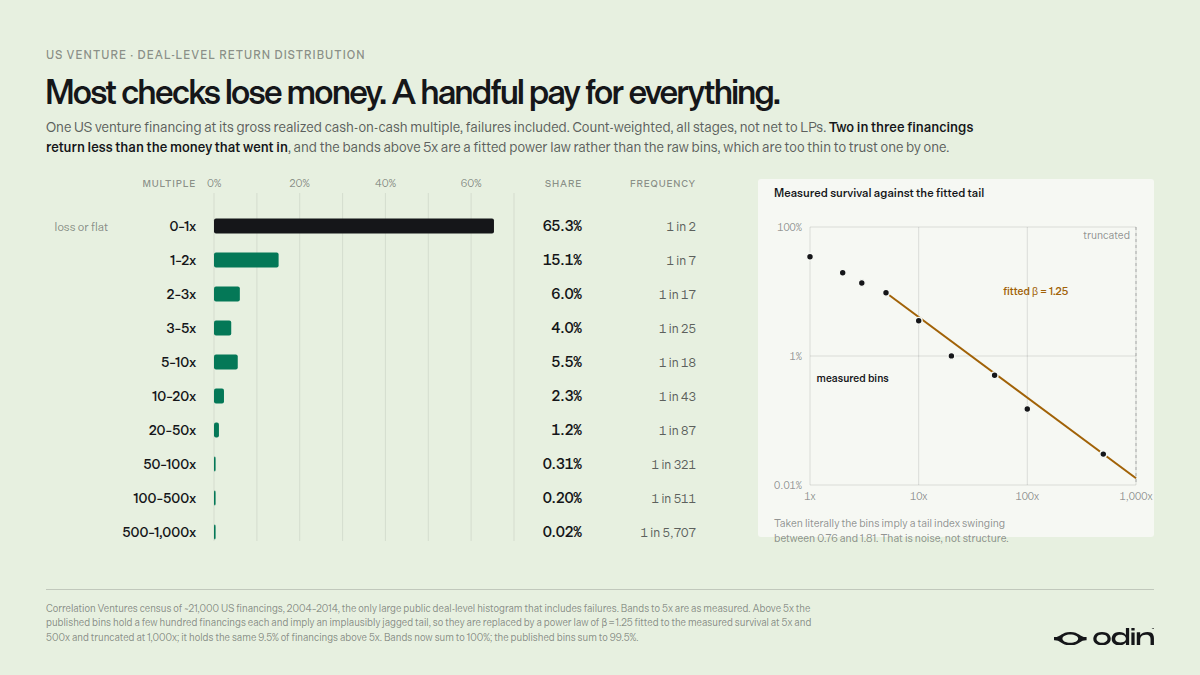
The high rate of total failure is an indication of just how hard it is to predict outcomes.
Investors that are successful enough to be honest will readily admit that they can’t forecast which of their portfolio companies are more likely to succeed.
“After the deployment period for 20VC Fund I, I did an analysis of the portfolio. I predicted the top 5. Three years later, not one of the top 5 is as predicted. The true value from seed is always the messy middle.”
Statistically, this is reflected in the lack of any meaningful correlation between Series A round sizes and their ultimate outcomes. Even once companies have traction, investors aren’t able to predict which are more likely to succeed.
Combining this uncertainty with the large variation in returns from investments, from 0x up to 2000x in extreme cases like Facebook, the case for large portfolios begins to emerge.
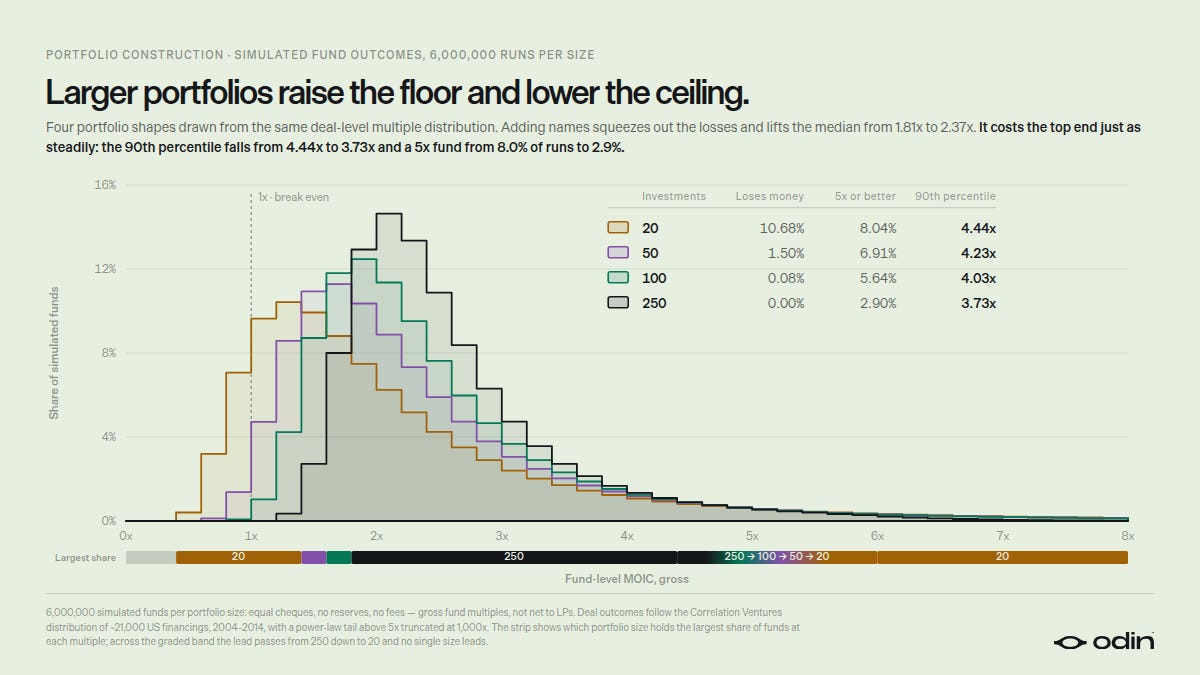
Indeed, if venture capital was to emulate the more mature fund strategies, and offer more rational and achievable promises of performance, it would appear that larger portfolios are logical. A 3–4x fund, which is a top 10%–5% outcome, is more easily achieved through greater diversification.
The graphic above illustrates simulated portfolios based on the distribution of outcomes, and their resulting share of different MOIC bands. Clearly, the larger portfolios generally deliver the highest chance of good performance, while the long tail of great performance is held by the smallest portfolio — although it becomes increasingly less likely.
Consider the median DPI benchmarks from Pitchbook, looking at funds from 2005 to 2015, with data from December 2025:
Bottom quartile: 0.72x
Median: 1.23x
Top quartile: 1.94x
This suggests that venture capital’s fundamental problem is not a lack of 10x funds, but the painfully high rate of 0–1.5x funds that drag down the aggregate performance.
In fact, it’s probably the pursuit of high-risk strategies to deliver large multiples which contributes to so many funds returning less than the cost of capital.
Essentially, venture capital’s failure is built on the silly, recursive notion that funds must also follow a power law curve where there is no sensible middleground.

Swinging for the Fences
The diagnosis, in summary, is that venture capitalist managers are routinely taking unnecessary levels of risk in pursuit of returns that exceed rational expectations.
As a result, there’s a higher rate of absolute failure, and the strategy ends up looking unappealing relative to public market benchmarks.


This coherence is best explained by Daniel Kahneman’s concept, the Illusion of Validity, and manifests as overconfidence.
Overconfidence
In the process of raising a fund, a manager might speak to a hundred prospective LPs. To each, they sell the same promise of outperformance, with some finely crafted story story that justifies why their fund will outperform.
LPs want reasons to feel confident, so confidence is what they get. Such reassurance is best delivered via the medium of simple, coherent stories (which may have very little connection to reality).
“A slow and steady ‘venture is a numbers game’ pitch is much less emotionally compelling than “I am a rock star who can consistently beat the odds.” And GPs need an emotionally appealing pitch to get funded.”
The Pervasive, Head-Scratching, Risk-Exploding Problem With Venture Capital (2020)
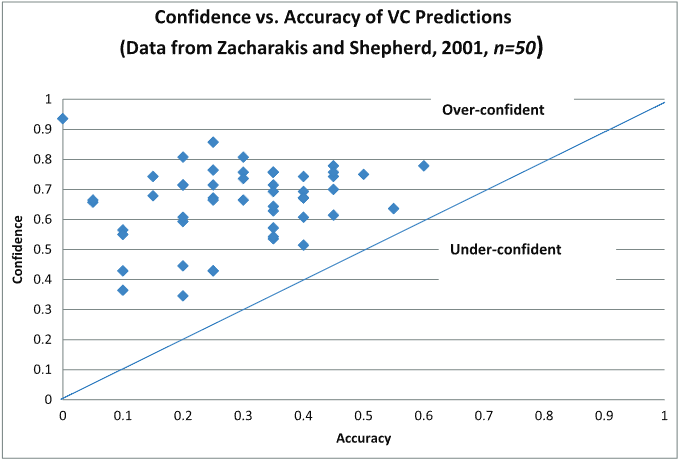
Eventually, and inevitably, the managers end up believing their own hype. As a result, the industry has a chronic issue with overconfidence.
Overconcentration
Translated into portfolio design, overconfidence produces overconcentration as managers allocate capital in a manner that doesn’t reflect the probabilities they are contending with.
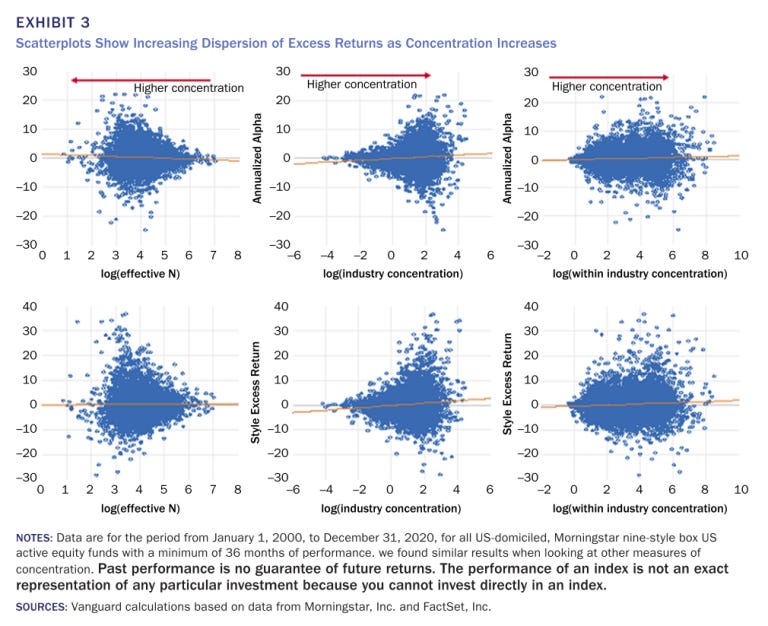
If they’re correct, this concentration pays off with amplified returns. Unfortunately the downside is asymmetric to the upside; concentration hurts when they are wrong more than it helps when they are right.
“We find that increasing concentration has a pronounced positive impact on performance for outperforming funds; the opposite is true for underperforming funds. Most importantly, higher levels of concentration generally hurt the poorly performing funds more than it helps the outperforming funds.”
This habitual overconcentration results in venture capital having the widest spread of potential returns from any investment strategy, and a lower median than most.
Types of Risk
“Entrepreneurs with riskier, possibly early-stage projects are more likely to receive funds from more diversified VC funds. Entrepreneurs are less likely to receive capital at the early stage from highly specialized funds, unless they are run by experienced VC managers. … Entrepreneurs cannot expect VC managers to consider their start-ups an investment in isolation. … The willingness of VC managers to invest will also depend on what else they invested in.”
Diversification, risk, and returns in venture capital (2017)
Having reached this point, it might appear as though the answer is clear; venture capital funds should all target much greater diversification to narrow the band of returns and raise the median across the industry.
Unfortunately nothing is ever so simple, particularly in venture capital.
This analysis has generally treated venture capital as a homogenous industry, when in fact it contains a range of distinct strategies which each play a distinct role.
A fairer interpretation of these results is to say that venture capital should generally be more open to diversified strategies.
Too many LPs look at large portfolios as offering capped upside, when even that “cap” might be an outcome in the top 5% of funds.
Too many Fund of Funds, particularly, believe that diversification at the fund level replaces the need for diversification at the portfolio level.
Too many GPs talk about the importance of being in “the handfull of companies that matter”, when they have absolutely no idea which those companies will end up being.
Fundamentally, the question of diversified versus concentrated will depend on what type of risk a manager is trying to accommodate, which is a question influenced by a range of factors including stage and specialisation.
Idiosyncratic Risk
“We show how technological shocks to the cost of experimentation can play a central role in shaping both the rate and trajectory of startup innovation, by allowing more long shot bets to receive initial funding and thereby also reducing the chance of ‘false negatives’ in the economy.”
Cost of Experimentation and the Evolution of Venture Capital (2018)
Idiosyncratic risk is the product of investing in ideas that are novel, unproven and therefore deeply uncertain. Entirely new technologies or business models, upturning industries or inventing entirely new categories.
Venture capital’s greatest success stories are related to idiosyncratic risk; investors who chose to believe in a founder who was doing something which seemed crazy to others around them. Of course, the majority of venture capital’s failures are also in this category, with many ideas that simply didn’t work out.
This extreme variance of outcomes is naturally dealt with through larger portfolios. Holding many investments in a portfolio allows a manager to back ideas that are fundamentally more boom or bust in nature, which would be dangerous otherwise.
(Our profile of Boost VC is a good example of this strategy at work.)
Execution Risk
“Advising firms is time consuming and creates a trade-off between intensity of advice and portfolio size. … With progressively increasing managerial effort cost, however, a larger number crowds out advice to each individual firm. As they receive less support, entrepreneurs request a larger profit share, making further portfolio expansion eventually unprofitable.”
The optimal portfolio of start-up firms in venture capital finance (2003)
For certain firms, particularly those who focus on specialist fields like life sciences, or those making later-stage investments, the primary concern may be execution risk.
These managers are generally targeting ideas that are technically quite well understood, where the success or failure is more dependent on the quality of execution rather than some inherent feature.
Here, investors will play a more active role in supporting the founders, providing stronger governance and support on subsequent financing events. More often, this will involve leading rounds, providing follow-on capital, and taking board seats.
Implicitly, there is a limit to the number of companies any firm can support at this level, and therefore it favours a more concentrated strategy.
(The Acquired.FM profile of Benchmark is a good lens on this strategy.)
Synergetic Allocation
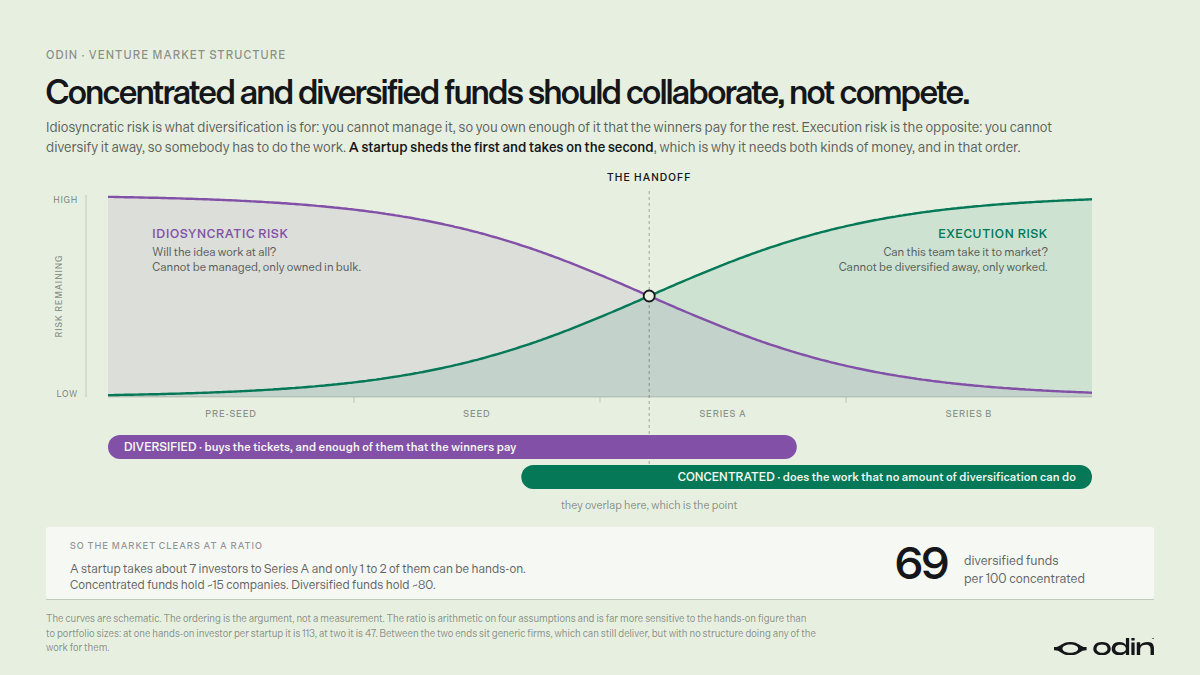
In reality, startups are likely to contain both types of risk.
Early-stage, deeply technical companies will initially carry more idiosyncratic risk and therefore depend more on diversified managers. However, as they develop and shed some of that idiosyncratic risk, future questions shift toward execution.
Implicitly, venture capital needs investors with appetites for both.
There are companies that simply would not get a chance at proving their work without the risk appetite of diversified funds, and there are companies that would not have survived without a concentrated believer in their corner.
So, this is not a question of competing strategies, and a right or wrong way to do venture. The reality is that different investments require different appetites, and there is a natural equilibrium between the two which makes the market function smoothly.
In fact, if we make a few assumptions about portfolio sizes and round structure, it’s possible to determine a hypothetical equilibrium. In the case outlined below, it works out at around 70 diversified funds per 100 concentrated firms.
Where the Buck Stops
Fundamentally, like many of the issues in venture capital, today’s attitude is downstream of LP expectations.
It’s likely that they’ve seen the math which indicates that concentrated funds have the greatest potential for outperformance, and they’ve been drilled with the logic that venture capital is a power law industry — so they draw the natural conclusion and back whoever is willing to sell them the best story of outsized potential.
I suspect if you build an industry around selecting for people who are best at manufacturing confidence (let’s call them “confidence men”, for the sake of argument), you might not end up getting the highest quality outcomes.
Indeed, what LPs have not stopped to consider is that this very attitude is what is warping returns and producing such a weak aggregate result.
Backing managers that have a well-articulated and logical shot at 3–4x DPI, rather than those who will land somewhere between 0–10x DPI, would likely produce a broad and healthy lift in performance which benefits all involved.
Run your investment firm from your phone, with Odin

The concentration-as-magnifier finding has a clean betting analogue: concentration is position sizing, and sizing above your actual predictive edge lowers long-run outcomes even when the edge is real. The Stebbings quote is the empirical version of that. If the best-informed insider cannot rank his own portfolio three years in, the honest estimate of picking edge at seed is close to zero, and the sizing that matches it is broad. What gets priced instead is the story about edge, which is how the widest return spread in asset management ends up paired with one of the lower medians.
You are the Yoda of Venture Knowledge!