
Two months ago we wrote about the difficulty of ranking venture capital firms.
Essentially, without granular cashflow data from every LP, there’s really no way to accurately measure VC performance on the only truly accurate measure: DPI (preferably within contracted fund periods).
Existing rankings look at cumulative exits, funding activity or “unicorn” portfolio companies; rewarding age, scale or volume of activity rather than quality. As a result, these lists consistently feature the same set of multistage platforms at the top.
The challenge is to design a ranking based on observable data which is the best possibe representation of quality.
To invoke Moneyball, the goal is to find the “on-base percentage” for venture capital.
Here, we focus on a few key considerations:
Going public - From SpaceX to NVIDIA and Google, the most important companies all eventually list on public markets. Acquisitions have historically been a secondary consideration, and don’t entirely reflect intrinsic value.
Compounding value - Significant stakes are often held for 4–7 years post-IPO — potentially longer where the firm still has significant conviction about the opportunity. Long-term compounding, across private and public life, helps to smooth volatility and reveal genuine quality.
All models are flawed, but the most useful model should reward firms with a history of backing the world’s most consequential companies, early. This broadly follows the “power law” logic of venture capital, focusing on the most significant outcomes.
So, we add three further considerations to this analysis:
Scale-relative returns - The long-term value generated by investments relative to the capital at risk; looking at the funds under management when the investment was made.
Primary investments - Investments made to support the growth of the company, rather than secondary transactions where an investor buys into a winning company at scale.
Consistent performance - To control for one-hit wonders, the value creation is calculated with ⅓ weighting without the largest position and ⅔ to the total blended result.
The result: We rank firms by the long-term performance of their most successful portfolio companies, relative to capital deployed.
This perspective is not without limitations, but those limitations focus attention on the right question: the durable quality of the resulting companies rather than looking at questionable (and market-sensitive) incremental measures.
It’s also worth stating that this approach overlooks emerging managers, who will naturally have fewer companies who have reached an IPO. It’s not that these firms are less deserving, simply that they are inherently impossible to rank. We continue to believe that most LPs are underallocated to emerging managers.
TL;DR - Truly understanding the compenece of any investor requires evaluating performance with a “weighing machine”, not a “voting machine”.
So, over the past month, we have worked backwards from venture capital’s most successful outcomes to analyse more than 1,100 individual funding rounds, from 1,562 main funds, 488 SPVs, 115 opportunity funds and 737 side vehicles, along with market data on 424 IPOs, from 2014 to October 2026.
Without further ado, the results:
The Top 10 Firms
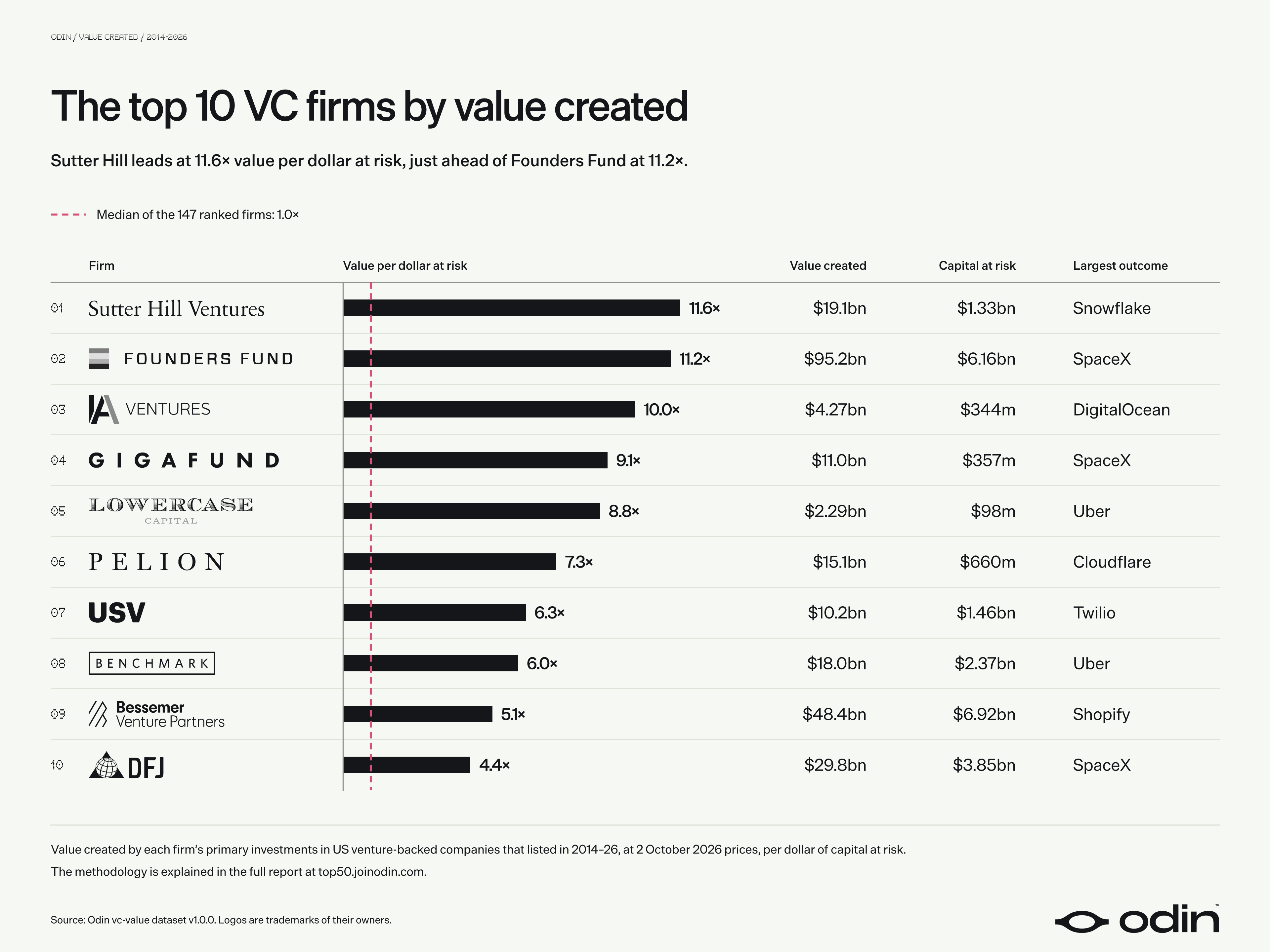
A few things are striking about the firms that top the leaderboard with this methodology.
First, it’s clear that small firms and large firms are both capable of scoring well here. The boutique end is represented by IA Ventures (#3), Gigafund (#4), Lowercase (#5) and Pelion (#6). Mid-sized firms also feature heavily, thanks to Sutter Hill (#1), USV (#7), Benchmark (#8) and DFJ (#10). Finally, Founders Fund (#2) and Bessemer (#9) represent the large funds, although Bessemer is the only true “platform”.
Unsurprisingly, the small firms are highly concentrated. Gigafund and Pelion both have 100% of their value coming from one company, SpaceX and Cloudflare respectively, and Uber is 98% of Lowercase. It is impressive that these firms comfortably place in the top 10 despite the methodology penalising “one-hit wonders”.
Sutter Hill ranks first, ahead of Founders Fund, although the position of the two could be questioned. Sutter Hill has produced slightly more value per dollar in the central estimate, although the ranges overlap and Founders Fund has created more value than any other firm at $95.2 billion.
The Top 10 Funds
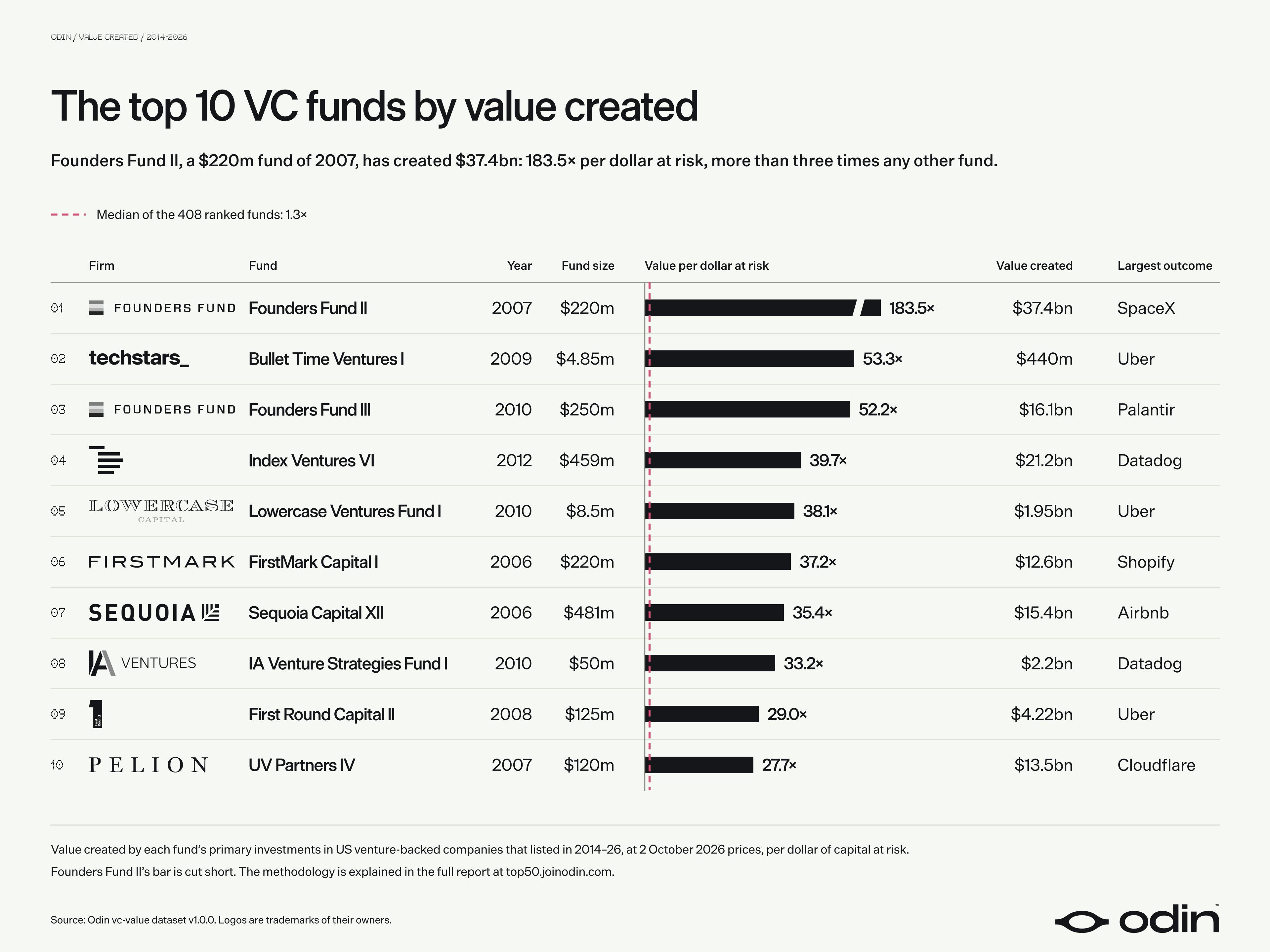
Amongst the top 10 funds, Founders Fund II (#1) is clearly in a league of its own. The long-term value has primarily been created by SpaceX (at 68% of the value), although Palantir, Airbnb and Twilio were also strong performers.
Some small debut funds also feature prominently here, with Bullet Time Ventures I (#2), Lowercase I (#5), and IA Venture Strategies Fund I (#8), along with the larger debut fund FirstMark Capital I (#6). The oldest fund to make the top 10 is Sequoia Capital XII (#7).
The returns from these funds are highly concentrated in a handful of companies, only Index Ventures VI (#4), IA Venture Strategies Fund I and First Round Capital II (#9) are somewhat diversified.
The Top 10 Companies
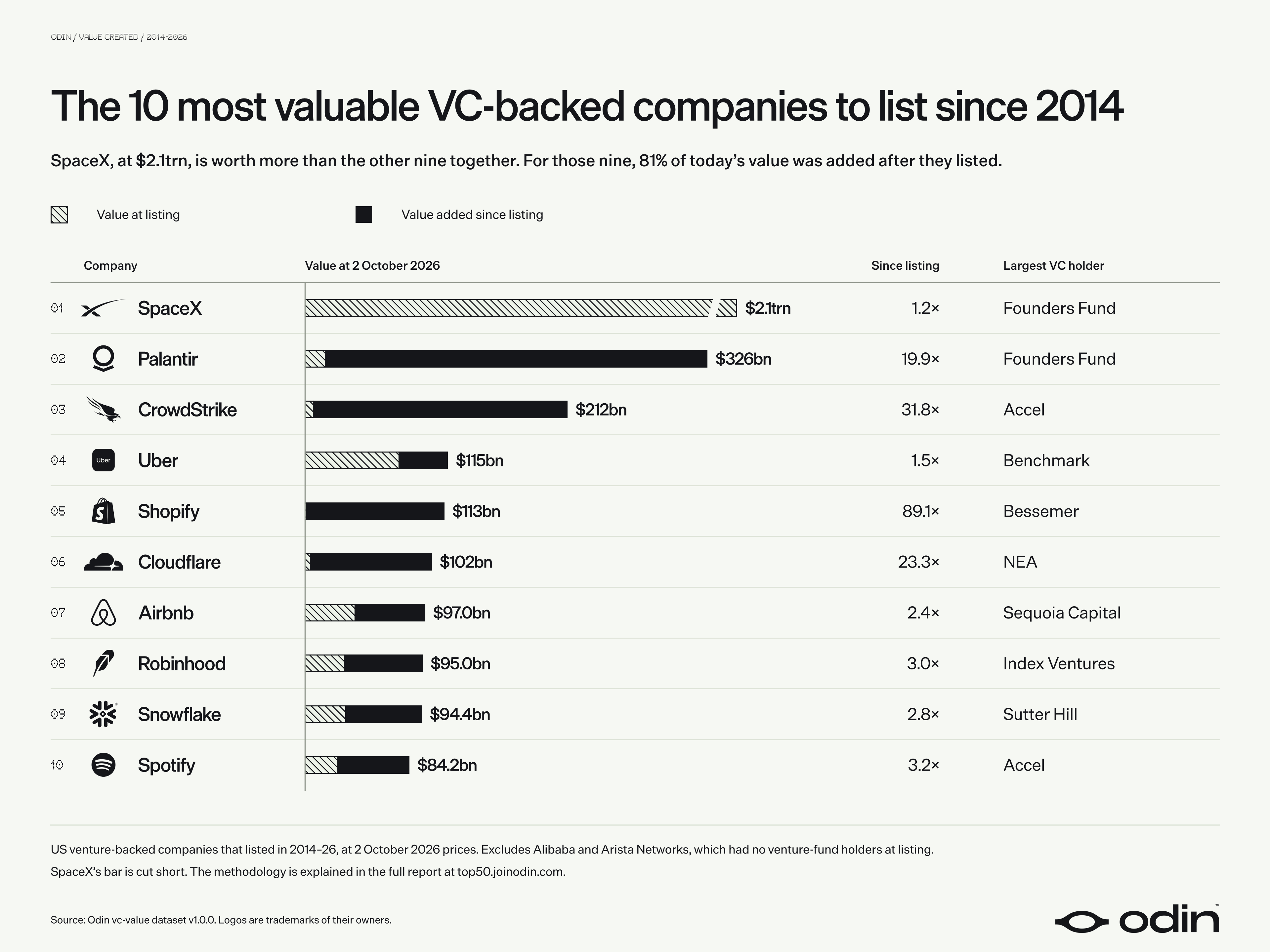
The top 10 companies are defined by (1) extreme concentration (especially SpaceX), (2) a handful of companies that compounded massively after listing, and (3) highly uneven venture ownership, ranging from ~50% stakes down ~11%.
The company with the most VC primary ownership is Cloudflare (#8), at 50.4%, but the company which actually generated the most value for VCs is SpaceX (#1) where VCs had just 10.9% of a primary ownership.
Shopify (#7) has compounded the most since listing, at roughly an 89x multiple. On the other hand, Robinhood (#10) is the only US listing that raised more than $3 billion which has posted positive alpha versus the QQQ.
The Data
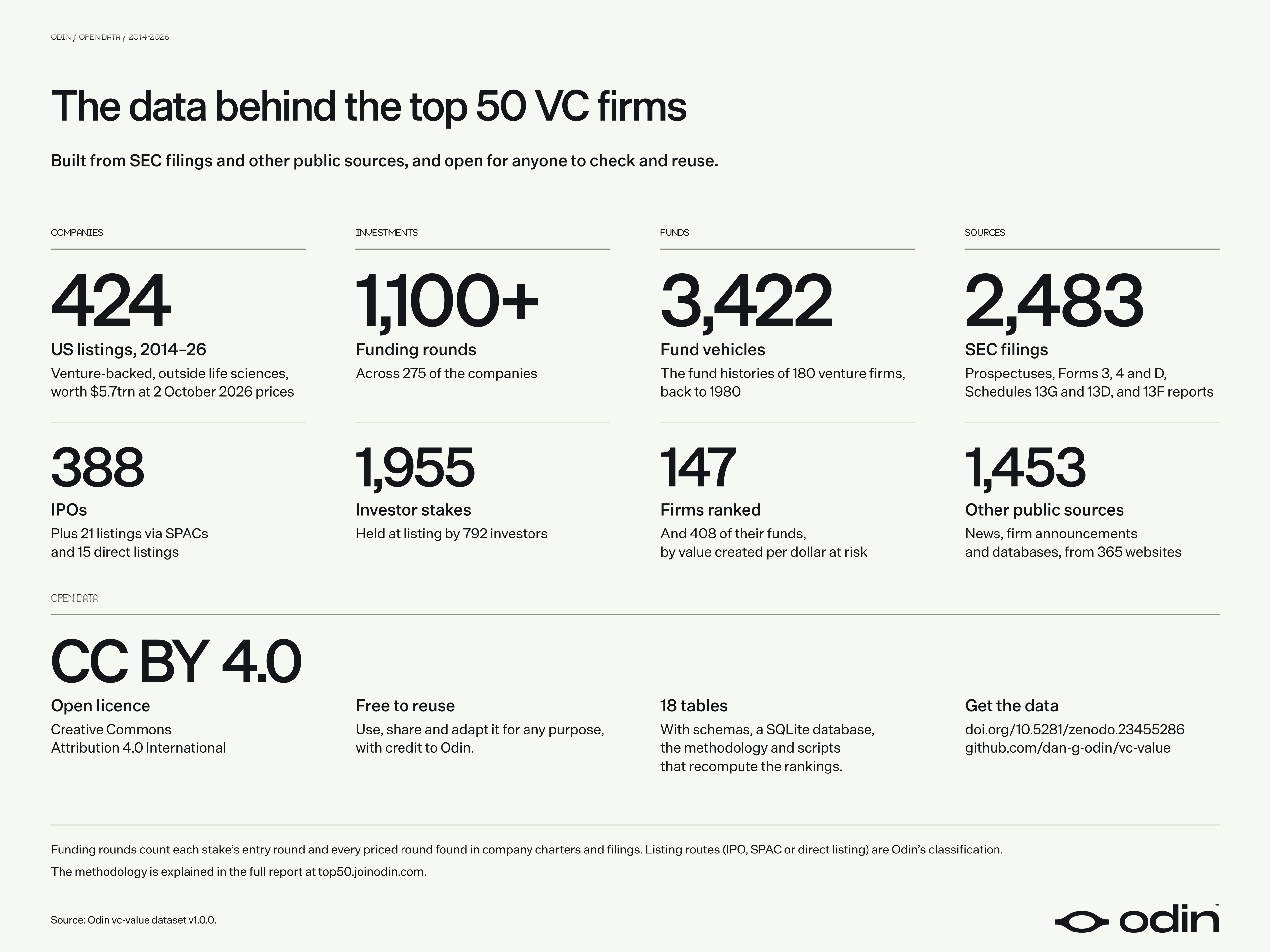
Another issue with many venture capital rankings is that the underlying data may not be clear or auditable.
Like most industry databases, our analysis is based on SEC filings and an aggregation of publicly reported transactions. Unlike those databases, we have released it under CC 4.0. The data is available on GitHub and Zenodo, and users can download the full set, as well as suggesting updates or corrections.
Run your investment firm from your phone, with Odin

bit surprised not to see Long Journey in the top 50
Hi Dan! An interesting read. I think an interesting area to look at in the future would be Solo GPs who have created big outcomes. I think this also shows us very lean venture firms, especially with AI being capable of deal sourcing, market research and diligence I the next set of venture firms will be lean, solo-GP driven. It'll be interesting to compare that vs firms with higher headcount in the context of the sizes of their outcomes.