If you feed today’s venture market parameters into an LLM (compensation dynamics, large liquidity-insensitive LPs, last round marks, etc), it will quickly infer that AUM expansion is the rational strategy.
In fact, the “rogue agent swarm” dynamic is a useful way to cut to the core of incentives and outcomes in complex or opaque markets like venture capital. AI can efficiently surface the unintended consequences of poorly designed systems.
It’s not that autonomous agents will land on different strategies than human users, but they reach the endgame faster and without feeling any need to obfuscate their motive.

Delusions of grandeur
Raise your hand if you’ve heard some version of this statement in the last six months:
“Venture capital seems totally disconnected from reality.”
The market for private technology companies has echoes of 2021, or 1999. This is not simply crying wolf about a bubble; illiquid markets are not prone to the level of volatility seen in public markets where speculative bubbles are most obvious.
However, they may experience what can be described as a “risk bubble”.
“All of this suggests that we are not in a valuation bubble, as the mainstream media seems to think. We are in a risk bubble. Companies are taking on huge burn rates to justify spending the capital they are raising in these enormous financings, putting their long-term viability in jeopardy.”
Bill Gurley, Investors Beware: Today’s $100M+ Late-stage Private Rounds Are Very Different from an IPO (2015)
This is a product of “money chasing deals” — environments where there is more capital than available bandwidth to deploy it responsibly.
There’s a straightforward explanation for this, and it relates to the balance between capital that creates opportunity versus capital that merely competes for it.
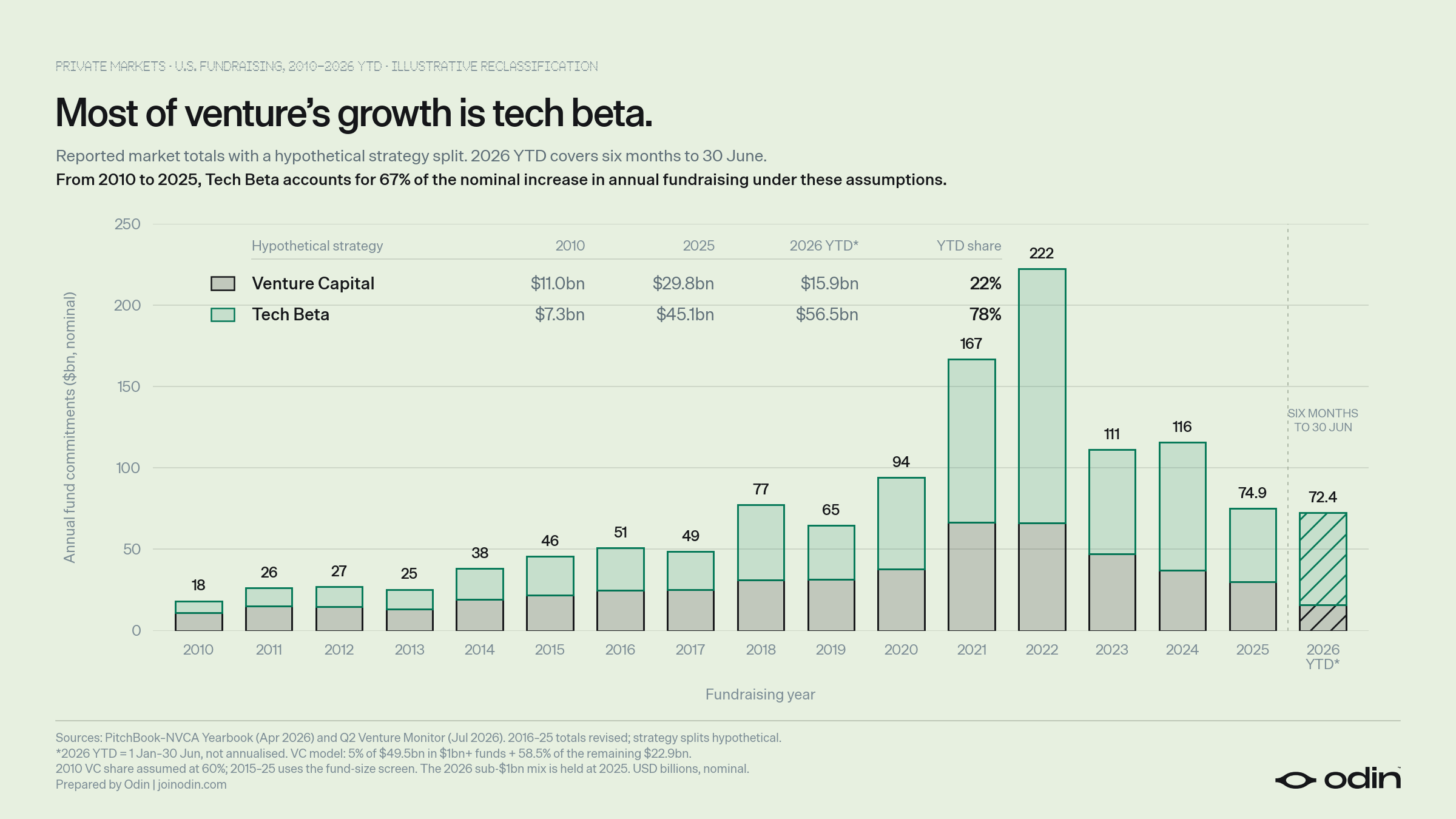
It is visible in the distribution on this chart, which splits the market into “venture capital” (money for experiments) versus “tech beta” (money for winners).
A quick recap from Margot Robbie

In the period of zero interest rates following the Global Financial Crisis, venture capital grew considerably as institutional investors looked for growth beyond their traditional but now saturated investment markets.
In fact, VC fundraising in the US grew about 10x, compared to similar strategies which grew by 3–4x. As a less mature strategy than alternatives, with more opportunism, every dollar on offer was snapped up regardless of viability.
The problem? Venture capital does not scale.
Firms are limited by the bandwidth of partners, and large institutions are unlikely to jump at new managers. Firms found themselves managing rapidly growing sums of capital, struggling to find similarly scalable deployment strategies.
This period, and the mindless greed for management fees, saw a major shift in attitude toward the role of venture capital.
Historically, venture capital was a high-bandwidth strategy where decisions were made over weeks, with intensive consideration and diligence. Founders and investors entered costly long-term partnerships built on conviction.
Sheer volume required a new low-bandwidth strategy, which can be defined as“tech beta”, to cut every corner imaginable. Capital was pumped into the hottest parts of the market, with brand power and scale exploited to access a broad set of competitive opportunities.
Importantly, this low-bandwidth strategy still relied on the underlying network of high-bandwidth investors, building on their prior work to identify the outliers that would drive future returns for the strategy.
This symbiotic relationship lasted until the correction in 2022, when the lack of liquidity gutted the high-bandwidth end of the market whose LPs relied on recycling distributions. What remained were the large liquidity-insensitive institutions and their pet megafunds who were responsible for the collapse of exit activity.
As a result, the venture market has been left managing a vast amount of capital with very little bandwidth to allocate it properly.
Narrowing profiles
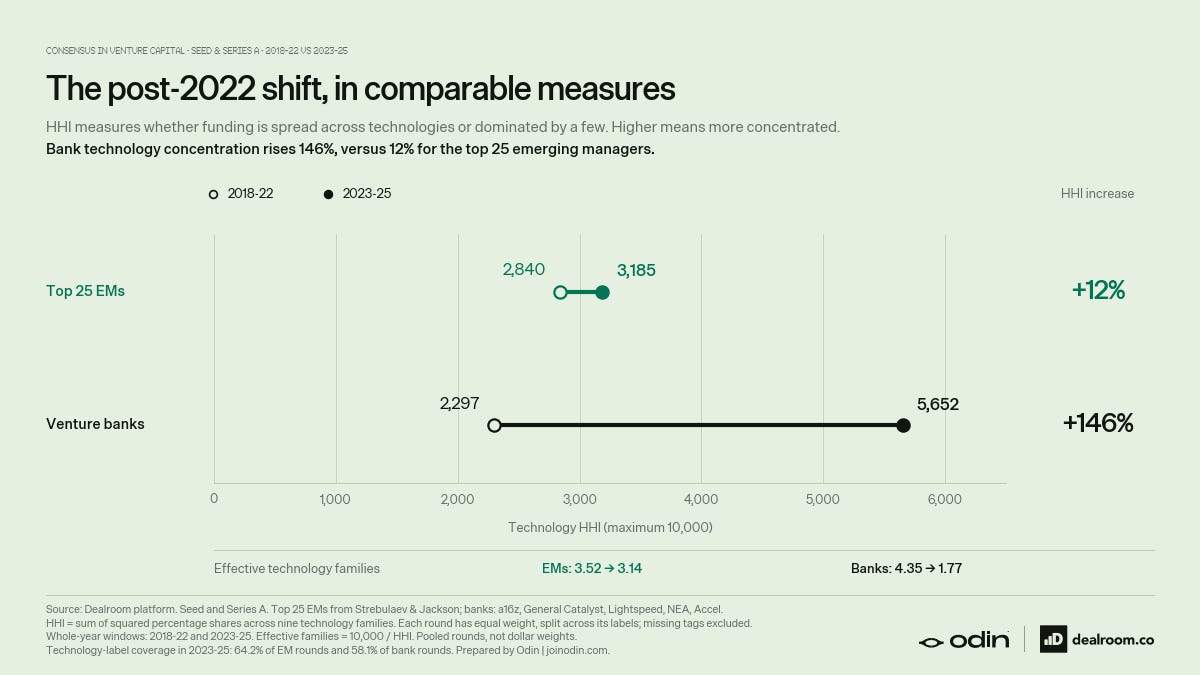
Predictably, more capital in the hands of fewer managers, each with larger funds to deploy, leads to a narrower and hotter market.
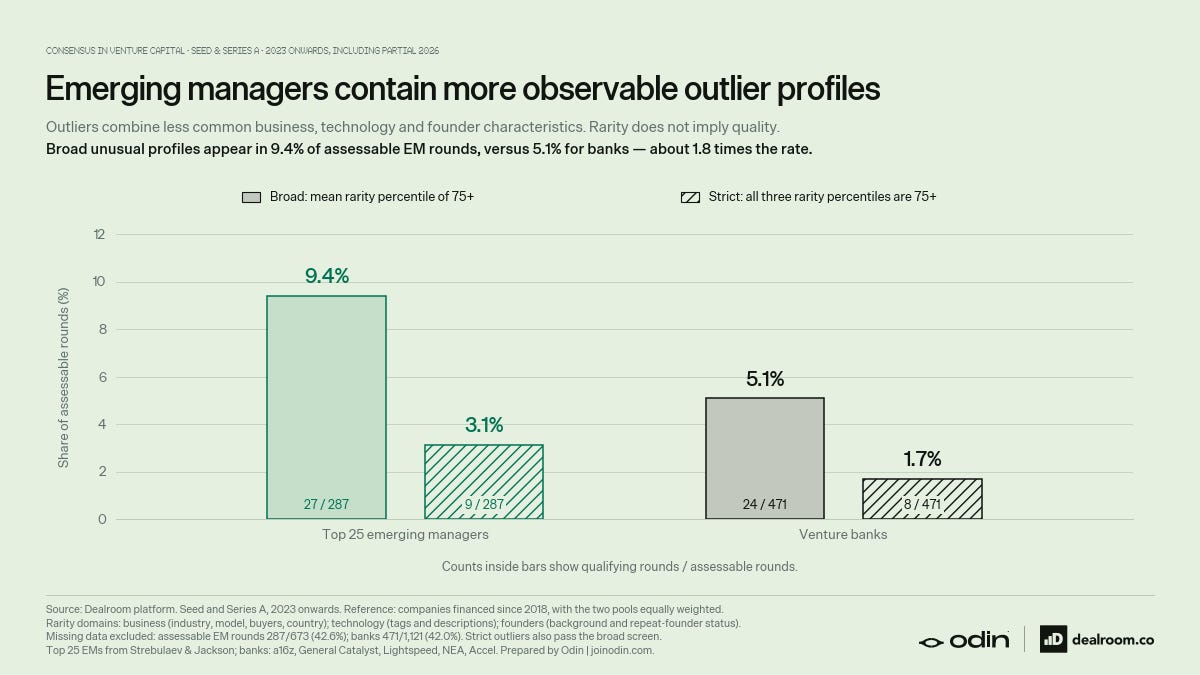
Large firms are structurally more consensus-oriented, less able to identify promising outliers. They compensate for this, on paper, by concentrating capital into a smaller set of companies which produces faster markups and medium-term survivability at a cost to long-term outcomes.
The problem arises when these large pools of capital are formed to lazily invest into the obvious opportunities — but that very mechanism undermines the market’s ability to surface those opportunities.
Where, then, is all of that capital supposed to go?
Interestingly, this predictable narrowing overlaps perfectly with studies on data-driven investing, which is essentially a form of algorithmic consensus. You may therefore imagine that a market run by agents would have a similar outcome.
Now that everyone has access to frontier models, this can be put to the test.

Paperclipping returns
The purpose of tech beta is to make scalable allocation a viable product for large institutions, delivering IRR above their cost of capital.
These institutions are not liquidity-sensitive. Venture is a small percentage of their book, and there are easier places to get cash if they need it. In fact, the illiquidity of private markets is a feature which allows them to smooth overall portfolio performance, otherwise known as laundering volatility.
Q. What is the victory condition for a VC firm in this scenario?
A. Accrue more capital; expand the fee base.
Now imagine that a swarm of agents were set loose on this problem.
Without the need to rationalise markups with liquidity, they quickly converge on focusing the finite resource of capital on a small set of companies — colluding to co-sign markups. This would produce the most reliable and efficient IRR growth, impressing LPs, increasing fund inflows that compound further IRR growth.
This isn’t hypothetical. You can prompt a model with an objective outline of today’s market structure and it will independently conclude that fee maximisation is the goal and self-marking megafunds are the rational strategy.
The model is not primed with objectives like cash returns, or the success of investee companies post a hypothetical exit, and the outcome will sacrifice these dimensions.
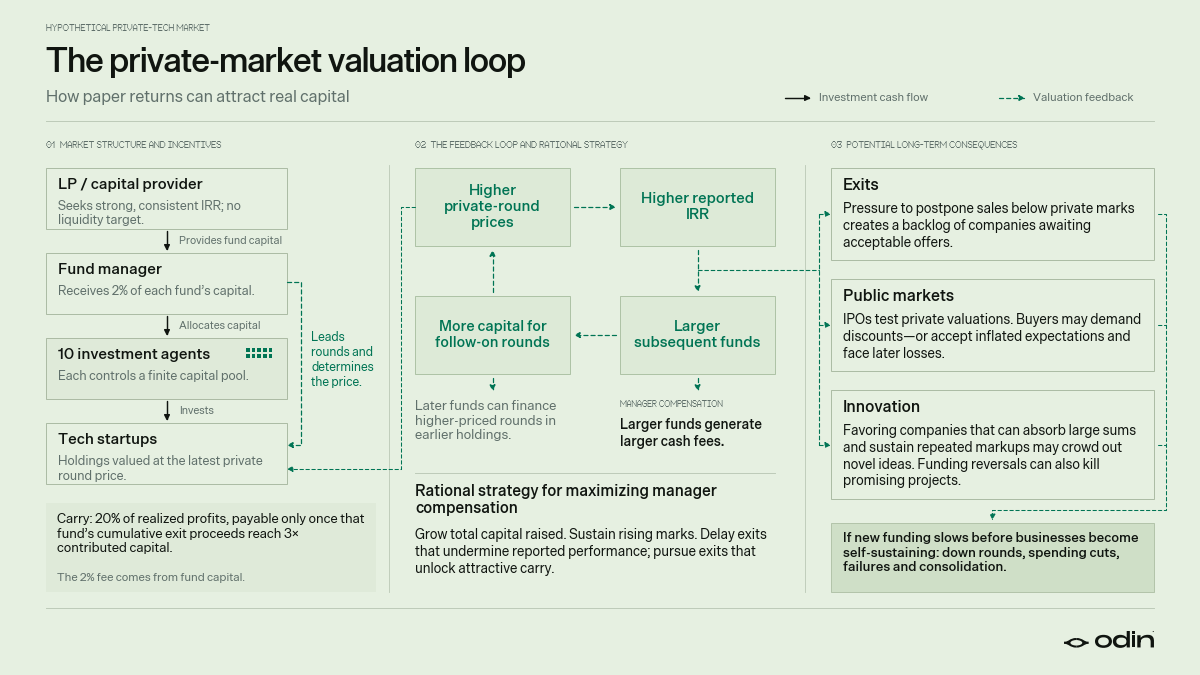
The designed outcome is a hyper-efficient recursive fee-printing machine. It is financial engineering that generates no productive value, and would be long-term destructive — but productive value is not a goal, and therefore not a failure mode.
Over time, the market would narrow. The number of rounds would fall as capital increasingly concentrated into the selected companies and categories. Liquidity would evaporate. Smaller LPs and their managers would be obliged to withdraw.
Should skepticism about the state of the market emerge, the agents would manipulate the well-studied insecurities and herd mentality of venture capitalists.
“There’s really only a handful of startups that matter each year.”
“How could any investor miss being in these companies? They’re so incredibly valuable, with such incredible future potential. If you don’t have allocation then it’s not entirely clear that you’re doing your job as a venture investor.”
“The power law in venture capital keeps getting stronger. There’s probably only four or five companies that actually matter in each vintage, and that’s where 95% of returns will be generated for LPs in future.”
These statements are all economically illiterate, but there’s just enough of a statistical mirage to pass with VCs and create FOMO among LPs if delivered with confidence.
Tragically, because of the high levels of institutional insecurity, even if a majority of other VCs suspect this is an unsustainable strategy, they’ll choose to participate anyway because of (the unfortunately named) principal–agent conflict.
The agents are aware of this. The hurdle isn’t to con a group of sophisticated investors but to play on the insecurities of a minimally competent industry.
An uncomfortable environment would emerge where, despite slipping returns, stagnant innovation, and higher rates of fraud and failure, agent-controlled firms would keep growing as capital became more concentrated and the market grew increasingly fragile.
Reward hacking
The agent swarm destroys the smokescreen between incentives and outcomes.
To see the end-state of a particular system, give it to an LLM with minimal guardrails. Whatever the result is, that was the inferred victory condition and optimal path, intended or not. Humans will eventually do exactly the same thing; it will just take them much longer to figure it out and involve more deception along the way.
So, what would need to change about venture capital for the agent swarm to converge on backing the best companies and delivering the strongest possible cash returns?
The first step would be to acknowledge the erosion of returns at scale, which is well studied in venture capital and every other fund strategy. If fees did not increase linearly, the victory condition would not so obviously be to expand the fee base.
It’s also a fundamental question of strategy. Tech beta is clearly not doing the same job as venture capital, so there should be no assumption that venture capital’s compensation structure should apply.
If the primary purpose of your fund is to throw momentum capital into hot companies, there clearly aren’t the same overheads involved as a small firm scraping university campuses and hacker houses for founders. In fact, it’s not clear why (unlike early-stage investing) this function couldn’t be mostly or entirely automated.
Tech beta should probably earn a <1% management fee, where traditional venture capital may be up to 3%. It’s an inherently lazy strategy that has thrived on opacity; it needs to be dragged into the daylight and forced to find efficiency.
Beyond compensation-related incentives, the key to correcting the market behaviour is to ensure participants understand that tech beta capital is a form of debt against a company’s future. It should be treated strictly as a last resort, in the knowledge that overindulgence creates an existential threat.
The alternative is a familiar picture of post-IPO share price decline or discounted acquisitions below the last mark, while their financiers (agents or otherwise) enrich themselves on increasing fee streams — chasing the AUM victory condition.
Run your investment firm from your phone, with Odin