“Badness you can get easily, in quantity: the road is smooth, and it lies close by.
But in front of excellence the immortal gods have put sweat, and long and steep is the way to it, and rough at first. But when you come to the top, then it is easy, even though it is hard.”
Hesiod, Works and Days (c. 700 BCE)

The Truth of venture capital is that the best returns come from the gnarliest problems, and the greatest uncertainty.
There are no easy answers or obvious ideas.
This is evident in the distribution of outcomes: More than any other strategy, the beta (median performance) is unappealing, while the alpha (outlier performance) is the source of virtually all value creation. Returns are driven by the top 5% of outcomes, and dragged down by the bottom 75%. Failure is the default mode.
Implicitly, it’s difficult — and that difficulty is necessary, because it forms a systematic filter for belief, dedication and ability.
Aggressive selection lowers the cost of failure, which enables participants to take more risk, accelerating the pace of progress.
Conversely, if the market allows bad ideas to persist then the cost of failure increases, raising risk-aversion and slowing progress.
Whether the target is a fund manager or a founder, it should never be easy to raise money. However, the challenge must be meritocratic in nature. This principle is fundamental to any high-trust, high-stakes strategy.
Soft Enemies
“A Navy Seal takes a house, naked, with a wheel gun, and he walks in backwards. That motherfucker is going to be out there on Instagram teaching that next week. That doesn’t make it right. We’ve been fighting goat-herders for decades, banging our chest like we’re men.”
John “Shrek” McPhee is a retired U.S. Army Special Operations Sergeant Major.
He describes a problem with American defence doctrine, where tactics and standards have evolved around a recent history of conflict with non-peer states.
Essentially, warfare started to feel easy. People up and down the ranks started doing things that felt good, rather than doing things correctly, because the consequences of failure were no longer brutally existential. At the same time, it became increasingly easy to pull the lever of military intervention without fearing the costs involved.
The result, McPhee argues, is that neither the modern soldier, nor modern military leadership, is really prepared for conflict against a hard enemy — and may sleepwalk into disaster.
If you can make the leap from one to the other; it is clear that a similar problem has emerged in venture capital.
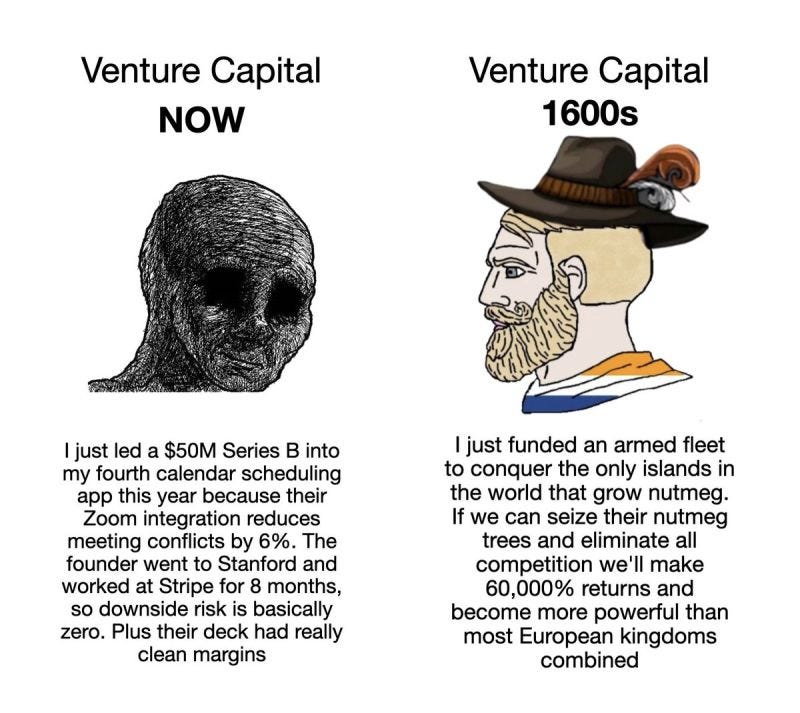
Without dragging out yet another well-covered topic, venture capital became increasingly formulaic (arguably to the point of fraud) over the last couple of decades.
Credentialled founders are drilled on a standard growth playbook, fed a predictable sequence of rounds based on hitting certain metrics, and valuations increase at multiples engineered to enable raising successor funds. It’s a process which is increasingly detached from the act of actually generating returns.
Founders, in this paradigm, are treated like a slave class. First, they must make the pilgrimage to San Francisco and prostrate themselves at the Ivory Towers of Sand Hill Road. The chosen few are anointed with status and money, treated as stars of the venture industry — as long as they are willing to burn themselves down in service of the playbook. It’s closer to The Hunger Games than it is to entrepreneurship.
This has been the industry’s modus operandi for an unfortunately long time. The only change is that the hurdles and multiples have risen as liquid returns have fallen, in an ouroborosian attempt to mask the central flaw: it does not produce good companies.
Essentially, we’re deep in the “soft enemy” era of venture capital. Today’s investors are expert in raising capital, and few have real experience with distributing it.
The Narrow Gate
“If you have to choose which way to go, always ask yourself first which is the harder and choose that one. It will be the right choice.”
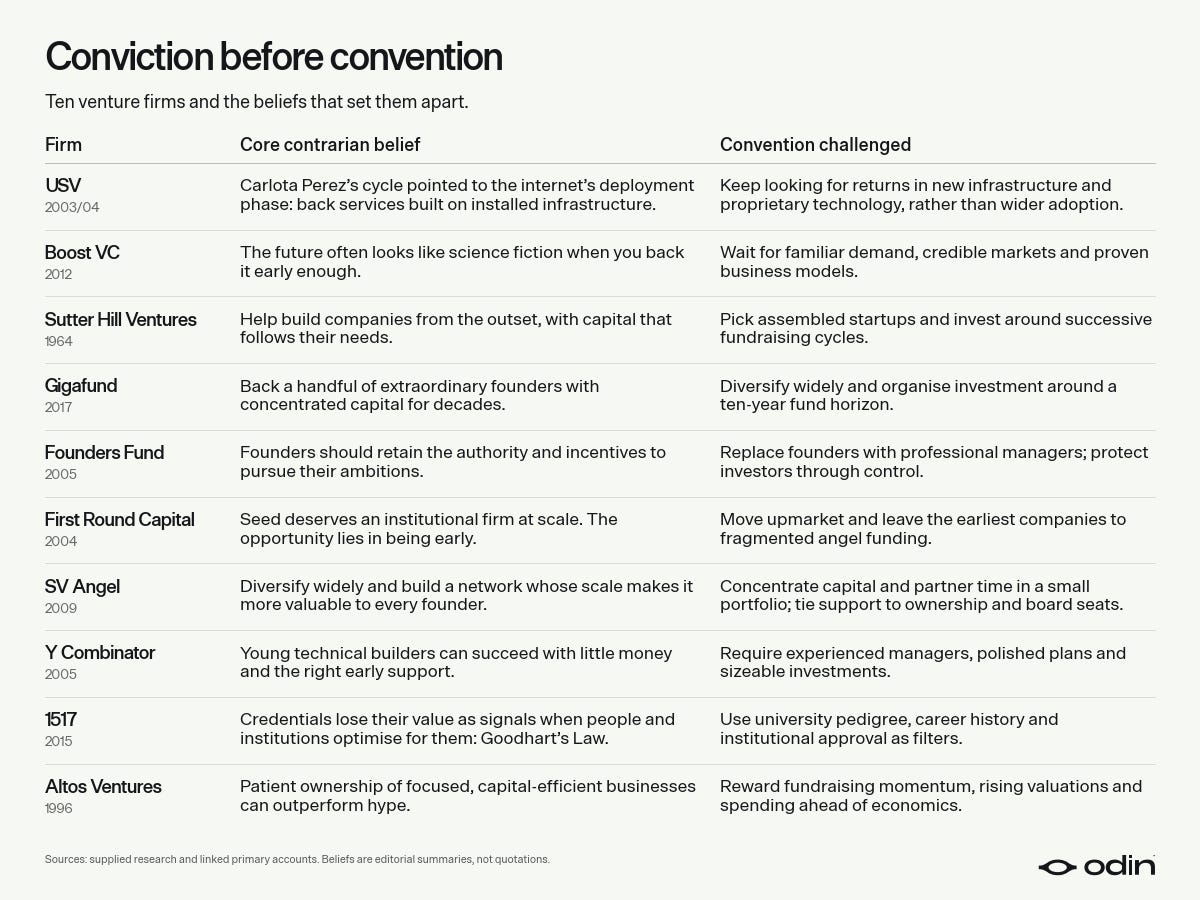
When you look across renowned venture capital firms, a (hopefully) unsurprising feature is that they were each founded on some fundamental contrarian belief.
Indeed, the willingness to be contrarian is likely what made them good venture investors to begin with. The ability to take an unintuitive idea and shop it around to raise a fund is ultimately the test of conviction and quality which separates good managers from fee-seeking opportunists.
The same is true for founders, of course. Generally speaking, a founder that can sell uncomfortably idiosyncrasy to investors is implicitly higher quality than a founder offering something with more obvious appeal.
Indeed, if you pitch a venture capital firm as a vanilla-flavoured asset manager that lives or dies on access, you misunderstand where the edge in venture capital lies. On the other hand, if you view your firm as the expression of a unique model of the world, that model will guide you toward sources of potential alpha.
Unfortunately, for the reasons described above, LPs have gotten used to the former, not the latter. They’re more likely to fund a well-connected moron with deals that are cosigned by incumbents, rather than the brilliant investor who will spend a few years wandering the wilderness before it’s clear what’s working. The criteria driving selection in that part of the market are no longer meritocratic.
The outcome is effectively a tax on new entrants, where in order to enter the mainstream flow of LP capital they must set aside some portion of their fund to be sacrificed to incumbent interests in the name of “access signalling”.

So, not only do venture capital’s incumbent firms command an increasing share of the capital in the market, they now have LPs convinced that other managers must contribute to that pile — for no better reason than it provides confidence.
This enmeshment also ensures that a broad pool of managers back the dominant narrative; if the consensus is NFTs, that’s the category to get behind. If an incumbent backs a particular company, it becomes unwise to back a competitor.
Similarly, you can’t be reliant on a firm for access, markups and (surprisingly often) LP capital, and simultaneously criticise their dishonesty or malpractice — so an awful lot goes unsaid, or is dispersed across ephemeral messages in GP group chats.
This squashing of intellectual diversity is wildly contradictory to the spirit and objectives of venture capital, as is the general notion of serving incumbents.
However, it’s nothing new. Venture capital has a long and storied history of anti-competitive behaviour. From the infamous meeting at Bin 38, to research going back decades which shows strategic control of networks to block new entrants — a thin veneer of positive-sum optimism barely covers the vicious insecurity.
The only difference is that today the network effects are much larger and more powerful, with much more at stake.
“Incumbents appear to respond strategically to an increased threat of entry, consistent with networking deliberately rather than accidentally reducing entry. The strategic response is not only large, it is persistent and increasing over time.”
Networking as a Barrier to Entry and the Competitive Supply of Venture Capital
The Broad Road
“Wide is the gate and broad is the road that leads to destruction, and many enter through it.”
Matthew 7:13
These incentives haven’t just created a separate strategy that exists alongside venture capital — they are consuming it from the top down. The influence of the megafunds has spread to the roots of venture-backed innovation.
The concept of founders as a Thielian species of unconventional geniuses is being displaced by the hyper-fundable Andreessonian archetype; authentic missionaries are traded for slick mercenaries peddling vice.
The “competition is for losers” celebration of outliers is losing ground to a rote strategy of kingmaking; attempting to manufacture winners in target categories rather than discovering them on their own terms.
No longer harvesting returns from the chaos of creative destruction, venture capital appears increasingly centrally planned, more risk-averse, and frequently serves the incumbents of other industries. This is a natural, expected consequence of scale.
“When a fund has too much money per partner, they are forced to cope by either making bad deals or by taking on less uncertainty. The former is bad business, the latter is not venture. Venture is therefore, once again, dying.”
This shift has progressed in six stages:
Careerist allocators want to invest in stuff that feels obvious and defensible.
Megafunds emerge with the product of ‘synthetic beta’, generating markups on the expanding inflows to venture capital.
Other firms slipstream the megafunds as capital concentrates.
Consensus gets funded at scale, the rest falls away.
Raising money means fitting a pattern, not breaking one.
Venture capital becomes a captured industry.
This is not just theory; it’s increasingly well-documented as a narrowing and warping of the innovation economy around these incentives.
“Even entrepreneurs whose preferences lie in solving tough problems or doing good in the world find it hard to resist VCs’ signals about what projects will produce the highest returns in the shortest amount of time. As a result, VCs induce entrepreneurs to bend their innovative behavior toward VC preferences.
The result is a distorted innovation environment. VC inducement contributes to the narrowing of entrepreneurial innovation, interferes with the efficient operation of VC markets, and reinforces dominant hierarchies in the entrepreneurial ecosystem, narrowing both the range of innovators who are enabled to pursue entrepreneurial projects and the range of consumers who benefit from those projects.”
Disrupting Venture Innovation
So, instead of choosing good quests, important problems or the vital creative destruction of industries and technologies, today’s founders are more often willing to just do whatever it takes to get funded — knowing they will be well compensated.
Venture investors are fine with this, because it gives them more willing slaves to throw at proven playbooks to print reliable markups.
Institutional allocators are fine with this, because it feeds the machine which generates reliable IRR and gives their employer confidence.
As McPhee would warn, when this shell game supercycle comes to an end, the problem won’t just be a drawdown and a washout. It will become clear that a whole generation of venture capitalists have learned, perfected and perpetuated a mostly performative style of investing.
Who will fund what must come next?
Embracing Uncertainty
“Venture capital did not die for good after the 1980s, and it won’t this time either. The big money will get the headlines, but the real action, for anyone who has the sense to look, will be with small investors backing new market uncertainty.”
Against the odds, there are still managers who recognise the Truth of venture capital, rejecting the deception of engineered markups and mercenary founders.
Driven by the awkward outliers, not expedient deals, they have chosen the long, steep path to prosperity. They choose difficulty because it’s honest, and because it’s the natural habitat of the finest founders.
However, the challenges for these firms only get greater each year, as an increasing share of the venture market is captured by rent-seeking agglomerators and malign incentives. Their list of allies grows thin. Yet, it remains the right thing to do — and where the greatest returns are found. A fiduciary good, and a moral good.
This is broadly the sentiment which Santiago Pliego captured in his 2024 essay, Vibe Shift, which helped introduce The Gundo to the world.
“The Vibe Shift is a return to—a championing of—Reality, a rejection of the bureaucratic, the cowardly, the guilt-driven; a return to greatness, courage, and joyous ambition.”
Today, Santiago is the co-founder of Vashon Company, a firm that shares more DNA with merchant banking than modern venture capital.
To speculate, I’m not sure Vashon cares whether they’re investing in an LA seed round or recapping a Bolivian tungsten mine. I’ve heard stories of them tracking down critical equipment in foreign countries or delivering off-grid power in adverse conditions, all to support their equally ambitious portfolio companies.
Vashon does not have a media arm. Their brand is reminiscent of Barings Bank, who famously didn’t even put the company name in their letterhead (when you got a letter from them, you knew exactly who it was). The impression is that they care more about discretion than about noisily claiming credit, which is unusual — and refreshing.
Vashon’s thesis is that we’re at the end of an unprecedented era of global stability (the soft enemy), and there’s a growing need to rebuild and retrench. It is deeply held, well researched, and has clear implications about where opportunity lies. It’s unlikely to have been an easy pitch to LPs, when all attention is consumed by AI hypergrowth.
A similar idea is reflected in Chaotic Capital’s perspective that the world is becoming increasingly complex and unpredictable. Or 1517’s view that legacy institutions are no longer fit for purpose; that typical credentials are gamed and worthless. Or the Cantos thesis that the default is a dark future, which requires grit, mettle, intensity and relentlessness to resist.
These firms, and others like them, will play an important role when this supercycle comes to an end, and the hard enemy appears. There will be a need for investors who are built for hard times and extreme uncertainty, rather than those who choose the comforting deception and the saleable lie.
“Three issues are particularly concerning to us: 1) the very narrow band of technological innovations that fit the requirements of institutional venture capital investors; 2) the relatively small number of venture capital investors who hold and shape the direction of a substantial fraction of capital that is deployed into financing radical technological change; and 3) the relaxation in recent years of the intense emphasis on corporate governance by venture capital firms. We believe these phenomena, rather than being short-run anomalies associated with the ebullient equities market from the decade or so up through early 2020, may have ongoing and detrimental effects on the rate and direction of innovation in the broader economy.”
Venture Capital’s Role in Financing Innovation: What We Know and How Much We Still Need to Learn
Run your investment firm from your phone, with Odin