
“I’ve always felt like an outsider no matter where I am, and I think that’s been wonderful and incredible for my career. You can certainly look at that and have kind of a victim mindset about it, but I took the opposite path, which was, this is what makes me special, is that I don’t fit in wherever I am.”

A central feature of venture capital is that there are no recipes for success.
There are recipes to control downside; to manage risk, to diligence, to be a good fiduciary. But none that can conjure upside.
The wins are unpredictable. They typically resolve from strange propositions, shaped by equally unusual people. Ideas that are drawn from science fiction, mad ambition or impenetrable technicality. Singular, daring, and incredible in every sense.
It’s the hunt for outliers. The need to go where nobody has gone before, to see what others cannot, and to believe when nobody else will.
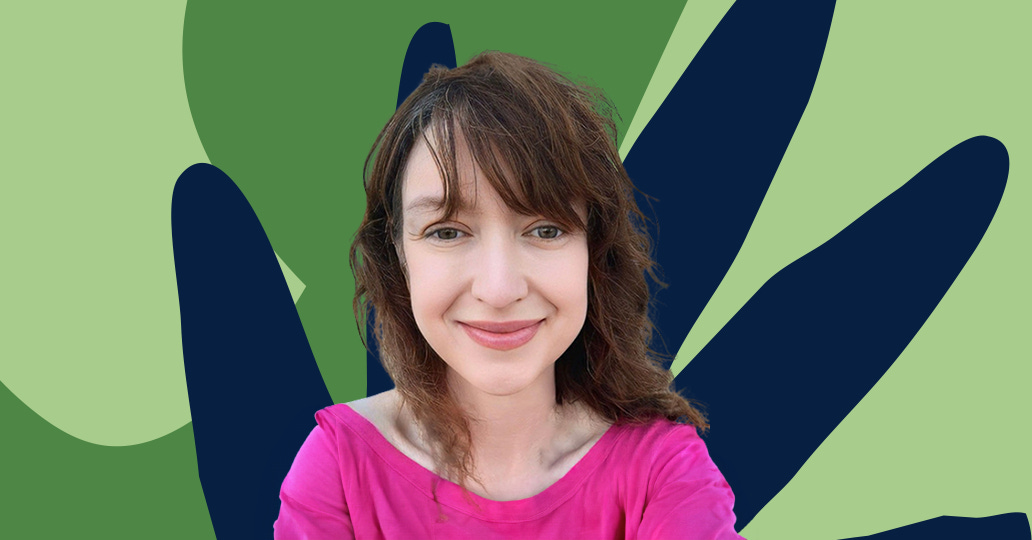
Few understand this as well, and as intuitively, as Cyan Banister.
Random Spaces
“I’m a wanderer. I am tethered by some of my life’s choices, but in general, I like to roll around like a tumbleweed. A lot of my decisions, my gut instinct, and what I like to do comes out of that random space.”
Cyan Banister, on Dialectic (2025)
To understand why venture capital offers no playbook, consider the library of academic research on venture capital and investment outcomes. If you want to examine the attributes of predictably bad investments, there’s a plethora of papers.
But predictably good investments? There’s simply no such thing.
The main regional hubs? It might be beneficial to look elsewhere.
Hot categories? History suggests you’re already too late.
The prestigious universities or former employers? Probably overrated.
Past entrepreneurial success? Likely to be priced in.
Facial features, personality, political views… researchers have studied a myriad of factors that might have some correlation with outcome, and have drawn a blank on any pattern that meaningfully indicates success.
The only consistent finding is that people and companies who don’t fit the usual patterns are probably overlooked and undervalued.
“The companies that have had the largest returns in my portfolio came from the most unusual places.”
In summary, venture capitalists should look for founders that are from somewhere, have done something, and may or may not have any qualifications. Essentially, they are looking for incredible people with brilliant ideas, regardless of their background. The generic heuristics for venture investing are a mirage for those thirsty for confidence.
The magic of venture capital is an investor’s unique perspective on the world. By nurturing valuable idiosyncrasies, and avoiding groupthink, they’re able to recognise potential where others cannot, to explore the gaps in reality.
This precludes much of what is known as venture capital today; the sea of glorified SDRs who wear variations of the same uniform, go to the same events, went to the same school, and scour Silicon Valley for the same profile of startup.
“If I’m chasing the competitive deals of today, I’m going to lose money. I’ve got to find things at lower prices that are still a moonshot, where I can get a good percentage ownership, like any good seed fund should do.”
Cyan Banister, on Sourcery (2026)
Indeed, the fundamentally unpredictable nature of success in venture capital is why research suggests that success is often related to being in the right place, at the right time (which makes it risky for everyone to be in the same place). It’s not that success is a factor of luck, but it’s certainly related to being patient, optimistic, and open-minded. And a little serendipity doesn’t hurt.
“When I roll the dice it puts me in places and it puts me in a frame of mind where anything’s possible, and anything at any moment can happen and you just have to be ready for it.”
Gaps in Reality
“Lately I’ve been daydreaming. I think about how the world could be better, I think about what people could be creating, and I imagine it in all the various ways I can with my perception. Then I let go of my attachment to it. […] Maybe someone gets that spark, and maybe they decide that’s the company they want to build.”
Cyan Banister, on Dialectic (2025)
Venture capital can be understood by visualising a map of overlapping knowledge about the world. People, markets, culture, finance, technology… All of the data about reality as it exists today, wrapped around the globe in ragged layers.
Most professions are built where there is the most certainty — the most overlapping knowledge. Venture capital, on the other hand, is focused on where the uncertainty is greatest. The frontiers of our experience; thin walls that separate us from the future.

“I tend to not play in the why now space. I tend to play in the what’s coming space.”
Cyan Banister, on Sourcery (2026)
It is the job of the venture capitalist to mine these uncertain spaces for opportunity; to expand the aperture of the possible and help pull new ideas into the world.
This is what makes venture capital such a challenge for many people. They are used to following recipes, in the form of self-help books, podcasts or biographies. Their ability to think independently is often a distillation of other people’s ideas, because the insecurity associated with just being themselves is too uncomfortable.
Indeed, rarely is anyone encouraged to approach a complex judgement by simply applying their own point of view. More often, our processes hedge against embarrassment or disagreement by outsourcing judgement to some authority.
As a result, we’re less able to appreciate the value of novel ideas.
“People are afraid to show who they really are. We’re taught from an early age to have manners and discipline, and how society really works. You don’t want to stand out too much, because then you’re weird, or quirky.”
Cyan Banister, on Sourcery (2026)

Catching Outliers
Cyan’s investment history spans more than 20 years, from the angel investments with her husband Scott Banister, to her time at Founders Fund, and most recently in her role at Long Journey Ventures. Over time, that track record has evolved into a list that includes many of venture capital’s most impressive success stories.
“I made my own luck by simply waking up every morning and telling myself I could do anything. By getting out there and meeting people and simply showing up, I created opportunities.”
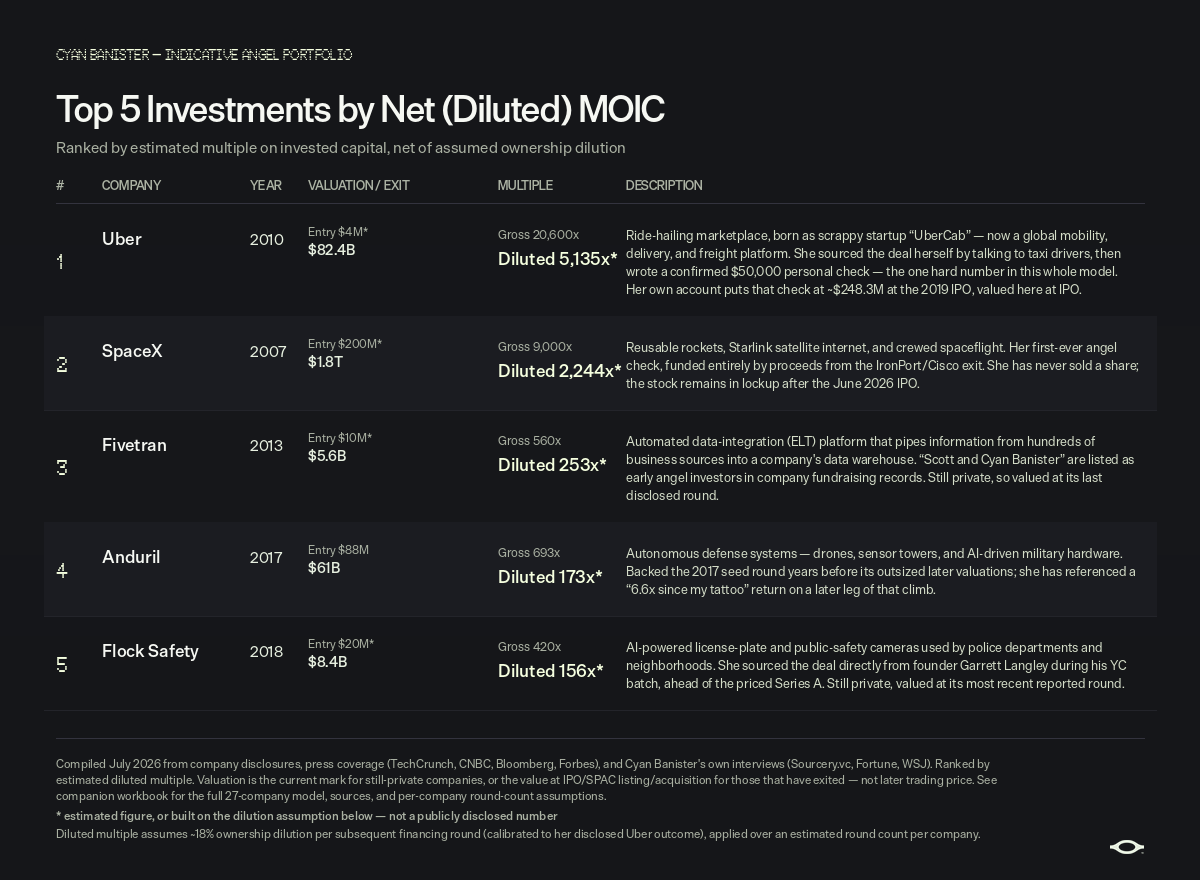
Below is a rough estimate of the performance of 27 of her investments, based on the significant assumption of a standard $50,000 investment (later investments like Anduril were likely much larger), and some estimated entry prices.
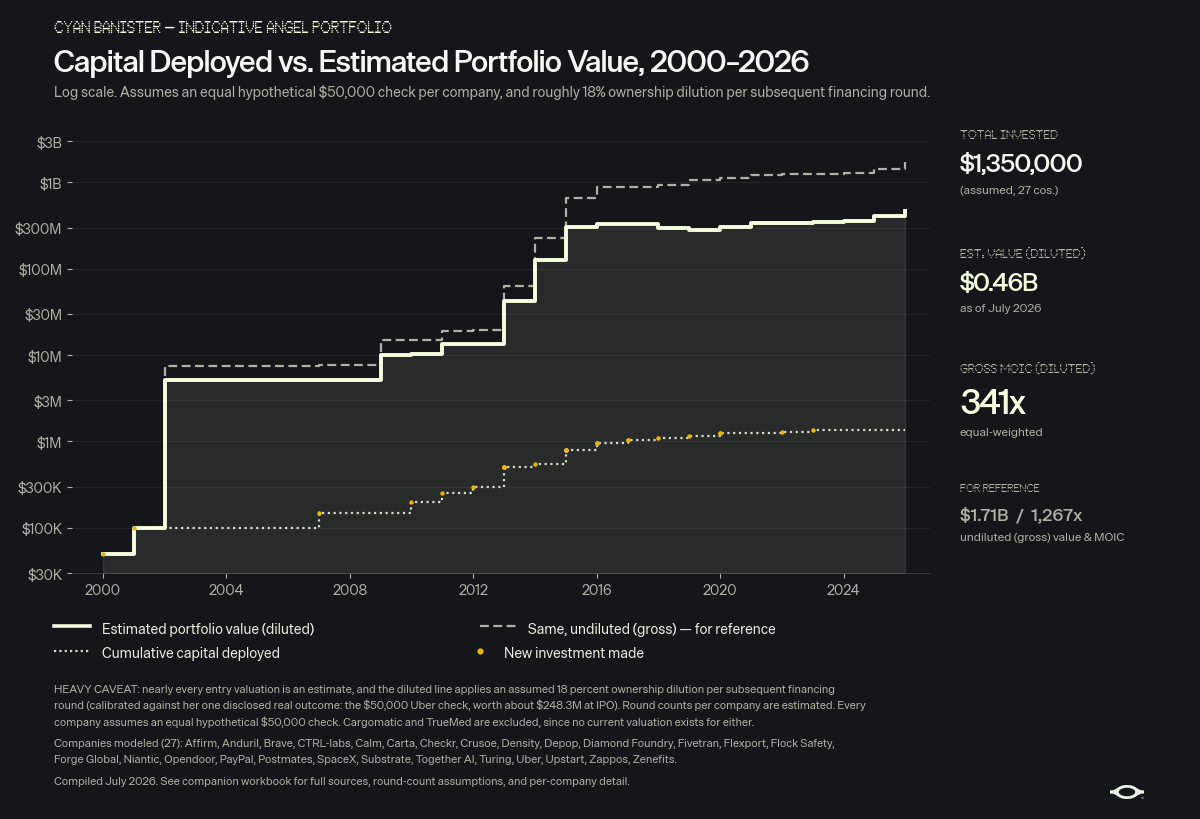
These results make for a strong case that Cyan (alongside Scott) might be the highest performing angel investor of our time. And that’s without considering investments she’s doubled-down on, and shares she’s held after exit.
The lesson to take from this is not to model your investing process after hers; you cannot reproduce Cyan’s success by emulating her behavior. Instead, understand that it is rooted in her judgement as an individual, her confidence to act on it, and what a scarce resource that has become.
In the words of Chris Cornell, be yourself.
“A lot of people will want to label you. They’ll say, ‘There’s more power when there’s all of us together,’ but I believe there’s more power when you find yourself and when you don’t become a part of group think. If you can think with individual thoughts, you’re more likely to set yourself apart.”
Indeed, in the world of scaled venture capital, where associates get a starter kit that seems to include a reboot of their personality, this celebration of the individual is all the more important. The next generation of outliers depend on it.
Run your investment firm from your phone, with Odin
Sources:
Cyan Banister talking to Mario Gabriele:

Cyan Banister talking to Jackson Dahl:

Cyan Banister talking to Molly O’Shea:

Cyan Banister talking to Tim Ferris:

Cyan Banister at Techcrunch Disrupt 2018:
A mirror version of this for founders would help reduce a lot of panic. You hear conflicting advice everywhere. The reality is that VCs all differ and none of them have it figured out.
This capture really well Cyan's investment philosophy!
If one wants to dig deeper into her serendipity, I encourage you to listen to this podcast with Patrick O'Shaughnassy: https://open.spotify.com/episode/7sz80hb9JYyaxQTAAsNK6c