You have a choice between two boxes, both of which cost $20.
You are told Box One contains $100, and Box Two contains $10,000 — but can’t be opened.
If you need to use the capital yourself, you will choose Box One. However, if you can trade on the reported value of the box, you should choose Box Two.
Later, you will realise that you can also just tell people there’s $20,000 in Box Two. Or $100,000. Whatever you want.
It turns out that being locked up can be a valuable feature.

Selling Confidence
Venture capital is an awkward investment strategy.
The premise is that there’s huge value in technology startups, which are underpriced because of the uncertainty about their future. The majority will fail, but the occasional success will repay those failures many times over. That risk profile, with the challenge of extreme idiosyncrasy, prohibits traditional underwriting.
This uncertainty is tolerable for individuals, investing their own money, who can make a reasoned judgement and live with the consequences. Thus, the industry has historically been the domain of angel investors; high-net-worth individuals and small family offices. Idiosyncratic people investing in idiosyncratic founders.
That all began to change as institutional allocation crept upwards.
Large institutions are inherently risk averse, reluctant to rely on subjectivity, and require regular feedback to assure themselves about decisions. Their priorities are fundamentally opposed to the nature of venture capital, and yet that conflict could be reasoned away with sensible arguments about diversification and future growth.
So, a veneer of professionalism began to form on the venture industry. Investments were packaged in 10-year “blind pool” vehicles, marketed with slick pitches about the opportunity of technology.
Over time, that uncomfortable uncertainty has been hidden away inside these black box fund products, wrapped in a benchmarked rate of return, a standard level of due diligence, and a typical fee structure.
Institutions are offered exposure to the most exciting trends of the future, without needing to acknowledge the true risk involved.
What could go wrong?
“Economists of all people should know that if a system can be abused, it will be abused.”
Confidence games
Consider a simplified explanation of this market structure:
Managers approach institutions with the promise that their particular black box will be populated with assets of immense value.
Later, the investments they’ve made will be marked-up by their peers, determining firm survival and continued fundraising activity.
Some of those peers will share exposure to the same assets, so the process is somewhat reciprocal — particularly for larger firms with multi-stage strategies.
Managers also broadly benefit from juicing market momentum, as herding capital into a particular category will drive up prices; systematically accelerating markups —particularly for the most “obvious” winners.
AKA, “shut up and dance”, or “playing the game on the field”.
“There was a collective belief that things were at relatively high prices. The idea that people didn’t know there was a bubble didn’t exist. People knew these were frothy times.”
To understand how this issue is exacerbated in a bifurcated market, begin by dividing institutional LPs into the two significant groups:
Those who are sensitive to liquidity, and will need that black box to be opened after about 10 years so assets can be sold on the open market.
Those who aren’t sensitive to liquidity, and do not care about opening the box as long as the assets inside it continue appreciating over time.
Then, divide the managers into two groups:
Collaborative firms with large, diverse networks of peers, whose goal is to discover non-consensus outliers that will produce immense value.
Incumbent firms with tight-knit relationships with enmeshed peers, whose goal is to anoint consensus winners with large capital injections.
Consider the incentives involved; the management fee income, the confidence product, and the collegial marking of each other’s books. It’s clear which combination is more attractive if the goal is raw accumulation.
If LPs no longer enforce the structural requirement for liquidity on decade-long horizons, or tolerate awkward workarounds like continuation funds, there is no real need to open that box and reconcile reported value with reality.
Fundamentally, if LPs don’t open the box, it doesn’t matter what’s inside.
All that matters is how confident they are about what they’re told is inside.
If everyone goes along with the same story, it might as well be the truth.
Firms are therefore incentivised to collude, at least tacitly; building confidence around inflated metrics across shared investments and consensus categories.
To be clear, this is unlikely to reflect deliberate fraud; most of the time it’s just “cargo cult capital”; investors chasing the same signals, with the same beliefs, based on conveniently aligned incentives. They may even believe these signals are real, and meaningful — despite the evidence otherwise.
“It is difficult to get a man to understand something, when his salary depends on his not understanding it.”
Clearly, even the most enmeshed incumbents often have exposure to good assets.
Large firms can buy their way into “winners”; collecting logos to build evidence of the confidence they sell to LPs. The remaining question is whether those assets remain good, or if they are systematically overcapitalised and drained of expected value.
It’s not that all markups are phony; it’s the degree to which the markups are phony.
“We value unicorns using financial terms from legal filings and find reported unicorn post-money valuations average 48% above fair value, with 14 being more than 100% above.”
The more dominant this “shared enthusiasm” model of venture capital becomes, the more the underlying assets only need to be convincing vessels for deployment. So, attention drifts toward credentials and consensus. Perversely, the higher this behaviour drives prices, and the more irrational they seem, the more attention they gather.
Consider how many times you’ve seen a company that is already widely regarded as grossly overvalued raise yet another oversubscribed round.
Venture capital has essentially become a highly reflexive confidence game.
i.e. Investing large amounts of capital produces momentum which attracts more capital, and as long as nobody calls the bluff it can be presented as real growth.
Remember: When you are targeting risk-averse institutions, it’s far easier to sell the lie that the winners are obvious and the constraint is access, paid for with scale — rather than the uncomfortable truth that successful startups are always inherently uncertain outliers.
If you have the barest grasp of economics, you might be puzzled by this behaviour.
Surely, investors crowding into lower-quality / higher-consensus investments will erode alpha and destroy returns?
Here we return to the crux of it: only if you need to sell.
If firms are incentivised by their LPs to deliver strong and stable IRR, year after year, they will pursue that goal to the detriment of everything else. Without the need to reconcile marks with reality, and without being held accountable for the quality of their investments, they will just shovel capital into the hottest furnace.
We can test this theory on five dimensions:
If it was true that scaling venture capital meant firms are more-often exploiting the nature of illiquidity, to pump stock they know they’re unlikely to be pressured to sell, you might expect a few logical consequences:
A concentrating set of late-stage companies [✅Yes]
Large investors sharing more portfolio overlap [✅Yes]
An increasingly constrained exit environment [✅Yes]
Remaining exit activity more dependent on market conditions [✅Yes]
Higher rates in fraud and failure in exited companies [✅Yes]
To summarise, the scaled venture capital strategy is producing larger companies, not better companies. Exits are more difficult, economics are more fragile, and outcomes are not durable. It’s a strategy that feeds incumbents, rather than displacing them.
If you assume this persists, and extrapolate into the future, venture firms essentially trade on their ability to herd capital into their own portfolio, and deny it to others. This is reflected in the increasingly oligopolistic, zero-sum nature of the industry.
To repeat, this may or may not be calculated and deliberate — that doesn’t really matter. It is no less problematic if it’s just a natural drift toward the exploitation of a vulnerable system. What matters is that it appears unstoppable without intervention.
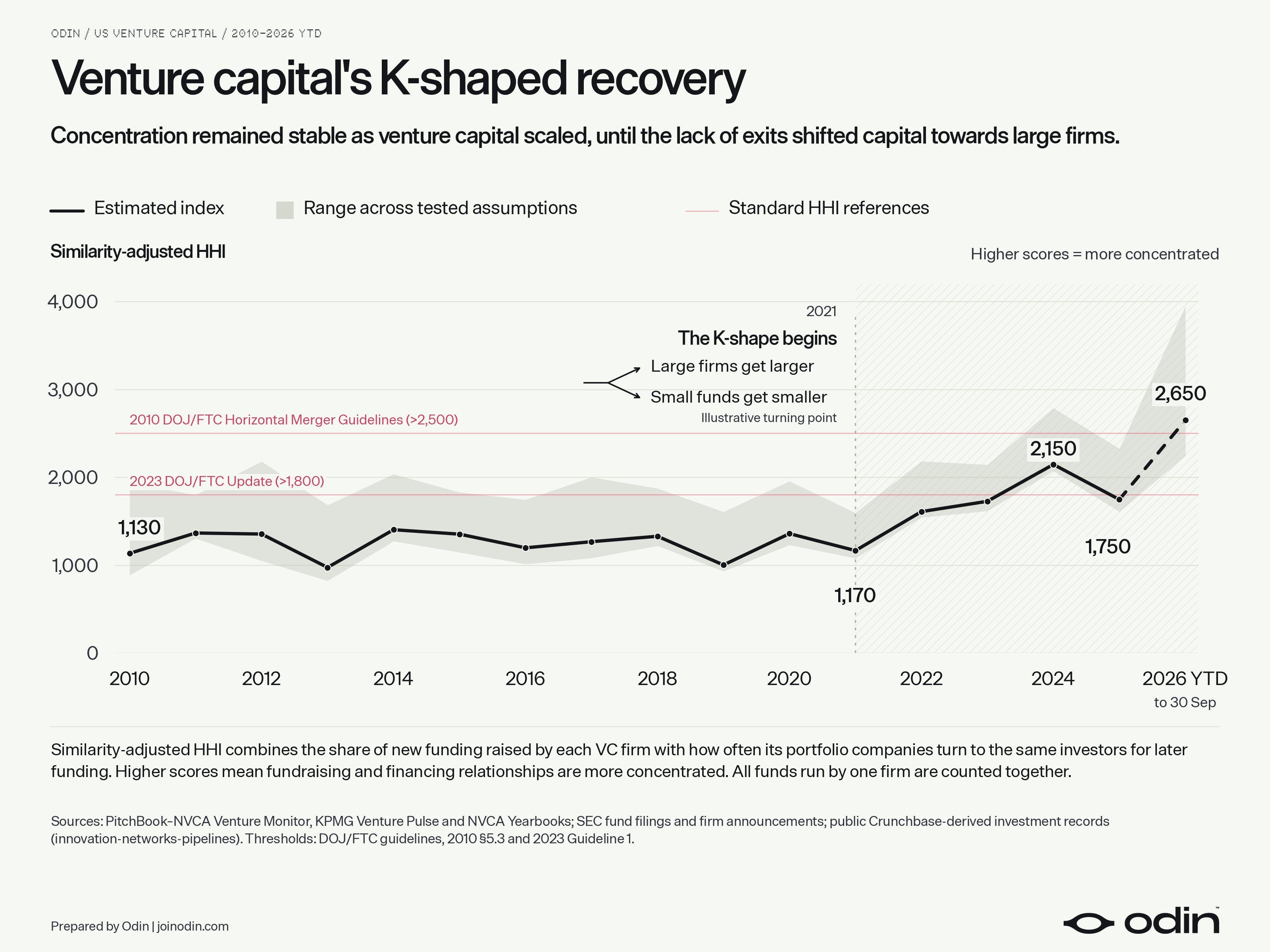
To understand how we arrived at this point:
Cyclical boom and bust has been a hallmark of venture capital for decades. While this volatility produces much waste, it has also driven capital into sectors of opportunity and helped the winners raise the money they need.
However, this trend has been growing more extreme over time, as incremental private market deregulation has enabled larger institutions to enter the venture market.
This began with the 1979 end to the “prudent man” rule, allowing pension funds to allocate to venture capital — inflating annual commitments from hundreds of millions to billions of dollars. It was compounded by the National Securities Markets Improvement Act, which removed more friction from the process for institutions.
This set the stage for the post-Global Financial Crisis era of zero interest rates; the saturation of other asset classes left institutions hungry for diversification into early-stage technology. From 2008 to 2022, venture capital fundraising grew by an order of magnitude, to a peak of about 170 billion dollars.
This period was a major departure from the earlier era of venture capital.
Historically, venture capital’s limited partners were smaller and more sensitive to the timing of returns. Thus, a 10-year fund ought to actually run for 10 years. Portfolio companies had to consciously orient towards an exit, so the goal was implicitly to maximise the price that buyers were willing to pay.
In the modern era, exits have slowed to a crawl, funds are routinely stretching out to 16 years, and capital has begun to concentrate in wildly overvalued late-stage companies. This change has been driven by the large, liquidity-insensitive limited partners. It has also pulled the venture strategy closer in correlation with public markets, as the “vibes” are connected to wider market sentiment.
Critically, the market reckoning of mid-2022 clove the market in two.
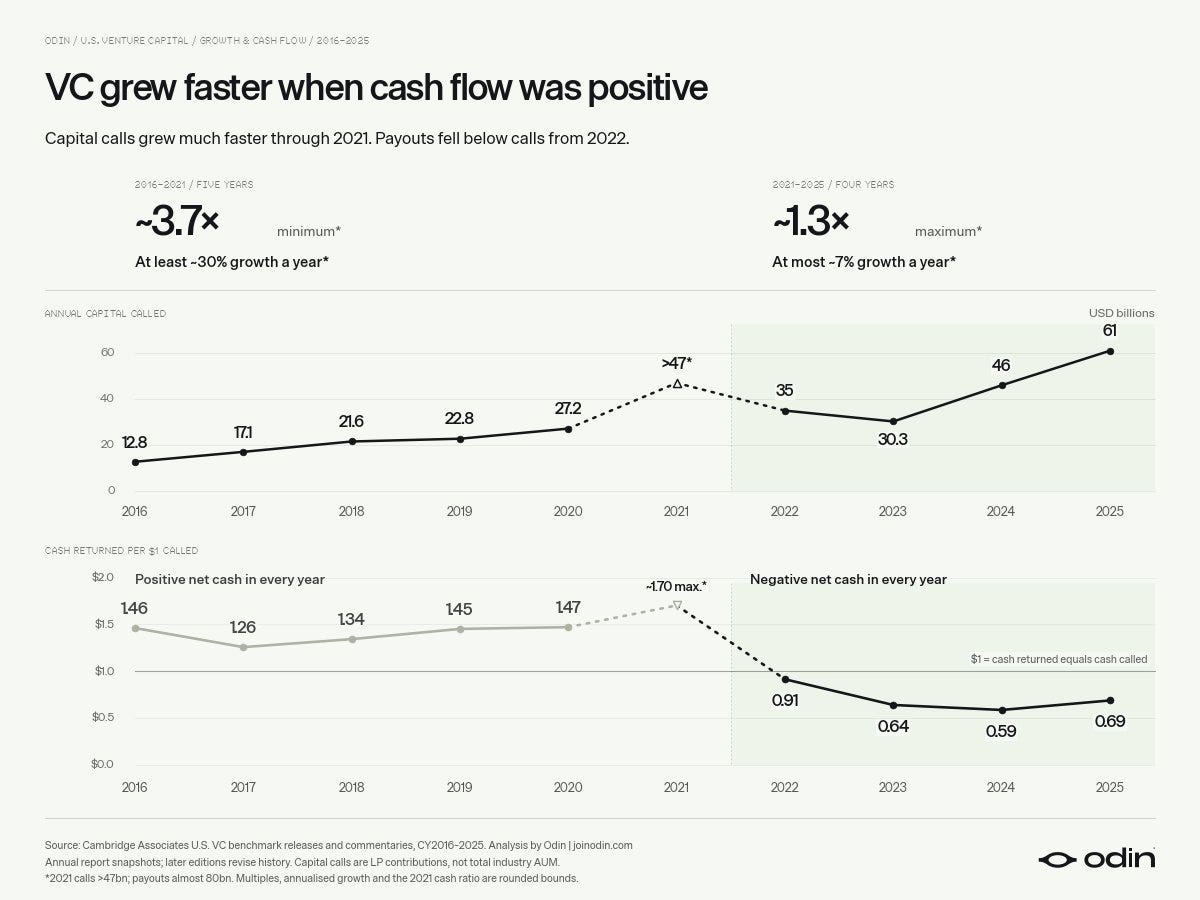
As rates rose and exit markets closed, unable to reconcile price with value, it was the traditional limited partners who felt the pain. Without distributions to recycle into new commitments, funding for the boutique end of venture capital fell precipitously. On the other hand, the larger institutions, with easier places to get cash when required (treasury bills, public market investments) did not feel the squeeze.
Even the much larger PE allocation of institutions (15–25% of portfolios, vs 3–5% for VC) is an easier place to get liquidity. It’s a mature strategy with more regular liquidity events, assets that are easier to value, and scrutiny related to debt covenants and frequent secondary market activity. While PE marks aren’t perfect, they are more regularly tested and thus closer to liquid than frothy VC marks.
Indeed, the illiquidity of venture capital has become a feature; by holding positions at inflated marks, venture helps shield portfolios from volatility. In fact, you could argue it has evolved into the ideal product for large institutions: providing a simple, scalable vehicle for stable private market beta, neatly checking the venture allocation box.
To summarise, venture capital spent about half a century inflating with capital from investors that aren’t particularly sensitive to liquidity. So, when liquidity collapsed, the shape of the market changed dramatically. The traditional “boutique” end of venture capital fell away, and virtually all of what remained were the modern “megafunds” that target institutional capital.

Confidently wrong
Venture capital’s original structure was no accident.
Distributing capital through many small firms effectively increased the surface layer of opportunity. An individual limited partner with a portfolio of a dozen venture firms could expect meaningful diversification across themes, industries and geographies. This is critical in a strategy that is reliant on finding the outlier needles in a haystack.
Indeed, the winners are empirically never predictable, early investor attention has no real correlation with outcome, and value ends up being dominated by ideas that seem unusual or unlikely at the time. Thus, the modern narrative of access, at least at earlier stages, is plainly a smokescreen for the rent-seeking of large firms.
Today, because the ratchet of illiquidity has driven remarkable concentration, venture capital lacks this coverage. Not only do fewer, larger firms reduce surface area of opportunity, they are also structurally consensus oriented. Despite having much larger portfolios, their coverage is significantly narrower than their small and emerging manager peers. At the same time, the sheer volume of capital they command inevitably drags other firms and companies into their wake, reshaping the market.
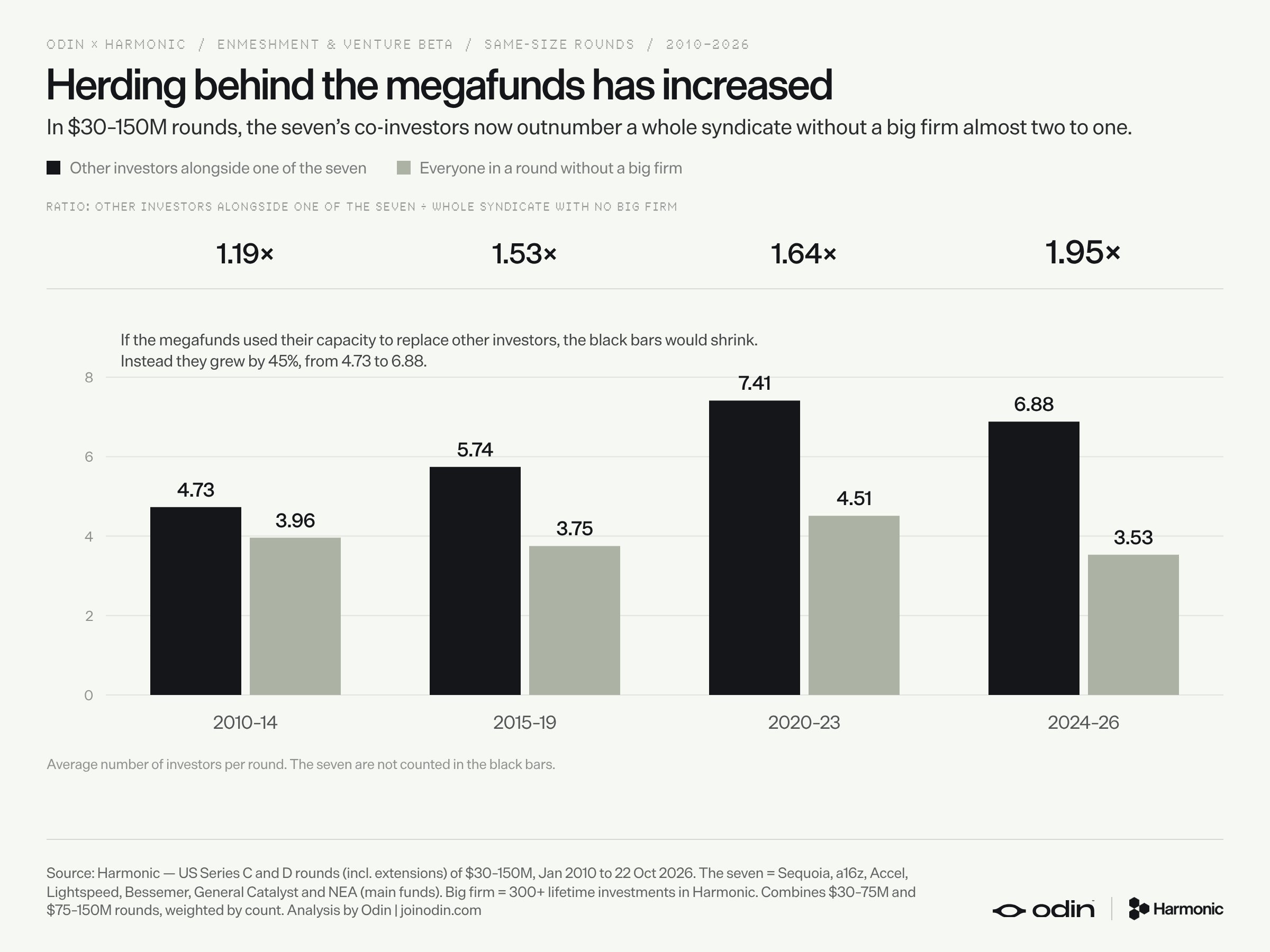
This consensus-seeking behavior is a coping mechanism designed to preserve fees by channeling capital into a smaller set of increasingly inflated opportunities around which it’s easier to build a confident narrative.
In venture capital, and every other fund strategy, it’s a simple economic reality that large funds produce worse cash-on-cash returns. As a result, management fees in other industries no longer scale linearly with the capital base. In defiance of this, the large venture firms have landed on “access” as a defensible value proposition. The idea is that their scale allows them to win competitive deals for the “best” companies — the most obvious opportunities.
Focusing so much attention on these “obvious” winners contradicts the original purpose of venture capital; finding value in outliers that are overlooked or underpriced. See, for example, the frequency with which founders are now told they must be “legible to capital”, when surely venture capital was built on the illegible opportunities.
So, fewer firms pursue a more limited set of opportunities, driving larger volumes of capital into their portfolios without any real pressure to secure exits. So, prices surge upwards, metrics look good on paper, and limited partners are happy with the resulting metrics.
Meanwhile, venture capital becomes increasingly net-negative in cash flow to LPs.
This leaves small firms with an ugly choice:
One strategy is to attach themselves to the large firms, like remora cruising along with a great white shark. They feed large firms attractive opportunities in return for markups, and hope their own investors will be patient about liquidity. However, this leaves them with a dangerously fragile portfolio and a good chance they’ll be wiped out if the market turns.
Alternatively, they can avoid the categories where the large firms swim entirely. This avoids the risk associated with momentum investing, but they may find themselves struggling to assemble downstream capital for portfolio companies in such a narrow market. While exits may end up looking healthier, and arriving sooner, markups along the way will be slower.
Confidence Men
It’s worth taking a moment to consider the history of bubbles, and how that is reflected in the venture capital market today.
Whether it was railways, canals or internet, the typical pattern is that exuberance creates a surge of companies and investment, followed by consolidation back into an oligopoly of survivors who buy out struggling competitors as capital retreats.
The hope, roughly matching the techno-economic cycles described by Carlota Perez, is that the technology propagates, information costs fall, and the oligopoly is gradually eroded via ‘resource partitioning’ — where incumbents cede peripheral activity to small specialists and thus the market reaches a healthier equilibrium with greater competition.
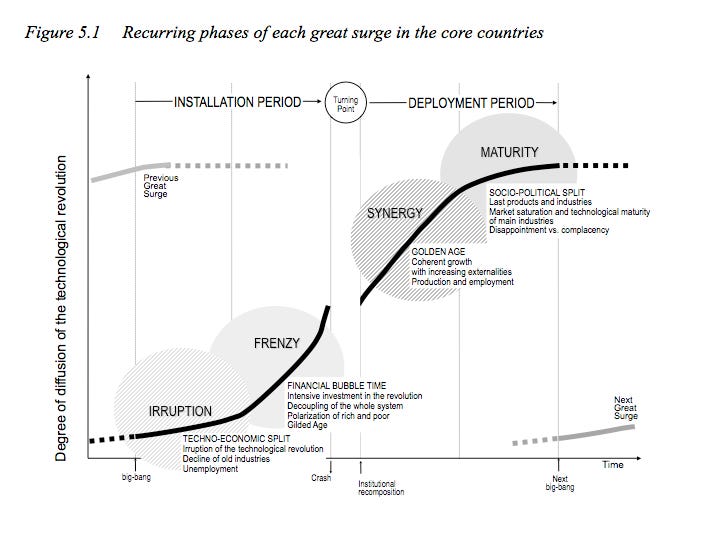
If you think of 2021 as the peak of what was essentially a venture capital bubble, the parallels are clear. In the years since, capital concentrated into a handful of incumbent firms and the actual product of venture has suffered for it. A traditionally boutique, eccentric strategy has been dominated by industrial capital; and the cracks are beginning to show in both innovation and financial value generation.
In theory, what happens next, as the shortcomings of today’s market activity become clearer, is a shift in the balance of capital toward small specialist firms who restore the otherwise unscalable and crucial function of discovery.
However, it’s unclear to what extent the relationship-driven nature of venture capital will resist the development of resource partitioning; whether market concentration is irreparable — or what scale of catastrophe would be required to undo it.
For well over a decade, LPs have been sold a “too big to fail” narrative designed to instil confidence. Reversing out of that, into a new Golden Age for venture capital requires a level of humility and agility which large institutions aren’t used to.
Run your investment firm from your phone, with Odin