
Marc Andreessen thinks venture capital could be one of the last remaining jobs performed by humans. Meanwhile, David Beisel is worried that AI is already an existential threat to the profession.
The truth, as usual, is somewhere in the middle; Marc may be right about David, and David may be right about Marc.
This relates to the divergence into large generalists and small specialists, and what AI means for these two sides of venture capital.

An LLM can be viewed as a library of human achievement. Everything that we have theorised, discovered, calculated and ultimately recorded. What we know about life on Earth, and the little we know about what lies beyond.
Venture capital exists to fund the expansion of that frontier. Never looking backwards, always looking forwards for the next opportunity.
Through this lens, AI and venture capital should exist in harmony.
As VCs take pitches about anything from asteroid mining to plutonium batteries, AI is the expert partner that costs $20 a month and doesn’t disappear for ski trips or try to fire founders. Agents can break cold inbound down into the most practical format, handle reporting for LPs, synthesize investment memos and package market research.
In many ways, it’s the perfect teammate.
“Individuals working with AI showed a substantial 0.37 standard deviation performance increase over the baseline of working alone without AI. This finding suggests that AI can effectively substitute for certain collaborative functions, acting as a genuine teammate by granting individuals access to the varied expertise and perspectives traditionally provided by team members.”
The Cybernetic Teammate: A Field Experiment on Generative AI Reshaping Teamwork and Expertise
So, the era of AI is also likely to be the era of the high-agency capitalist. It will empower an army of individuals and small firms.
This is a stark contrast to the development of “mega-funds”, who have consuming a growing share of total allocation in recent years. But a “barbell distribution” is supposed to have two equal ends; there should be a small number of very large firms, and a large number of very small firms.
Sixteen years after Seth Levine first wrote about the bifurcation of venture capital, the market may finally reach a more productive equilibrium.
Flight from the Centre
To understand this notion of “barbelling”, consider the framing in Oliver Williamson’s seminal work, Markets and Hierarchies, from 1975.
In environments where transaction costs are high, with more focus on diligence, monitoring and execution risk, hierarchies are the natural solution.
In environments where transaction costs are low, with more focus on speed, optionality and diversity with smaller investments, broader markets emerge.
Essentially, the larger multi-stage platform end of the venture market has drifted further towards centralised and hierarchical firms that service larger pools of capital and scaled capital needs.
Equally, the smaller early-stage segment should drift in the opposite direction, towards a decentralised market of many independent actors, better suited to engage with early-stage founders.
This process is easier to observe in mature industries that are further along in their transformation. There we can see how bifurcation is not only reflected in scale, but also in economics and incentives that reflect two very different products and end-users.
Consider asset management:
On one end of the spectrum are a handful of mega-managers like BlackRock and Vanguard. Here, fees have been driven down to 0.03–0.10% by scale and systematisation.
On the other end of the spectrum is a variety of smaller active asset managers, like Capital Group or Baron. Here, fees are in the 0.5–2%+ range, reflecting performance.
Essentially, as scale erodes returns, fees must come down. Otherwise, large funds would produce a huge fee drag, which wouldn’t be appealing to investors. So, scaled firms use systematic and organisational efficiency to bring down costs and compete on cost.
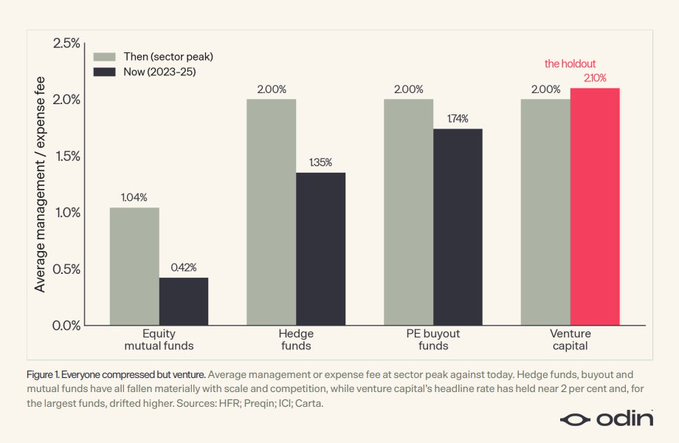
In other major fund strategies, management fees have fallen towards the marginal cost of providing the product thanks to competition and scale. As funds have expanded, firms have been able to compress their fee % to remain competitive. Venture capital is the only strategy where fees have increased, even as funds have gotten larger.
This is where venture capital has been stuck, as the amount of capital the large firms managed has grown by an order of magnitude, yet they maintain the same boutique manager fee structure. It’s an unwieldy one-ended barbell at the moment.
The result has been underperformance, stagnation, and a weaker product for both founders and LPs, because venture returns do not scale.
In order to correct this behaviour, the firms and economics at both ends of this spectrum must be well-understood by LPs.
Unreasonable People
“The reasonable man adapts himself to the world: the unreasonable one persists in trying to adapt the world to himself. Therefore all progress depends on the unreasonable man.”
Consider that boutique venture capital is fundamentally a hunt for the purest source of alpha; outlier founders and companies, the weirder the better.
Implicitly, it’s a deeply insecure strategy. The best investments are non-consensus, with no peer validation. Success is revealed on distant horizons, incremental metrics are mostly useless. Investors never really know how well they are doing at any given moment.
The result of this insecurity is herd behaviour. Because performance across the industry is understood on a relative basis, there is an incentive to do the same thing as everyone else, even when participants recognise it’s likely to be wrong. So, venture firms become enmeshed with each other, literally and ideologically, and alpha decay pulls down returns.
The survivors are “unreasonable” individuals, by definition. Angel investors or solo GPs with conviction in a perspective that precludes herd behaviour. Their idiosyncrasy is a shield, and their eccentricity prevents them from ever fitting into the group too comfortably. As a result, they tend to struggle in larger firms with more bureaucracy and louder peer effects.
This archetype is the inversion of an LLM. They are outliers. They spend their time thinking about what could be, rather than what is. What people should be doing, rather than what they are doing. They may or may not study history, but they certainly have strong opinions on the future.
Their success is reliant on recognising other outliers, so origination and selection are vital skills which amplify the idiosyncrasies of the individual. These investors provide the critical interface between capital and talent, where potential is least obvious. It’s inherently an unscalable human job, best achieved by a larger field of independent actors.
So, these investors are best positioned to benefit from an AI teammate that handles everything other than the interface. That benefit, in theory, is that AI allows these investors to take bigger swings and spend more time on investing, producing even stronger investment performance.
“The future isn’t written in training data. Early-stage investing lives in what hasn’t happened yet. Humans are still the best at this and I can’t imagine AI being better on any alarmist timeline.”
For the best investors in this category, there is room to increase fee income without a meaningful drag on performance. Indeed, by making life with a smaller fund much more manageable, it incentivises raising right-sized vehicles that can deliver attractive multiples. It also allows for increased compensation without shifting strategies in a way that erodes returns.
The Firms
To the extent that an AI can predict the future, it will do so by extrapolating the past; assuming a continuation of the status quo. Ask an AI how to deploy capital in the stock market and it will recommend buying the index because markets are mostly efficient and everything knowable, everything in the model, is already priced in.
Definitionally, this is a beta-generating strategy that supports today’s incumbents. There is no variance, positive or negative. For almost everyone, almost all of the time, it’s the right thing to do.
Apply the same logic to venture capital, and the result is something like the mega-fund platforms. Their strategy is to index market themes, reduce the brand-related risk of missing “obvious winners” and juice fund metrics with momentum. Implicitly, they are incentivised to support a stable status quo that produces clear winners and predictable outcomes, rather than messy disruption.
“Smart Beta are large multi-stage platforms that “index” across legible signals so that they may plow capital into companies that break out. We define legible companies as those with recognizable signals (i.e., well-formed businesses, founder spinning out of Big Tech, repeat founders, meaningful product/commercial traction, etc.).”
This strategy inherently sacrifices outliers; the startups building novel solutions in obscure categories. It’s an acceptable compromise, as the bigger firms can always pay up for access later as the opportunity becomes more legible.
Here, AI can create huge gains in efficiency by informing screening and investment decisions according to a clearer set of target parameters. The benefit is not better performing investments but rather lower costs, and therefore lower fees and stronger net performance.
Indeed, early experiments with applying LLMs to venture capital deal selection do appear to improve the overall rate of success. It comes with the same sacrifice of outliers, as the model’s inherent biases in the training data, but this could be reduced over time and isn’t a deal breaker for the scaled strategy.
“We evaluated nine state-of-the-art LLMs and found that several outperform not only the market index but also the leading VC firms, with GPT-4o achieving the highest F0.5 score. These results show that anonymized founder profiles are sufficient to surpass human-expert baselines in early-stage venture forecasting.”
A similar result comes from studies looking at how AI can be used to categorise and filter opportunities. The LLM-based approach was 537 times faster than the human analyst without any loss in quality. Again, outliers will be lost in the margins of this process, but that is already accounted for in the scaled venture strategy.

Better Economics
“The fee drag on gross-to-net returns is estimated at 0.1x to 0.7x, equivalent to an annualized impact of 5% to 8% on returns. This impact is notably higher for buyout funds (7.9%) and venture capital funds (8.5%) than previously documented. […] This drag raises concerns that high fees may significantly erode investors’ returns, potentially outweighing the benefits of investing in private capital markets.”
In practice, a reduction of management fees to ~0.5–1% would significantly lift the performance of this part of the market, making it even easier to draw in LP capital, pulling down the cost of capital that gets passed on to the founders and their companies. It would also resolve some of the incentive-related issues at the larger end of the market.
Today this cost of capital often becomes the killer over time, as it jacks up valuations beyond any reasonable appetite for exit markets.
Essentially,
a high fee-drag means LPs expect significant multiples on their capital which often aren’t possible with a large-fund...
so, capital increasingly concentrates into inflated “winners” in an attempt to hit an unreasonable target returns…
and the outcome is the weak performance of companies post-exit, the favouring of consensus, the stagnation of technology, etc.
It is rational that scaled firms should operate with reduced management fees compared to smaller funds. This makes sense both in terms of expected returns and in terms of fee income relative to workload. As described above, it’s also true of every other fund strategy.
Correcting this holdover of previous eras would ensure a healthier exit market for venture investments, stronger performance for LPs and a better product for founders at both ends of the spectrum.
A Wedge for Innovation
“Ironically, innovations in venture capital haven’t kept pace with the companies we serve. […] As chips shrank and software flew to the cloud, venture capital kept operating on the business equivalent of floppy disks.”
For a long time, and for reasons related to everything fromfund structure to economics, it has been clear that venture capital is bizarrely behind the times. As an industry that supposedly obsesses over innovation, it clearly doesn’t spend nearly enough time on introspection and has become top-heavy and stagnant.
As the market has changed since the turn of the century, few people have asked what this means for the “2 and 20” structure, which dates back to Alfred Winslow Jones in 1949.
That lack of critical thinking about compensation is a red flag for market capture; conditions that incumbents have clearly grown comfortable with. Indeed, new GPs remain reluctant to innovate on fund strategy or economics for fear of scaring off risk-averse LPs, having been warned it would induce adverse selection.
“Consistent with the literature on institutional behaviour, we find that the continuous use of boilerplate provisions is a form of ‘collective conservatism’. We argue that these results help explain why venture capitalists typically maintain using suboptimal boilerplate provisions. Venture capitalists may be hesitant to abandon these provisions out of concern that their peers and major rivals prefer to use them in their partnership agreements. This suggests that the often ineffective ‘2 and 20’ rule may persist for this reason.”
There is a clear argument that AI breaks this status quo.
For scaled, systematic allocation there are obvious gains to be made in efficiency and productivity, which would allow for reduced fees and a lower cost of capital for entrepreneurs. This would help keep the late-stage market more rational, and preserve the viability of paths to exit and liquidity for LPs.
For small firms and solo investors, there is reason to feel more bullish than ever. Adding a cybernetic teammate to their arsenal will help to scale their impact on the world. An expanded appetite for moonshots from much larger group of investors.
Watch the latest episode of Going Solo, with Adam Besvinick of Looking Glass Capital
Run your investment firm from your phone, with Odin

I’d love to learn more about this cybernetic team-mate for early stage investors.