
“US VC fund managers consistently report strong LP interest in co-investments. Coinvesting in deals offers LPs direct exposure to startups, lower blended fees, and the potential for enhanced returns. However, not all LPs have the resources or expertise to build and manage a diversified direct investment portfolio, increasing their exposure to idiosyncratic risks inherent to venture investing. Underperformance in such deals can also strain GP-LP relationships.”
PitchBook Analyst Note: LP Co-Investments in US VC: Chasing AI at a Price

There’s no hiding from the fact that SPVs have had a rough couple of years.
As companies have stayed private longer, the business of selling pre-IPO equity has boomed. As a result, there has been a growing number of horror stories about opportunists with triple-layered fees or phantom allocation.
In the rush to own a piece of companies like Anthropic or SpaceX, many investors have lost their heads entirely.

Most of all, these investors seem to have forgotten that their function is to make a good return, rather than to collect hot company logos like Pokémon cards.
Hot SPV allocation in the 2020s is not unlike hot IPO allocation in the 1990s, hot oil and gas syndication in the 1970s, or hot closed-end funds in the 1920s. Investor FOMO, linked to the managers or the underlying assets, combined with opaque intermediary vehicles, traditionally enables fee extraction and disappointing returns.
Like many innovative financial products from junk bonds to securitisation, industry standards often have to catch up with how products are used to correct extractive behaviour. For a long time, SPVs were associated with GPs harvesting fees without risking their fund metrics, creating an adverse selection problem. Today, reporting and economics are showing signs of improvement.
We are coming to the end of the chaotic era for SPVs, in which they were exploited by deal-slinging cowboys and cynical managers. As the industry matures, and LP sophistication increases, SPVs are gradually becoming a force for good.
The Role of Blind Risk
The traditional structure of venture capital is the 10-year closed-end blind pool.
This involves LPs agreeing to let a GP manage their capital for up to a decade, although in practice that stretches much further. The “blind pool” reflects LPs having no discretionary control (outside of LPA terms) over individual investments. The GP is free to put that capital into any opportunity that fits the agreed scope.
Clearly, this requires a significant level of trust. It also reflects the fact that such discretion would likely do more harm than good with early-stage investments. When great startups start out as little more than a radical idea from unproven founders, having to whip around LPs to get them on-board would clearly be mad.
This blind pool approach, therefore, was designed for firms managing single- or low-double digit millions of dollars, making early-stage investments. By the time a company was at the point of becoming an obvious opportunity to LPs, it was likely already orienting itself toward an exit.
Today, not only are companies raising much more capital, across many more rounds, but LPs are also more sophisticated. They are more readily able to recognise a good opportunity early on, which can help simplify follow-on decisions. Many are former operators themselves, or current executives at firms in strategic sectors.
Essentially, the blind pool should not remain the permanent default for venture capital. It serves to enable risk appetite in early stages, where venture investors must find conviction in companies ahead of anyone else. Once a company has obviously attractive metrics or market position (perhaps as early as Series A, but certainly by Series C) they may be better served in many cases by lower-fee coinvestment vehicles that bring down their cost of capital and assemble a group of aligned LPs.
Techno-Capital Plumbing
Over the last five years, better backoffice infrastructure has lowered the friction of deal-by-deal formation. Solo GPs and small partnerships can now deploy more capital, with greater precision, by dual-wielding two complementary vehicles.
A small fund that gives LPs diversified exposure to early-stage opportunities which are inherently high-risk and difficult to evaluate. A portfolio of options.
Select coinvestment opportunities, allowing LPs to increase their ownership in companies as they become increasingly attractive. Targeted investments.
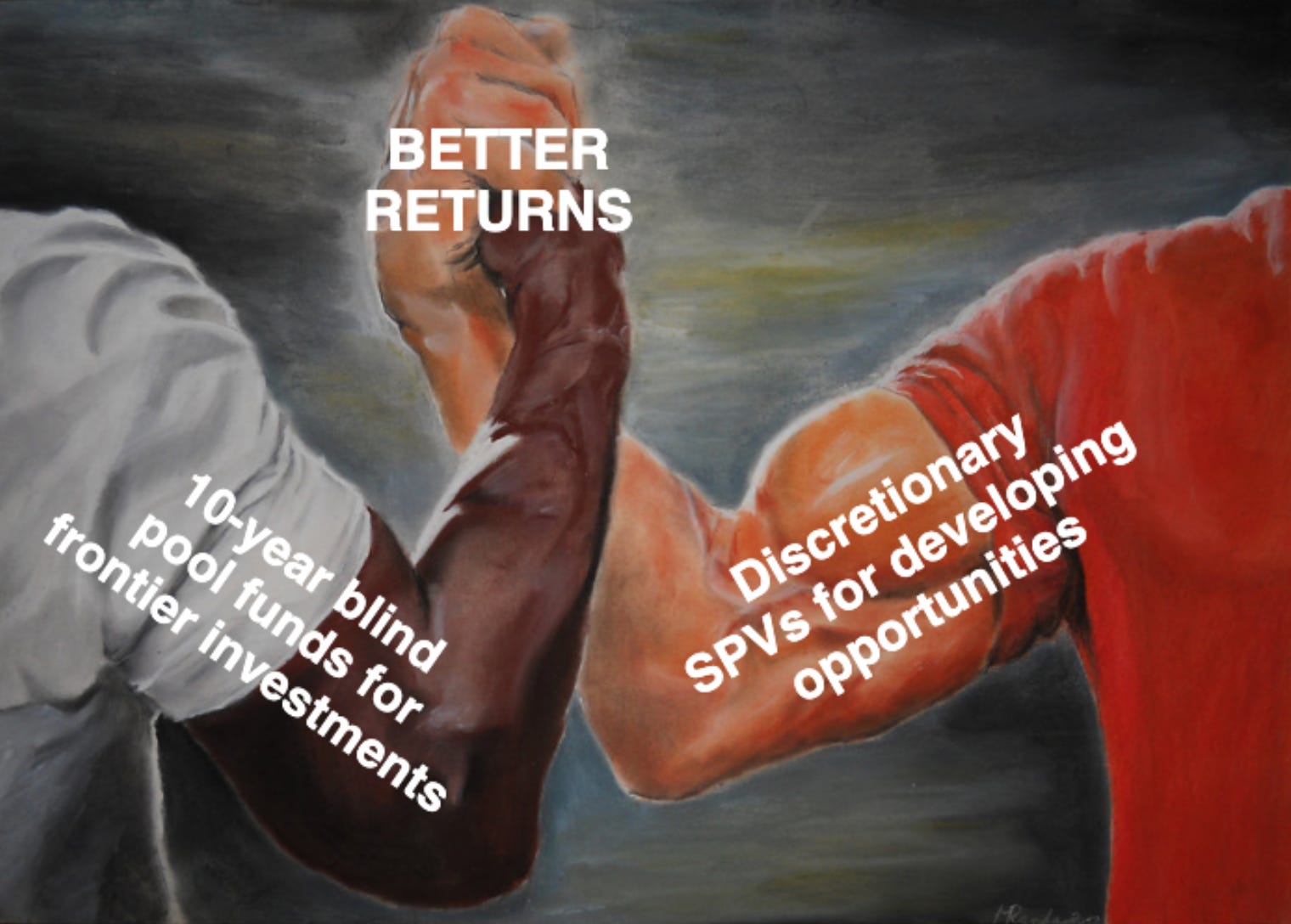
There’s still room for both strategies, individually, depending on the LP base and GP preferences. However, it has become harder to see how a small fund manager can manage without SPVs for follow-on capital, versus an SPV-only manager who may be happy to operate without the comfort of a fund.
“The best investments I have ever been involved with had weird ownership, a little top-up later, and some opportunity vehicles on top of that. Trying to make something as chaotic as early-stage venture rigid, to turn it into a model, immediately forces the wrong way of thinking about it.”
In the past, early-stage firms would build relationships with larger, later investors that would provide follow-on capital. This strategy has become increasingly risky in recent years, as the market has concentrated into fewer firms with interest in a narrower set of opportunities. There are even reports that large firms are undermining the fundraising efforts of smaller funds as they aim to control more of the market.
Of course, there are mid-sized funds who have the capital to continue funding portfolio companies through subsequent rounds. Where they take a sensible process alpha-style approach to reserves they may offer attractive returns on larger pools of capital, but this may not be the right strategy for smaller firms. Not only does scale become a drag on performance, but growing firms inevitably drift toward consensus and lose the agility of a solo investor or small partnership on the frontier.

Demand for Optionality
“LP co-investment activity is expected to grow incrementally over the medium term. As more institutional investors build the internal resources and portfolio infrastructure to co-invest consistently across a diversified deal set, the gradual institutionalization of direct investment programs among larger LPs will improve the strategy's risk-return profile and expand the pool of LPs capable of executing selectively.”
PitchBook Analyst Note: LP Co-Investments in US VC: Chasing AI at a Price
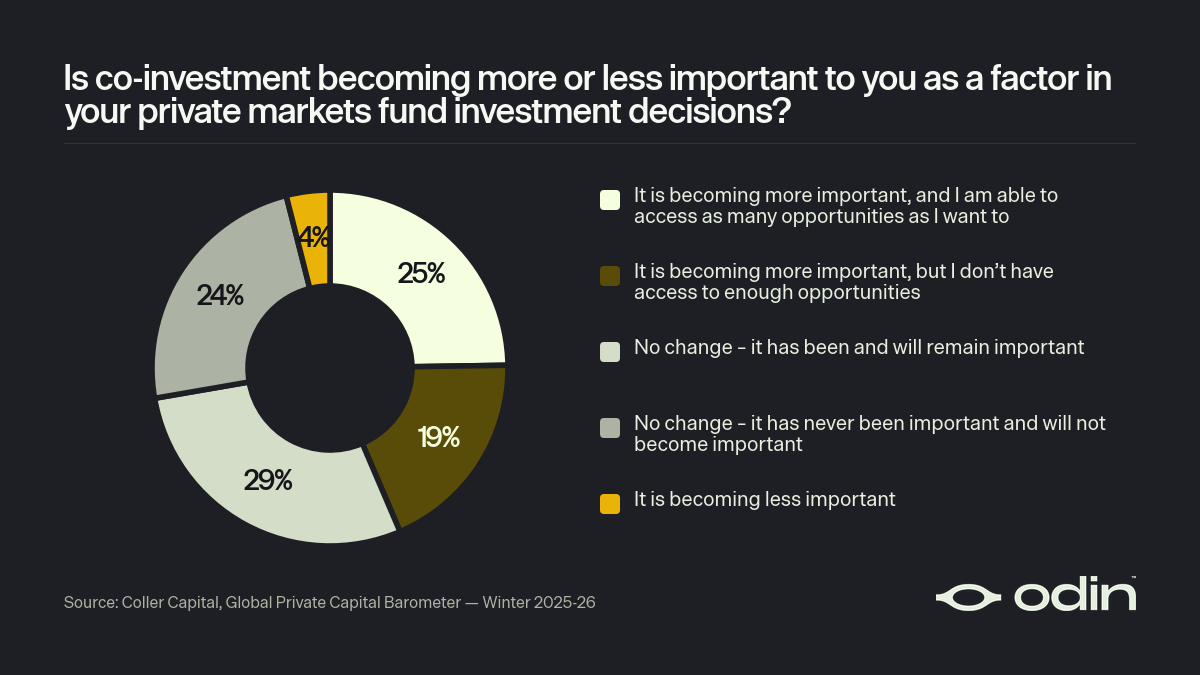
The demand for coinvest in venture capital has become a bit of a meme. Everyone asks for it, but nobody really seems to know what to do with it. However, it’s likely that this is a “teething problem” as the industry begins to treat coinvestment as a desirable standard, similar to the wider private equity industry.
Over time, better tools, standards and human capital will catch up with the practices.
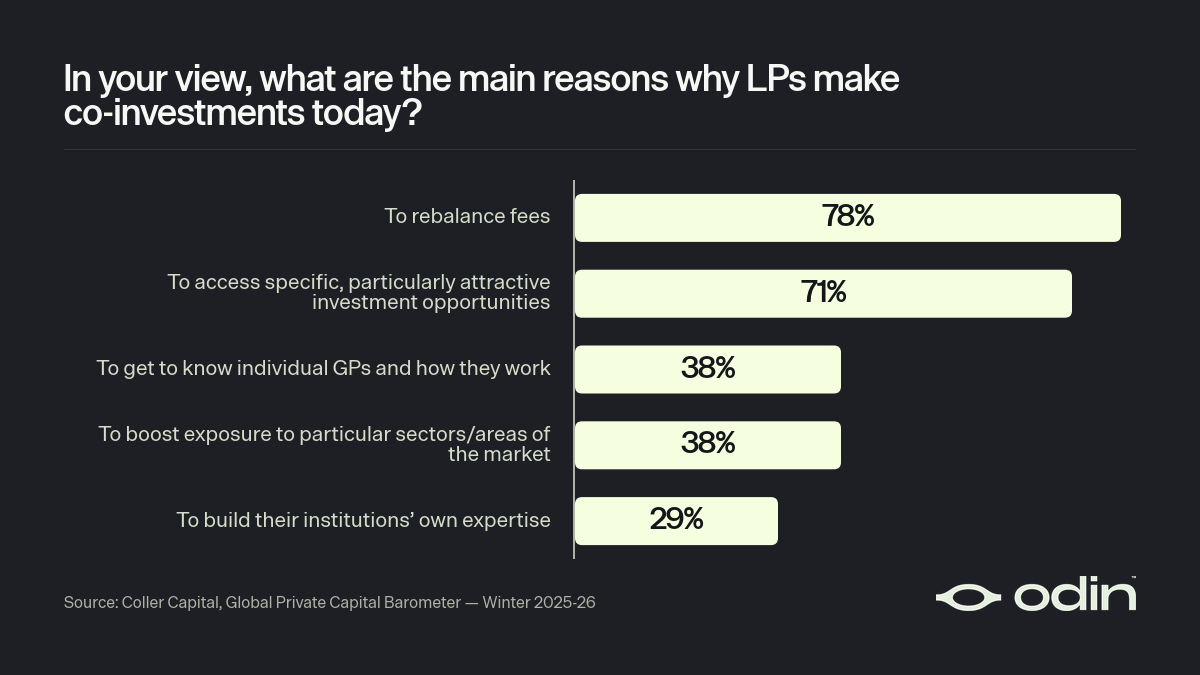
Anecdotally, much of the current desire for coinvestment rights in venture capital is driven by FOMO and the mindless overapplication of power law. Essentially, should an investor find themselves with a “hot” portfolio company, LPs want the ability to buy-in themselves for the status and IRR metrics.
Because this behavior is driven by opportunism, it’s often the case that LPs don’t really have the understanding or processes to handle these investments competently.
There is a learning curve here, for LPs as well.
For example, some LPs are using the difficult fundraising environment to push for zero fee, zero carry terms on SPVs from emerging managers. Eliminating carry is a poor way to align interests, unless the LP’s main objective is just to harvest dealflow. This treatment of coinvest partially explains why GPs default to fund inflation.
Despite these frictions, it’s clear that coinvestment activity is going to keep increasing. This is a natural evolution of the market seeking to maximise investment opportunities and reduce the blended fee cost.
Blended Economics
In a previous article, we looked at how taking a private equity approach to coinvestment rights and fee schedule would improve the economics of venture capital’s megafunds. The same is true at the smaller end of the market.
Imagine two hypothetical scenarios:
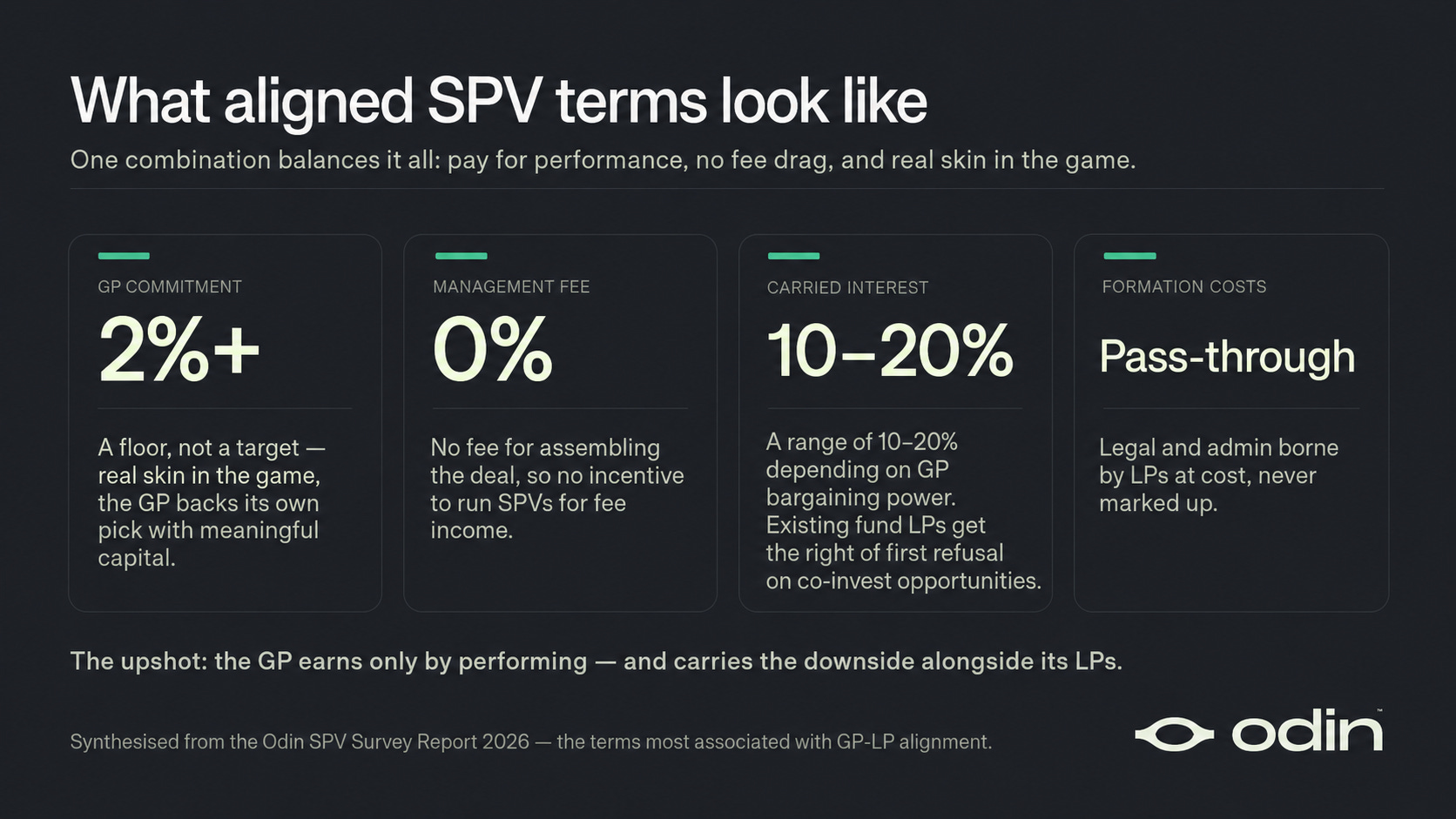
In the first, a manager raises a $10M microfund to support 30 initial investments of $250k, and then uses deal-by-deal SPVs (with 2% GP commit, no management fees, 10% carry) for select follow-on capital.
In the second, a manager raises a $38.3M fund. This is the size required to make exactly the same investments as the first scenario, including the follow-ons, but entirely from within the fund itself — no SPVs required.
Assuming the same outcomes across the portfolio in both scenarios, producing a 4x gross return, the microfund wins on DPI because of the reduced fee drag.
Of course, this means less immediate income for a GP starting out with a 2% management fee. However, funds will close much faster, and offer superior performance that makes future fundraising smoother. Indeed, based on the premise that a $10M fund is more likely to achieve a higher multiple than a $38.3M fund, the gap on compensation quickly closes with carry. In the meanwhile, the GP still has a servicable salary, and LPs have access to attractive dealflow.
The radical proposition here is that income should be connected to performance.
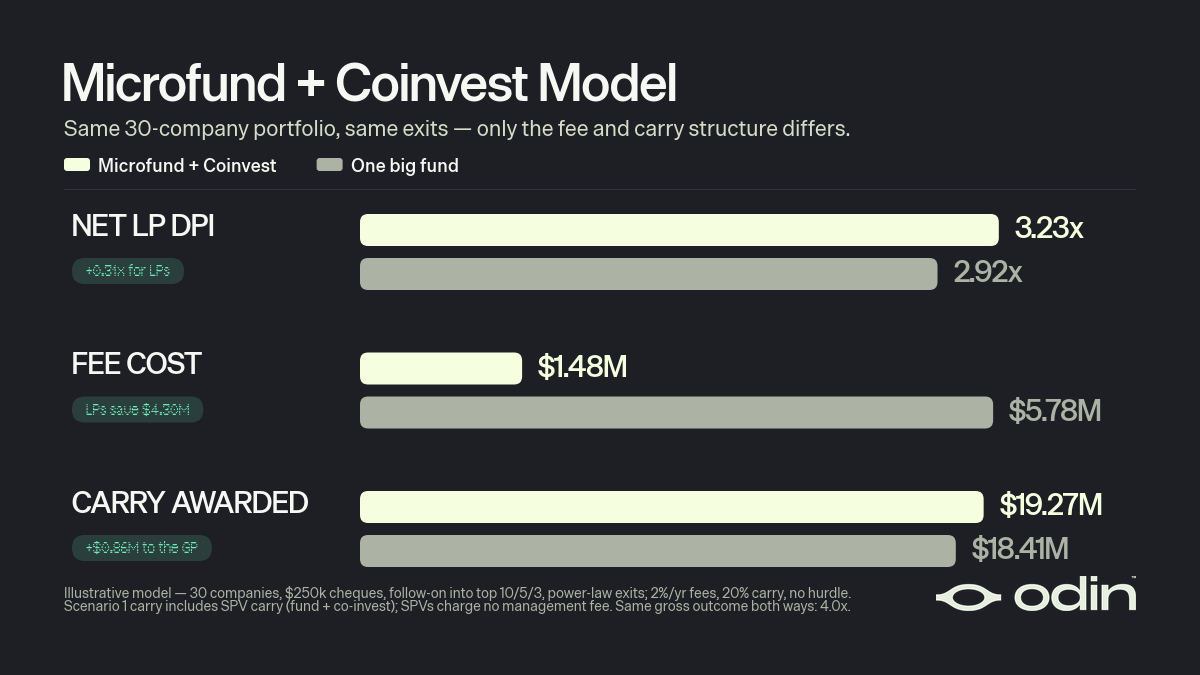
The numbers are only a small part of the picture. The microfund wins on a mathematical basis, but that’s actually not particularly important.
Crucially, the microfund GP is better aligned with the success of their investments. This blended structure incentivises missionary GPs, rather than fee-seeking mercenaries, which will systematically improve investment decisions and returns.
A smaller fund also allows the GP to operate more effectively as a solo investor, maximising the surface area of their idiosyncrasy. They face no pressure to make hires they might not need to justify their fee income. Their fund is small enough that they can remain focused on the earliest stages, without pressure to start chasing larger, later rounds. It’s the ideal setup for an investor who excels at frontier investing.
A Better Standard for SPVs
“Co-investment rights have emerged as one of the most tangible tools available to smaller and emerging managers to demonstrate deal access and deepen LP relationships. The offer of co-investment rights gives LPs a concrete reason to commit capital to lesser-known managers even as they manage the liquidity pressures of the current environment.”
PitchBook Analyst Note: LP Co-Investments in US VC: Chasing AI at a Price
The market is evolving, and small managers are beginning using deal-by-deal terms with much greater efficacy. This has been necessitated by fundraising headwinds and the general concentration of capital. SPVs have become a vital lifeline for managers looking to support portfolio companies through later rounds.
However, the evolution is incomplete; there is still work to be done before the LPs can embrace SPVs without fear of adverse selection, and reap the benefits to performance. This is partially a question of infrastructure, but mainly of education. GPs and LPs need to understand what the current standards, and how they might be improved.
For this reason, we conducted a survey of 56 GPs earlier this year.
Fifty-one of the 56 invest at Pre-Seed or Seed, 80% have funds under $100m, and 61% have five or more years of experience in venture.

Adoption is already strong, with 39 of the 56 already using SPVs, 16 regularly and 23 occasionally. Of the remaining 17, eight intend to start using SPVs in future, putting current and prospective users at 84%. Usage is highest amongst the more experienced GPs, and for those managing funds of $50M–$100M; operators who have the networks that can provide capital but insufficient reserves to cover follow-ons.
The primary use case for SPVs is follow-on capital, as reported by 39 of 47 respondents who indicated the use (or intended use) of SPVs.
“Our seed fund invests at the earliest stages. We have a light reserves model and instead go straight to SPVs for growth rounds. This makes a $20m fund feel a lot larger for our companies and allows us to deploy more capital in winners without getting tapped out.”
The economics are generally LP-friendly. Management fees of 0–0.5% are the clear norm, cited by 45% of respondents. Carry most commonly sits at 16–20%, cited by 46%, though a sizeable 26% charge only 1–10%. Two-thirds of managers pass formation and admin costs straight to LPs. On the GP’s own lead commitment, however, 44% put in just 0–0.5%, and only 27% commit 2% or more.

Where the market has bifurcated on terms, there is an obvious opportunity to establish better standards, improving outcomes and removing friction from the process. The goal should be to keep costs down for GPs, ensure they have real skin in the game, align them on the quality of the outcome rather than increased fee income, and reward LP loyalty with first right of refusal.
“Generally we believe in the principle of dance with the one that brought you. So while SPVs are nice to attract new LPs, existing LPs always get the first bite at the apple.”
A good template for SPV use in these circumstances (for GPs managing follow-on capital for fund investments), probably looks something like the below:
Exceptions will appear, as always.
Where the SPV isn’t associated with a fund it may be that GP commitment is better understood as a percentage of the lead’s net worth rather than as a fixed minimum.
Most importantly, SPVs must not be used as intermediary vehicles to obscure deal economics or insulate fund performance from excessive risk. They must be structured and offered with transparency and honesty, with clear goals and aligned incentives.
“SPVs are just a vehicle, it doesn’t make sense to love or hate them. Strong feelings belong with how they’re structured, whether there is bi-directional transparency, and how they are managed.”
Incentives and Outcomes
The final element is a simple piece of advice to LPs.
If small funds outperform, then it’s clearly mad that standard fee incentives push managers toward expansion. If the key to consistent outperformance is maintaining fund size (and so consistent strategy, organisational size, and target investments), then there should be scope for small managers who outperform to increase their fee percentage rather than growing their fee base.
Consequently, it’s expected that they will look to manage additional capital through SPVs, to meet their obligation to founders. This arrangement is also economically-beneficial to LPs, improving alignment and reducing fee drag.
In return, LPs must improve their readiness to participate in these deals, understanding the terms involved, the cost of breaking a commitment, and the portfolio approach required to harvest the performance benefits. In addition, they must be willing to offer compelling compensation for successful coinvestments via carried interest.
As all of this comes together over the next few years, the industry will strengthen. The shift to greater levels of coinvestment represents a long overdue evolution from the absurdity of overstretched 10-year vehicles and self-defeating fee incentives.
Run your investment firm from your phone, with Odin

Good article. I think something to watch is the rise of small/medium hybrid FoFs who will professionalize the co-invest. Hunter Walk recently posted reasons that funds under $100m shouldn't bother investing pro-rata. He is absolutely right. Data from AngelList and talks given by Abe Othman over the last couple/few years has pointed to this inconvenient fact. Look for Abe's talk comparing first check only versus pro-rata always strategies via Monte Carlo simulation. There is a nuance in their data.
The hybrids and others who catch on will realize LPs who invest broadly across the best small GPs will have a large opportunity set with which to pick into follow-on. As you say,the large firms will battle tooth and nail to cut back pro-rata rights in order to gobble allocations for themselves, but the best small GPs will retain the right because of the founder relationships they have built. These LPs are looking at these portfolios and building a view early so that their minds are better prepared when the time comes.
Avoiding pro-rata decisions avoids the agency issues that GPs face when they do follow on and allows them to focus on making first check investments only. By extension this builds a better opportunity set for their LPs. I see this kind of strategy as a counterpositioning for those who lack access to the best series A/B investors. It's a feature of this new cycle and with the rise of a new generation of GPs However, these LPs need to stay smallish in order to be nimble.